

Ring and pinion gears are the final-drive gear pair inside your differential — the small pinion on the end of the driveshaft turns the large ring gear bolted to the carrier, and their two tooth counts divide into the axle ratio your whole drivetrain is built around. If you have ever wondered what actually makes 4.10s “4.10s,” or why a re-gear job costs what it does, this one gear pair is the answer.
This guide covers what each part does, the simple division that turns tooth counts into ratios, the difference between hypoid and spiral-bevel gear cuts, when it makes sense to swap them, and how to break in a new set so it lives a long, quiet life. For the mechanism that surrounds this pair, start with what is a differential.
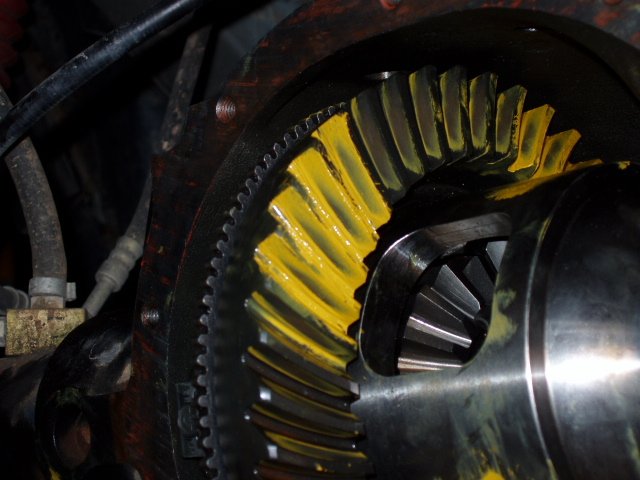
Ring and pinion gears: the two parts and what each does
The pinion gear is the input side of the pair. It is machined onto (or splined to) the pinion shaft, which the driveshaft yoke connects to — and it is always the smaller gear, with fewer teeth, spinning faster. The ring gear (also called the crown wheel) is the large gear bolted to the differential carrier with a ring of high-strength bolts; it carries the carrier — and the spider gears inside it — around with it.
Together, the pair does two jobs at once: they turn the power flow 90 degrees (the driveshaft runs front-to-back, the axle shafts run side-to-side) and they reduce speed while multiplying torque. That second job is the one you feel — the ratio of this pair decides how hard your truck pulls and how fast the engine spins at highway speed.
| Part | Role | Key detail |
|---|---|---|
| Pinion gear | Driveshaft input — drives the ring gear | Small gear, fewer teeth, spins faster |
| Ring gear (crown wheel) | Bolted to the carrier; carries it around | Large gear — its teeth vs the pinion’s set the ratio |
| Carrier | Holds the ring gear and spider gears | Rotates at wheel speed |
| Pinion bearings | Support the pinion shaft under load | Preload must be exact — see wear symptoms below |
| Ring-gear bolts | Clamp the ring gear to the carrier | Some axles use left-hand thread — check the manual |
One pairing rule matters more than any single part: ring-and-pinion sets are manufactured and lapped together as a matched set. The pinion from one set will not mesh correctly with the ring from another — even if the tooth counts are identical. Buying gears always means buying the pair.
How ring and pinion gears make the ratio: ring teeth ÷ pinion teeth
Your axle ratio is literally one division problem: ring-gear teeth ÷ pinion-gear teeth. The tooth counts are usually stamped as a pair on the edge of the ring gear, like “41 11” — divide them:
- 41 ÷ 11 = 3.727 → sold as 3.73
- 41 ÷ 10 = 4.10 → sold as 4.10
- 37 ÷ 9 = 4.111 → sold as 4.11
- 39 ÷ 10 = 3.90 → sold as 3.90
That number is how many times the driveshaft turns for one turn of the wheels. A 4.10:1 ratio means 4.10 driveshaft revolutions per wheel revolution — more multiplication, more pulling power, and more RPM at a given speed. Our axle ratio calculator does this math both directions, and the guide on how to find gear ratio shows the physical ways to measure what’s actually installed in your axle.
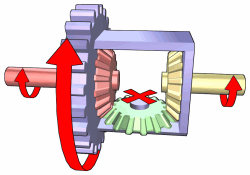
Here are the ratios you’ll actually encounter, with the tooth counts that produce them. Treat these as typical examples — exact counts vary by manufacturer and axle model, so always read the stamping on your own gears:
| Marketed ratio | Ring teeth | Pinion teeth | Actual division | Common use |
|---|---|---|---|---|
| 3.08 | 40 | 13 | 3.077 | Economy, highway cruising |
| 3.42 | 41 | 12 | 3.417 | Half-ton trucks, all-round |
| 3.73 | 41 | 11 | 3.727 | Towing, trail work |
| 4.10 | 41 | 10 | 4.100 | Heavy towing |
| 4.56 | 41 | 9 | 4.556 | 35-inch tires, off-road |
| 4.88 | 39 | 8 | 4.875 | 37-inch tires |
| 5.13 | 41 | 8 | 5.125 | Big tires, rock crawling |
Notice the pattern: as the ratio climbs, the pinion gets fewer teeth — 13 down to 8. There is a practical limit here. Below about 8 pinion teeth the teeth get so small and the contact so concentrated that strength drops off, which is one reason extreme ratios need physically larger axle assemblies to survive.
For every common ratio’s exact tooth counts in one place, see the differential gear ratio chart.
Hypoid vs spiral bevel: why truck ring and pinion gears look offset
These gears come in two cut styles, and the difference is visible the moment you look at an axle:
- Spiral bevel: the pinion centerline intersects the ring-gear centerline. Older design — the pinion is relatively small and fewer teeth share the load at any moment.
- Hypoid: the pinion sits offset from the ring-gear centerline, usually below it. The offset lets the pinion be larger in diameter with more teeth in contact at once, so hypoid gears are stronger and quieter. Nearly every modern truck and car axle uses hypoid gears.
The price of the hypoid offset is sliding contact between the teeth — the gears don’t just roll on each other, they slide. That is why hypoid axles demand extreme-pressure GL-5 gear oil, and why running the wrong fluid destroys them. The sliding action is also why a proper break-in matters more than it would on straight-cut gears: the tooth surfaces need controlled heat cycles to mate correctly.
Why change ring and pinion gears? (re-gearing)
People swap gear sets for three reasons:
- Bigger tires: a taller tire raises your effective gearing (fewer engine RPM per mph), making the truck feel sluggish. Re-gearing to a numerically higher ratio restores the factory feel. See gear ratio for 35-inch tires for the exact math.
- Towing: numerically higher ratios (4.10 vs 3.73) multiply torque and keep the engine in its powerband on grades. Compare the two most common towing choices in 3.73 vs 4.10 gears.
- Performance: shorter gearing means quicker acceleration off the line — at the cost of higher cruise RPM and more fuel burned per mile.
Every re-gear is a trade, so run the candidates through the RPM calculator before you buy: it shows exactly what each ratio does to your cruise RPM on your tires.
Before you commit, read how much does it cost to regear so the quote holds no surprises.
The matched-set rule: never mix ring and pinion gears
Worth repeating because it bites people buying used gears: the ring and pinion are lapped together at the factory as a pair, and their tooth profiles are mated to each other — not just to the tooth count. A 4.10 pinion from one set will not run quietly (or live long) on a 4.10 ring from another set. Buy them as a matched pair, new or used, from the same box. If a deal offers “just the ring gear,” it is not a deal.
The same logic applies to setup: a new gear set needs correct pinion depth and backlash, verified by reading the contact pattern — our guide on how to read a gear pattern walks through exactly that.
Breaking in new ring and pinion gears: the first 500 miles
New gears need a gentle introduction. The standard break-in procedure:
- First 500 miles: easy driving — no sustained high speeds, no heavy towing or hauling, no full-throttle launches.
- Heat cycles: drive 15–20 minutes, then let the axle cool completely. The first few heat cycles are what seat the tooth surfaces.
- Fluid change: after the break-in miles, change the gear oil. It will contain fine metal from the mating process — that is normal, and you want it out.
- Right fluid: the correct GL-5 weight for your axle, plus the friction modifier your manufacturer specifies if you have a clutch-type limited slip.
Skipping break-in is the most common reason a new gear set whines. The setup was fine; the metal just never got its chance to settle. Wikipedia’s differential article covers the underlying gear geometry, and suppliers like West Coast Differentials publish application guides when you’re shopping for a specific axle.
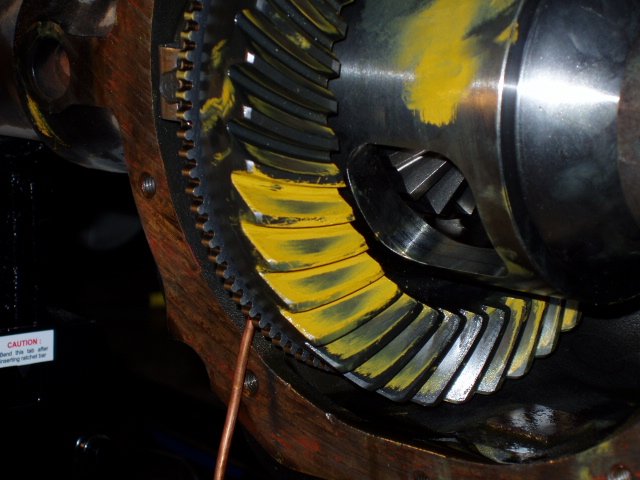
How to inspect used ring and pinion gears before you buy
Used gear sets are tempting — they cost half of new — but they’re only a deal if the teeth are healthy. Here’s what to check before money changes hands:
- Tooth faces: look for pitting (tiny craters), spalling (flaking), or chipped tooth edges. Light polishing is normal; craters are not.
- Heat discoloration: blue or straw-colored patches on the teeth mean the set overheated — its hardness is compromised. Walk away.
- The existing pattern: if the gears are still in the housing, paint the teeth and read the pattern. A centered pattern on a quiet-running used set is a good sign; an edge-riding pattern means it was set up wrong, and the wear is already baked in.
- Matched pair proof: check that the ring and pinion came out of the same housing. Mismatched stampings or different wear colors are red flags.
- Backlash feel: rock the ring gear by hand — excessive clunk suggests worn teeth or bearings, not just a setup issue.
Even a perfect-looking used set needs the full setup procedure on install — pinion depth, backlash, and a pattern check. Used gears don’t skip steps; they just skip the break-in, since the tooth faces are already mated.
Frequently asked questions
How do I know what ring and pinion gears I have?
Read the numbers stamped on the edge of the ring gear — they look like “41 11.” Divide ring teeth by pinion teeth (41 ÷ 11 = 3.73). That’s your ratio, and it’s the definitive answer for gear identification. The physical methods are all in how to find gear ratio.
Can I replace just the pinion gear?
No. The ring and pinion are a matched, factory-lapped pair. A new pinion on a worn ring (or a pinion from a different set) will whine and wear fast. Always replace them together.
Will changing ring and pinion gears affect my speedometer?
Yes — a ratio change alters the driveshaft speed the speedometer reads from, so it will read wrong until recalibrated. Our guide on how to recalibrate a speedometer covers the fix.
How long do ring and pinion gears last?
With clean fluid at the right level, they routinely outlast the vehicle — 200,000+ miles is normal. What kills them is neglect: low oil, wrong fluid, skipped break-in on a new set, or shock-loading from hard launches on sticky tires.
Are 4.10 ring and pinion gears better than 3.73?
Neither is “better” — 4.10s multiply torque harder (better towing, bigger tires, quicker launches) and 3.73s cruise at lower RPM (quieter, better economy). The full comparison is in 3.73 vs 4.10 gears.
Ring and pinion gears: the bottom line
Everything downstream of your transmission funnels through this one gear pair: the pinion takes the driveshaft’s spin, the ring gear turns it 90 degrees and multiplies it, and their tooth counts — ring divided by pinion — become the axle ratio every other drivetrain calculation starts from. Buy them as a matched set, set the pattern right, break them in gently, and keep the fluid fresh.
Know your tooth counts? Plug them into the free gear ratio calculator and see what your ring and pinion gears are actually doing — or use the axle ratio calculator to compare ratios before a re-gear.
For the ratios available in the most common Jeep axle, see Dana 44 gear ratios: every ratio from 2.72 to 5.89, carrier breaks and tooth counts.
For a worked example on the strongest common axle, see the Dana 60 gear ratios guide — every ratio, the carrier break and the right pick for your tire size.
For the ratios available in the most common Jeep front axle, see the Dana 30 gear ratios guide — every ratio from 3.07 to 5.38, the carrier break, and the right pick for your tire size.
For the full procedure after install, see our how to break in new ring and pinion gears guide — the 15–20 mile heat cycles, the 60 mph limit, the 500-mile oil change and the first-tow rules.