

Wondering how to find gear ratio without pulling the diff cover? You don’t need to drain the diff and count teeth to learn your axle ratio. Between the factory tags, option codes, and a two-minute rotation test with a floor jack, you can pin down your gear ratio with the cover still on — here’s every method, from easiest to most certain.
Method 1: Read the axle tag or option code (fastest)
Most axles leave the factory with their ratio stamped somewhere accessible — the fastest way to learn how to find gear ratio on a stock vehicle:
- Dana / Jeep / Dodge axles: a metal tag under one of the cover bolts reads something like “3 73” or “3.73” — that number is your ratio.
- Ford trucks: check the door-jamb sticker — the “AXLE” code maps to a ratio in your owner’s manual.
- GM trucks (RPO codes): check the SPID sticker (glovebox, center console, or spare-tire cover). GM’s RPO codes are the most systematic of the bunch — here’s the decode:
| RPO code | Ratio | Notes |
|---|---|---|
| GU4 | 3.08 | Economy |
| GU5 | 3.23 | Light duty |
| GU6 | 3.42 | Very common on half-tons |
| GT4 | 3.73 | Popular towing gear |
| GT5 | 4.10 | Heavy towing |
| G80 | — | Locking differential (not a ratio) |
The full code list lives in West Coast Differentials’ GM RPO code reference, with more model-year detail at FullSizeChevy’s RPO guide. One caveat: tags and codes describe the axle as built. If a previous owner re-geared it, only the physical methods below tell the truth.
Method 2: Count rotations with a jack (most reliable without opening)
This measures the ratio physically, so it reflects what’s actually in the axle today — it’s how to find gear ratio on any vehicle, regardless of what the paperwork says:
- Jack up the rear axle and support it safely — both wheels off the ground.
- Mark the driveshaft and one tire with chalk or tape.
- Open differential: hold one wheel still and rotate the other exactly two full turns, counting driveshaft rotations.
- Limited-slip / locker: rotate the wheels (or the single airborne wheel) exactly one turn, counting driveshaft rotations.
- Divide driveshaft turns by the number of tire turns. That’s your ratio.
Example: 7.45 driveshaft turns ÷ 2 tire turns = 3.73:1. Count 8.2 ÷ 2 and you have 4.10s. A half-turn of wobble in your counting is normal — real ratios land on standard numbers (3.08, 3.42, 3.73, 4.10, 4.56), so round to the nearest one.
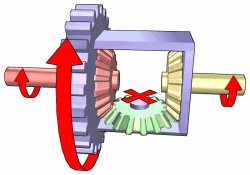
Reading your count: driveshaft turns to ratio
Fractional counts are where people second-guess themselves, so here is the translation table for the open-differential version of the test (two tire turns, one wheel held). Find the driveshaft count closest to yours:
| Driveshaft turns (2 tire turns) | Your ratio |
|---|---|
| ≈ 6.2 turns | 3.08 |
| ≈ 6.8 turns | 3.42 |
| ≈ 7.5 turns | 3.73 |
| ≈ 8.2 turns | 4.10 |
| ≈ 9.1 turns | 4.56 |
| ≈ 9.8 turns | 4.88 |
For a limited-slip or locker (one tire turn), halve the left column: about 3.7 driveshaft turns per tire turn means 3.73s. Either way, this table is the fastest sanity check for how to find gear ratio with nothing but a jack and a chalk mark.
Method 3: Work backwards from RPM and speed (no jack needed)
If the truck still drives, your tachometer can find the ratio for you. In your 1:1 gear (usually 4th in a manual or “D” with overdrive off), note your RPM at a steady 60 mph, then:
Ratio = (RPM × tire diameter) ÷ (60 × 336.13)
Example: 2,500 RPM on 30″ tires → (2,500 × 30) ÷ 20,168 = 3.72, which rounds to 3.73. Use your measured tire diameter (not the sidewall size) and make sure overdrive is off. The RPM calculator does this math both directions — and our speedometer guide helps if your speed reading is suspect.
Method 4: Read the numbers stamped on the ring gear (definitive)
If the cover is coming off anyway for a fluid change, the definitive answer is stamped on the edge of the ring gear — the most certain way to learn how to find gear ratio. Look for two numbers like “41 11” (or “41:11”):
41 ÷ 11 = 3.727 → 3.73 gears. Ring teeth ÷ pinion teeth always gives the exact ratio.
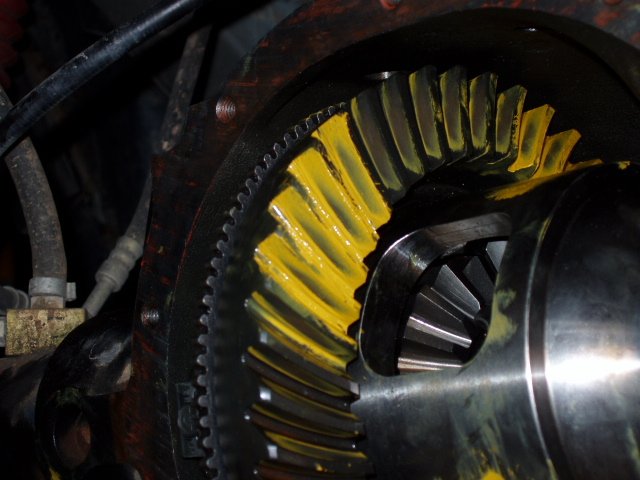
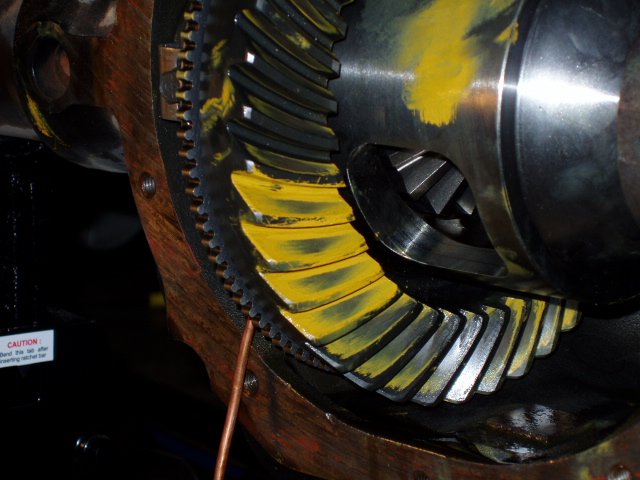
While you’re in there, check the gear oil level and the wear pattern on the teeth — uneven wear or metal in the oil tells you the setup needs attention before it gets expensive.
How to find gear ratio: which method should you trust?
| Method | Tools needed | Reliability |
|---|---|---|
| Axle tag / option code | None | Good — unless it’s been re-geared |
| Rotation test | Jack + chalk | Excellent — measures what’s installed |
| RPM + speed math | Tachometer + tire size | Good — small tire/slip errors possible |
| Ring gear stamping | Wrench + drain pan | Definitive |
Disagreeing methods? The rotation test wins for a stock-looking truck. For a built rig with aftermarket gears, trust the ring-gear stamping over everything — it’s the only method that reads the gears themselves.
How to find gear ratio on a lifted truck with unknown history
Lifted trucks are where tags lie most often. If the truck sits on 35s but still pulls like stock, a previous owner almost certainly re-geared it — common jumps are 3.55 → 4.10 and 3.73 → 4.56. On these trucks, skip straight to the rotation test: it’s the only method that measures the gears actually installed. And when you buy a used 4×4, test both axles — front and rear ratios must match, or the drivetrain binds in 4WD.
Frequently asked questions
How do I find the gear ratio on a 4×4’s front axle?
The same rotation test works — jack the front, mark the front driveshaft and a front tire, and count the same way. This is how to find gear ratio mismatches too: if the front counts 3.73 and the rear counts 4.10, someone swapped one axle and the truck must never be driven in 4WD until they match.
Can I find my gear ratio from the VIN for free?
Sometimes — a dealer parts counter can pull the factory build sheet from the VIN in minutes, and several free online VIN decoders list the original axle ratio. But the VIN only knows how the truck left the factory. On anything modified, knowing how to find gear ratio physically (the rotation test) beats any database.
How accurate is the rotation-count method?
Very — as long as you count whole and fractional driveshaft turns carefully. Real gear sets only come in standard ratios, so even a half-turn of counting error rounds to the correct answer (3.70–3.76 → 3.73).
Do I really need to know my gear ratio?
Yes, before any of these decisions: buying bigger tires (effective gearing changes), planning a re-gear, fixing a wrong speedometer, or calculating cruise RPM and towing capacity. It’s the single number every other drivetrain calculation starts from.
Once you know your current ratio
Put the number to work: the gear ratio calculator shows what your ratio means for speed, RPM, and pulling power. Thinking about bigger tires? The tire gear ratio calculator computes your effective ratio on the new tires and the re-gear that restores factory feel. Considering a swap? Compare candidates in 3.73 vs 4.10 gears.
Found it? You now know how to find gear ratio four different ways — put the number to work in the free gear ratio calculator and see what your axle is actually doing.