

How to calculate gear ratio is simpler than the jargon suggests: it is a single division. If you can count teeth (or read them off a spec sheet), you can calculate any gear ratio in seconds. This guide covers every method — teeth, diameter, and RPM — with worked examples for cars, gearboxes, and multi-stage gear trains.
Short on time? Skip the math and use our free gear ratio calculator — enter the two tooth counts and it does the division, the output RPM, and the torque estimate for you.
The gear ratio formula
Gear ratio = teeth on the driven gear ÷ teeth on the driving gear
The driving gear (driver) is the one power comes in on — the pinion, the motor gear, the chainring. The driven gear is the one being turned — the ring gear, the wheel sprocket, the rear cog. The result is written as a ratio like 3.73:1, read as “three point seven three to one”: the input turns 3.73 times for every single turn of the output. That single division is the core of how to calculate gear ratio — every method below is just a different way of getting the same two numbers.
Worked example (step by step)
Say a pinion gear with 11 teeth drives a ring gear with 41 teeth:
- Gear ratio = 41 ÷ 11 = 3.727, written as 3.73:1
- The driveshaft spins 3.73 times for each wheel revolution
- If the driveshaft is turning 3,000 RPM, the wheels turn 3,000 ÷ 3.727 = 805 RPM
- Torque at the wheels is (ideally) multiplied by the same 3.73× — that trade is the whole point of gearing
The torque–speed trade-off (with fresh worked examples)
Every gear ratio is a deal between torque and speed: a reduction multiplies torque but divides speed, and the power going in comes out (nearly) unchanged. “Nearly” because friction eats a few percent at every gear mesh — budget roughly 2–3% loss per spur-gear mesh, and 10–15% for a worm gear. So learning how to calculate gear ratio is only half the job; the other half is knowing what the ratio does to your machine.
Example 1 — truck axle. An engine makes 350 lb-ft at 3,000 RPM (about 200 hp: 350 × 3,000 ÷ 5,252). Through a 3.73:1 axle, the wheels get an ideal 350 × 3.73 = 1,306 lb-ft — roughly 1,240 lb-ft after ~5% driveline loss — while wheel speed drops to 3,000 ÷ 3.73 = 804 RPM. Same power, traded for pulling force.
Example 2 — motorcycle in first gear. An engine makes 60 lb-ft, first gear is 2.5:1, and the chain final drive is 45 ÷ 15 = 3.00:1. Total reduction = 2.5 × 3.0 = 7.5:1, so the rear wheel sees an ideal 60 × 7.5 = 450 lb-ft — while spinning at only 6,000 ÷ 7.5 = 800 RPM with the engine at 6,000 RPM. That’s why first gear launches hard and tops out early.
Example 3 — winch gearbox. A 10 lb-ft motor at 1,750 RPM drives a two-stage 20:1 gearbox (a 4:1 stage times a 5:1 stage). Output torque = 10 × 20 = 200 lb-ft ideally — a worm-gear stage only runs ~85% efficient, so expect closer to 170 lb-ft in the real world — and output speed = 1,750 ÷ 20 = 87.5 RPM.
The pattern never changes: multiply the torque by the ratio, divide the speed by the ratio, then knock a few percent off the torque for friction.
Method 2: calculate from gear diameters
No tooth counts? Here is how to calculate gear ratio from diameters instead. Because meshing gears share the same tooth size, the ratio of their pitch diameters equals the tooth ratio:
Gear ratio = diameter of driven gear ÷ diameter of driving gear
A 6-inch gear driven by a 2-inch pinion gives 6 ÷ 2 = 3:1. This is the method to use for pulleys and belt drives too — try it in the pulley RPM calculator, which adds belt speed and slip.
One caution: use the pitch diameter (the imaginary circle where the teeth actually mesh), not the outside diameter across the tooth tips. Measuring the outside diameter of both gears still works if you measure both the same way — the ratio of two outside diameters is very close to the true ratio — but the pitch diameter is the technically correct number.
Method 3: calculate from RPM (speed ratio)
If you can measure input and output speed, the ratio falls straight out:
Gear ratio = input RPM ÷ output RPM
A motor spinning 1,750 RPM with an output shaft at 500 RPM is running through a 1,750 ÷ 500 = 3.5:1 reduction. Going the other way — working out what RPM or road speed a ratio produces — is what our RPM calculator is built for.
Gear ratio in a car axle (ring and pinion)
In a rear differential the same formula applies: ring gear teeth ÷ pinion teeth. Counting the ring and pinion teeth is how to calculate gear ratio on any solid-axle car or truck. Common factory and aftermarket sets, from tallest to shortest:
| Ring teeth | Pinion teeth | Ratio | Typical use |
|---|---|---|---|
| 41 | 15 | 2.73:1 | Highway economy, V8 sedans |
| 37 | 12 | 3.08:1 | Highway economy |
| 41 | 12 | 3.42:1 | All-round trucks and SUVs |
| 39 | 11 | 3.55:1 | Light trucks, daily drivers |
| 41 | 11 | 3.73:1 | All-round street / light towing |
| 41 | 10 | 4.10:1 | Towing, bigger tires, performance |
| 41 | 9 | 4.56:1 | Off-road, heavy towing |
| 39 | 8 | 4.88:1 | Off-road, 37-inch-plus tires |
| 41 | 8 | 5.13:1 | Rock crawling, competition |
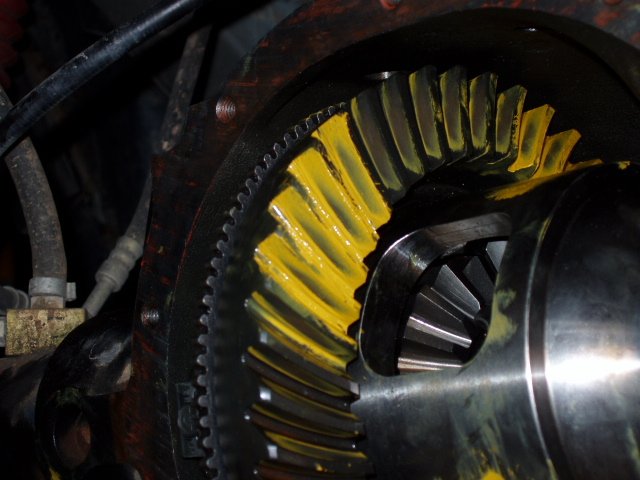
Choosing between these for your truck? The axle ratio calculator shows the cruise RPM each one gives on your tire size, and which off-the-shelf set lands closest to your target. For the deeper mechanical story, HowStuffWorks explains how the ring and pinion form the final drive inside an open differential — including why the pinion gear is always the smaller one.
How to calculate gear ratio by machine type
The core formula never changes — driven ÷ driver — but every machine counts its “gears” a little differently. Here is how to calculate gear ratio on the four machines people ask about most.
Bicycles: the flipped convention
Cyclists quote the ratio backwards from engineers: chainring teeth ÷ rear cog teeth. A 44-tooth chainring with a 16-tooth cog gives 44 ÷ 16 = 2.75, meaning one pedal revolution spins the wheel 2.75 times. This is the inverse of the engineering formula — cyclists describe speed multiplication (an overdrive number), while engineers describe the reduction. Both describe the same physical pair of sprockets.
Worked example: at a 90 RPM cadence on 27-inch wheels, that 2.75 gear gives 2.75 × π × 27 = 233 inches of travel per pedal stroke — 19.9 mph. Drop to the 34×34 climbing gear (34 ÷ 34 = 1.00) and the same cadence gives 1.00 × π × 27 = 84.8 inches per stroke, or 7.2 mph. Same legs, very different speed — that is the whole point of the calculation.
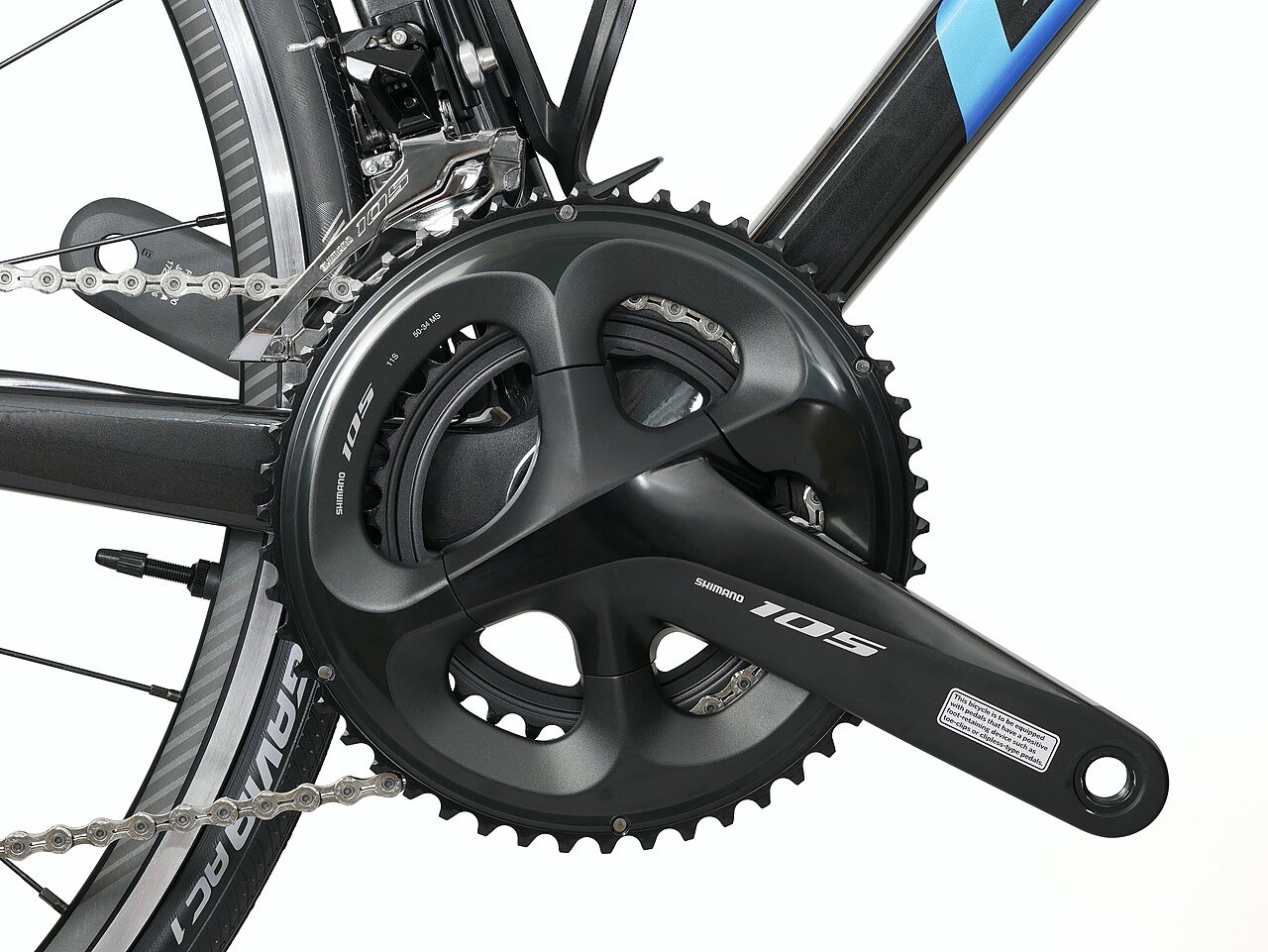
Our bicycle gear ratios guide goes deeper, including gear inches and development for comparing gears across wheel sizes.
Motorcycles: chain, belt, and shaft
Chain final drive uses the standard formula: rear sprocket teeth ÷ front sprocket teeth. A 15-tooth front and 45-tooth rear gives 45 ÷ 15 = 3.00:1. Rule of thumb: one tooth less on the front sprocket moves the ratio about as much as three teeth more on the rear, because the front sprocket is so much smaller — check it on a 16/40 setup (2.500:1): dropping to a 15-tooth front gives 40 ÷ 15 = 2.667 (+6.7%), while adding three teeth at the rear gives 43 ÷ 16 = 2.688 (+7.5%). Near-identical results, which is why racers tune the rear for fine steps and the front for big jumps. That is how to calculate gear ratio changes on a motorcycle in one step, before spending money on sprockets.
Belt drives use the same math with pulley teeth; shaft-drive bikes have a fixed final drive you read off the spec sheet — there is nothing to count. Model any sprocket swap in our motorcycle sprocket gearing guide.
Industrial gearboxes
A 12-tooth motor pinion driving a 48-tooth gear gives 48 ÷ 12 = 4:1 in a single stage. Need 20:1? Chain a 4:1 stage (60 ÷ 15) with a 5:1 stage (50 ÷ 10): 4 × 5 = 20:1 total, dropping a 1,750 RPM motor to 87.5 RPM at the output shaft. Worm-gear reducers reach 20:1 or even 30:1 in a single stage — a 30:1 worm box on that same 1,750 RPM motor gives 1,750 ÷ 30 = 58.3 RPM out — but worm gears only run ~85% efficient, so factor that into your torque estimate instead of assuming the ideal multiplication.
RC cars
RC gearing has two parts: the external spur/pinion pair and the transmission’s internal ratio. Final drive ratio = (spur teeth ÷ pinion teeth) × internal ratio. An 86-tooth spur with a 20-tooth pinion and a 2.6:1 internal ratio gives (86 ÷ 20) × 2.6 = 4.3 × 2.6 = 11.18:1. Racers tune this number for each track — and the math shows why small pinion changes matter: swapping the 20-tooth pinion for a 22-tooth one gives (86 ÷ 22) × 2.6 = 3.909 × 2.6 = 10.16:1, a 9.1% taller gearing from a two-tooth change. Lower for tight tracks, higher for long straights — that is how to calculate gear ratio for an RC car before buying a single pinion.
How to calculate gear ratio for a planetary gear set
A planetary (epicyclic) gear set packs a sun gear, planet gears on a rotating carrier, and a ring gear into one compact unit — it is what gives automatic transmissions several ratios from one small package. The ratio depends on which member is held still:
The handiest case: ring gear fixed, sun gear input, carrier output.
Ratio = 1 + (ring teeth ÷ sun teeth)
Worked example: a 12-tooth sun and a 48-tooth ring give 1 + 48/12 = 1 + 4 = 5:1 reduction. (Sanity check on the geometry: planet teeth must equal (48 − 12) ÷ 2 = 18, which is a valid gear — if this number is not a whole number, the set cannot physically exist.)
| Member held fixed | Input | Output | Formula | 12T sun / 48T ring |
|---|---|---|---|---|
| Ring gear | Sun | Carrier | 1 + R/S | 5:1 reduction |
| Sun gear | Ring | Carrier | 1 + S/R | 1.25:1 reduction |
| Carrier | Sun | Ring | −R/S | −4:1 (reversed) |
The minus sign in the last row is real: fixing the carrier makes the ring spin backwards relative to the sun — that is exactly how reverse gear works in many automatics.
Multi-stage gear trains: multiply the stages
Multi-stage trains follow the same rule — how to calculate gear ratio for a whole train is to calculate each pair separately and multiply:
Stage 1: 36 ÷ 12 = 3:1 · Stage 2: 45 ÷ 15 = 3:1 · Total = 3 × 3 = 9:1
An idler gear between two gears changes direction only — it does not change the ratio. Our homepage calculator has a Multi-Stage tab that chains up to four stages and shows the RPM after each one.
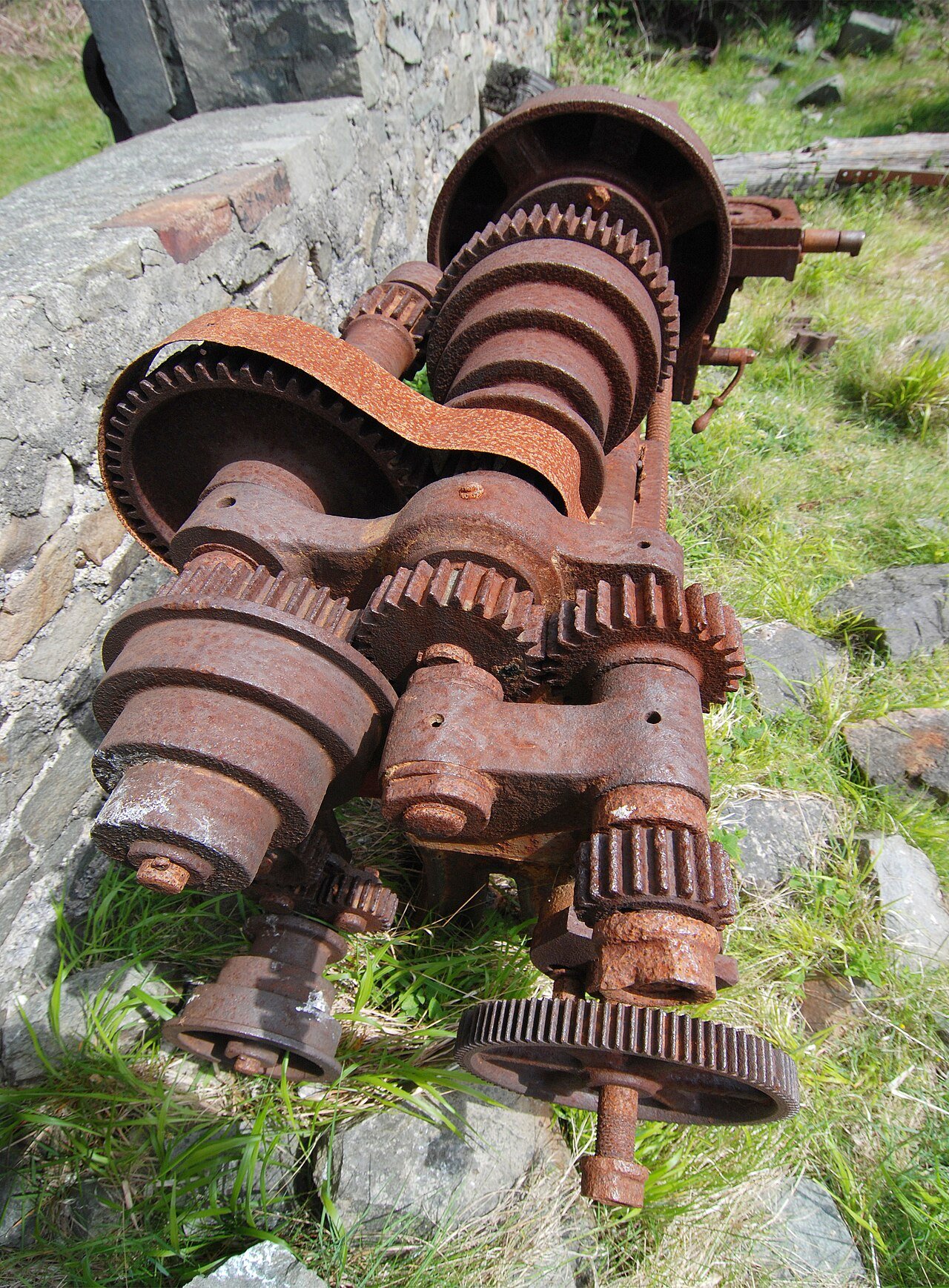
Worked example — a 4×4’s crawl ratio: first gear 3.06:1 × transfer case low 2.72:1 × axle 4.10:1 = 3.06 × 2.72 × 4.10 = 34.1:1. That number is the standard way off-roaders compare low-speed pulling power, and our crawl ratio guide breaks down what counts as good. Wikipedia’s gear train overview covers compound and epicyclic arrangements in more formal depth if you want the engineering treatment.
Reduction vs overdrive
- Ratio above 1:1 = reduction. Output turns slower, torque multiplies. Winches, climbing gears, first gear.
- Ratio below 1:1 = overdrive. Output turns faster, torque drops. Top-gear highway cruising.
- Exactly 1:1 = direct drive. Input and output turn together.
Whichever side of 1:1 your result lands on tells you what the gearing actually does — reading the result correctly is part of how to calculate gear ratio, not just producing the number.
HowStuffWorks has a visual walkthrough of how gear ratios trade speed for torque that pairs well with the examples above.
Common mistakes to avoid
Most wrong answers in how to calculate gear ratio trace back to these six slips:
- Swapping driver and driven. That inverts the answer — a 3:1 reduction becomes a 0.33:1 overdrive. Always driven ÷ driver.
- Mixing up “higher” and “lower” gears. A numerically higher ratio (4.10) is a “lower/shorter” gear; a numerically lower ratio (3.08) is a “higher/taller” gear.
- Forgetting the transmission. Wheel speed depends on the axle ratio × the transmission gear. A 3.73 axle in a 0.70 overdrive acts like 2.61 at the wheels.
- Ignoring tire size. A taller tire effectively lengthens every gear — check the effect in the tire gear ratio calculator.
- Measuring the wrong diameter. The ratio uses pitch diameters. Measuring across the tooth tips (outside diameter) of both gears still gives nearly the right answer if you measure both the same way — but mixing one outside diameter with one pitch diameter corrupts the result.
- Counting an idler as a stage. An idler gear reverses direction but leaves the ratio untouched: a 12T driving a 24T idler driving a 48T still gives 48 ÷ 12 = 4:1, not 2 × 2. The intermediate tooth counts cancel out.
Frequently asked questions
How do you calculate gear ratio from teeth?
Divide the driven gear’s tooth count by the driving gear’s tooth count — that is how to calculate gear ratio from teeth in one step. 41 ring-gear teeth ÷ 11 pinion teeth = 3.73:1.
What does a 3.73:1 gear ratio mean?
The input shaft turns 3.73 times for one turn of the output. Speed is divided by 3.73; torque is multiplied by roughly 3.73 (minus friction losses).
Is a higher gear ratio faster or slower?
A numerically higher ratio gives slower output speed but stronger acceleration and pulling power. A numerically lower ratio gives higher top speed and lower cruise RPM.
How do I calculate gear ratio without tooth counts?
Use diameters (driven ÷ driver) or speeds (input RPM ÷ output RPM) — both give the same ratio. For a vehicle axle, the rotation-counting method in our guide to finding your gear ratio without pulling the cover works with just a jack and a paint marker.
How do you calculate gear ratio for a bicycle?
Cyclists use the flipped convention: chainring teeth ÷ rear cog teeth. A 44-tooth chainring with a 16-tooth cog = 44 ÷ 16 = 2.75, meaning the wheel turns 2.75 times per pedal revolution. See the bicycle section above for the speed math.
What is the gear ratio formula for a planetary gear set?
It depends on which member is fixed. With the ring gear fixed, sun gear input, and carrier output: ratio = 1 + (ring teeth ÷ sun teeth). A 12-tooth sun with a 48-tooth ring gives 1 + 48/12 = 5:1.
Ready to run your own numbers? The gear ratio calculator handles teeth, RPM, speed, bicycle gearing, and multi-stage trains — free, with every formula shown.