

If you have ever asked what is a differential, here is the one-sentence answer: it is the gear assembly between your drive wheels that lets them spin at different speeds while still receiving engine power. Every car with a driven axle has one, and without it your tires would scrub, chirp, and fight each other through every single turn.
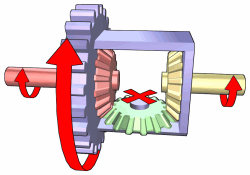
What is a differential in a car made of? The parts
Before the “how,” the “what.” A differential is a compact set of gears inside the axle housing, and each part has one job. Once you know the parts, the way it works becomes obvious:
| Part | What it does |
|---|---|
| Pinion gear | The small gear on the end of the driveshaft; it turns the engine’s rotation 90 degrees and drives the ring gear |
| Ring gear (crown wheel) | The large gear bolted to the carrier — its tooth count versus the pinion’s sets your axle ratio |
| Carrier (differential case) | The rotating housing that the ring gear bolts to; it carries the small gears around with it |
| Spider gears | Two small bevel gears on a cross-pin inside the carrier — the heart of the speed-splitting trick |
| Side gears | Bevel gears splined to each axle shaft; they mesh with the spider gears |
| Bearings | Carrier and pinion bearings that let everything spin true under heavy load |
| Housing | The axle housing (or “third member”) that holds the assembly in a bath of gear oil |
Notice that the ring gear and pinion are the same pair you read about when learning how to find gear ratio — 41 ring teeth ÷ 11 pinion teeth is what makes a 3.73 axle a 3.73 axle. The differential is where your final drive ratio lives; our final drive ratio guide explains how that number shapes everything from cruise RPM to towing. And if you ever shop for gears yourself, suppliers like West Coast Differentials publish ring-and-pinion application guides by axle model — useful when the numbers on your tag don’t match any factory ratio.
Why cars need a differential: the cornering problem
Drive straight and both wheels on an axle travel the same distance, so they can turn at the same speed. Turn a corner and the geometry changes: the outside wheel travels a longer arc than the inside wheel. A rigid axle with no differential would force both wheels to turn at the same speed, so one tire would have to scrub and slide through the turn.
That scrubbing is not a small thing. On pavement it chirps tires, wears them unevenly, loads up the axle shafts, and makes the car push and bind in tight turns. Off-road it is worse — a bound-up axle is how you break U-joints and axle shafts. The differential solves it by splitting one input (the driveshaft) into two outputs (the axle shafts) that are allowed to rotate at different speeds. The average speed of the two wheels always equals the carrier speed, no matter how the split falls — and that speed-splitting job is the everyday answer to what is a differential actually for.
How a differential works: straight vs turning
Here is the mechanism, step by step — the mechanical answer to what is a differential doing inside the axle. The driveshaft spins the pinion gear, the pinion drives the ring gear, and the ring gear rotates the carrier. Everything downstream of the carrier depends on what the spider gears are doing:
- Driving straight: both wheels meet equal resistance. The spider gears do not spin on their cross-pin at all — they just ride around with the carrier, and the side gears (and both axle shafts) turn together at carrier speed. The whole assembly rotates as one locked unit.
- Turning: the inside wheel meets more resistance and slows down. That speed difference makes the spider gears walk around the slower side gear, spinning on their pin as they go. This walking action is what lets the outside side gear — and the outside wheel — speed up by exactly the amount the inside one slowed down.
- The balance rule: the carrier’s speed always equals the average of the two axle speeds. If the carrier turns 100 RPM and the inside wheel drops to 80, the outside wheel rises to 120 — the governing equation of what is a differential, in one line: (80 + 120) ÷ 2 = 100.
This is also why one design detail matters enormously: a standard open differential always splits torque equally between the two wheels. That is fine on dry pavement — but if one wheel is on ice, it can only take a tiny bit of torque, so the other wheel gets the same tiny bit. The result: one spinning wheel, one parked car. Fixing that weakness is the entire reason limited slip differentials exist.
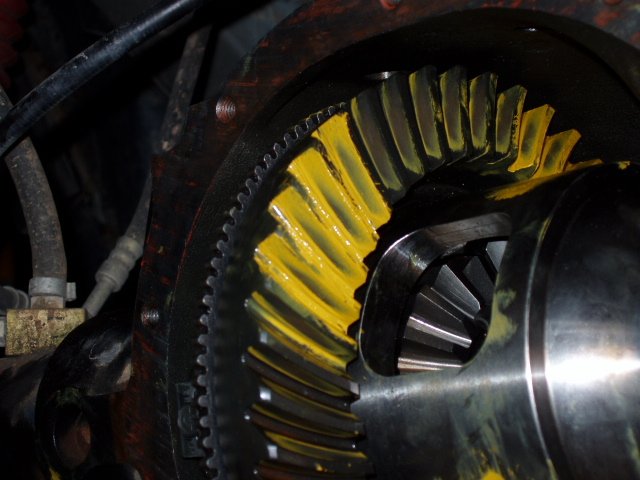
Where the differential lives: RWD, FWD, and AWD
Every driven axle has a differential — the only question is where the engineers packaged it. Wherever it sits, what is a differential doing is identical: splitting one input into two independently-speeded outputs.
- Rear-wheel drive (RWD): the classic layout. The differential sits in the rear axle housing, between the rear wheels, fed by a driveshaft from the transmission. Trucks and muscle cars live here.
- Front-wheel drive (FWD): the differential is built into the transmission, in a combined unit called a transaxle. It does the same job, just packaged sideways for a transverse engine.
- All-wheel drive (AWD) / 4WD: up to three differentials. There is one in the front axle, one in the rear axle, and a center differential (or transfer case) splitting power front-to-rear so the front and rear axles can also turn at different speeds in corners.
This is why a 4×4 has a front and a rear gear ratio — and why both must match. Our axle ratio calculator works for either end, and the RPM calculator shows what that ratio means at highway speed.
Types of differentials: the quick tour
All differentials split speed. They differ in how they handle the torque split — and that one difference defines every type on the market:
| Type | How it handles torque | Best for |
|---|---|---|
| Open | Always 50/50 torque split; the wheel with the least grip sets the limit | Everyday street driving, lowest cost |
| Limited-slip (LSD) | Clutches or gears resist speed differences, sending more torque to the gripping wheel | Sporty driving, rain/snow traction |
| Locking | Locks both axles together on demand (selectable) or automatically under slip | Serious off-road, rock crawling |
| Spool | Permanently locked — both wheels always turn together | Drag racing only (terrible on the street) |
| Torsen (helical) | Gear-driven LSD with a fixed torque bias ratio, no clutches to wear | Performance cars, daily drivers that see track days |
| Electronic / brake-based | Uses the ABS brakes to slow the spinning wheel, faking an LSD | Factory AWD systems, budget traction control |
The full comparison — clutch-type vs helical vs viscous vs locker, bias ratios, fluid requirements — is in our deep dive on the limited slip differential. If you are choosing gears for traction work, pair that read with best gear ratio for off-road and crawl ratio explained.
Symptoms of a failing differential
Differentials rarely fail without warning. These are the symptoms that point at the axle rather than the tires or wheel bearings:
- Whine or howl that changes pitch with vehicle speed (not engine RPM) — the classic sign of worn ring-and-pinion teeth or failing pinion bearings, and the sound most people mean when they ask what is a differential failure like. A whine on acceleration points at the drive side of the teeth; a whine on deceleration points at the coast side.
- Clunking when shifting into drive or reverse, or on throttle transitions — usually excessive backlash from worn gears or a loose pinion.
- Vibration at speed that isn’t fixed by balancing the tires — worn carrier bearings can telegraph through the whole drivetrain.
- Leaking or low gear oil — the pinion seal and axle seals are the usual suspects. A differential run low on oil will overheat and destroy its bearings fast.
Maintenance is simple and cheap compared to a rebuild: change the gear oil on schedule (most owner’s manuals call for 30,000–60,000 miles, sooner if you tow or off-road), use the correct GL-5 weight, and add the friction modifier your manufacturer specifies if you have a clutch-type limited slip. Wikipedia’s differential article has solid cutaway diagrams if you want to see the parts in motion.
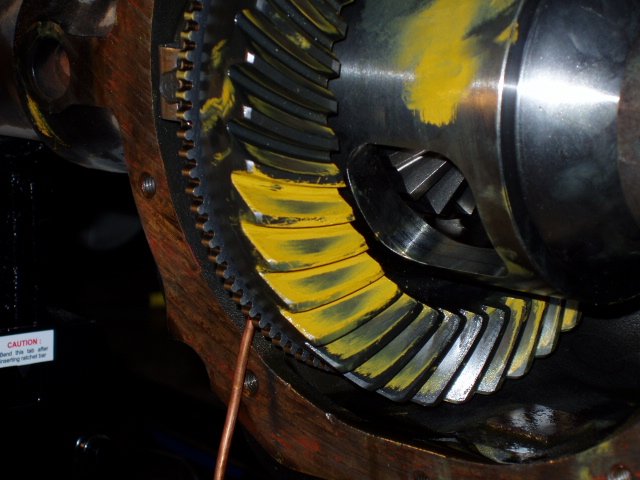
Worked example: how much faster does the outside wheel spin?
Time for real numbers. Picture a truck with a 60-inch track width (5 feet between the tire centers) taking a corner where the inside wheel follows a 20-foot radius:
- Inside wheel radius: 20 ft → its path length per revolution set: proportional to 20
- Outside wheel radius: 20 + 5 = 25 ft → proportional to 25
- Distance ratio: 25 ÷ 20 = 1.25
So the outside wheel must travel 25% farther than the inside wheel through that turn — and it spins 25% faster to do it. Tighten the corner to a 12-foot inner radius (a typical parking-lot turn) and the math gets more dramatic: 17 ÷ 12 = 1.42, so the outside wheel spins 42% faster. This is exactly why a locked or spooled axle chirps its tires around parking lots: something has to give, and it is the rubber.
How long does a differential last?
A healthy differential is one of the longest-lived parts of a car — 150,000 to 200,000 miles is normal with nothing but fluid changes. What kills them is almost always neglect or abuse: running low on gear oil, towing far beyond the rating with the wrong gears, or shock-loading from aggressive launches on sticky tires.
When people ask what is a differential rebuild going to cost, the honest answer is “it depends on what failed.” A bearing and seal job might run a few hundred dollars; a full gear-set replacement with setup labor can pass $1,500 on a truck axle. That is why the whine-and-clunk symptoms above matter — catching a failing pinion bearing early is the difference between a bearing job and a whole new gear set. Keep the fluid fresh, fix leaks promptly, and the answer to “what is a differential’s lifespan” is usually “longer than you’ll own the car.”
Frequently asked questions
What is a differential in a car, in simple terms?
A differential is the gear set between the two drive wheels that lets them spin at different speeds. In a turn, the outside wheel travels farther than the inside wheel, so it must spin faster — the differential makes that possible while both wheels still get engine power. That is what a differential is and why every driven axle has one.
What does a differential do when driving straight?
Almost nothing exciting: both wheels meet equal resistance, so the spider gears don’t spin on their pin and the whole carrier rotates as one unit. Both axle shafts turn at carrier speed, and all the engine torque flows straight through to the wheels.
Is the differential the same as the axle ratio?
They live in the same place but they are not the same thing. The differential is the mechanism that splits speed between the wheels — if you remember only one thing about what is a differential, make it that sentence; the axle ratio is the number (set by the ring-and-pinion tooth counts inside the differential) that describes how many driveshaft turns equal one wheel turn. Learn how to choose a gear ratio once you know which number your axle carries.
Can you drive with a bad differential?
Briefly, and you shouldn’t. A whining differential is a worn one, and worn gears shed metal into the oil, which accelerates bearing failure. A seized differential can lock a wheel at speed. Get the noise diagnosed — a fluid change and bearing job is far cheaper than a full gear-set replacement.
Do front-wheel-drive cars have a differential?
Yes — it is built into the transaxle (the combined transmission-and-differential unit). It works exactly like a rear-axle differential, just packaged for a transverse engine. AWD vehicles add a third, center differential to split power front-to-rear.
What is a differential on a car vs a transfer case?
The differential splits power left to right on one axle. The transfer case (on 4WD trucks and some AWD vehicles) splits power front to rear between the two axles. A 4WD truck has a transfer case plus a front and a rear differential.
What is a differential: the bottom line
So — what is a differential? It is the unglamorous hero of every drivetrain: a handful of gears that turns one driveshaft into two independently-speeded wheels, makes cornering possible without tire scrub, and houses the ring-and-pinion set that defines your axle ratio. Understand it and the rest of drivetrain math — gear ratios, crawl ratios, RPM at speed — falls into place.
Now that you know what a differential is, see what yours is doing: the free gear ratio calculator turns your axle ratio into real speed, RPM, and pulling-power numbers.