

Gear inches = (chainring teeth ÷ cog teeth) × wheel diameter in inches. It answers the one question raw ratios can’t: how does this gear on my bike compare to that gear on yours? — even with different wheel sizes, chainrings, and cassettes. This guide explains the formula, what the numbers mean, and how the figure relates to development and gain ratio. If ratios themselves are new to you, start with our guide to bicycle gear ratios explained, then come back here for the comparison shortcut.
The formula
Gear inches = (front chainring teeth ÷ rear cog teeth) × wheel diameter (inches)
The idea dates back to penny-farthing bicycles, whose pedals drove the wheel directly — a 60-inch wheel was geared “at 60 inches.” A modern bike “geared at 74 inches” would feel exactly like pedaling that old 74-inch monster directly. Wikipedia’s article on the term traces it to the high-wheel era, when the wheel’s diameter was literally the gearing. Round to the nearest whole number.

Worked example
44-tooth chainring, 16-tooth cog, 27″ wheels: (44 ÷ 16) × 27 = 2.75 × 27 = 74 gear inches. One pedal revolution feels like turning a 74-inch wheel once.
For honest numbers, measure your own wheel instead of trusting the nominal size — a “29-inch” tire often measures closer to 28.5″ once inflated and loaded. The quick method: mark the tire, roll the bike exactly one wheel revolution, measure the distance, and divide by π to get the true diameter.
Comparison table (27″ wheels)
| Chainring × cog | Ratio | Inches | What it feels like |
|---|---|---|---|
| 50 × 11 | 4.55 | 123 | Flat-out sprint |
| 50 × 14 | 3.57 | 96 | Fast group ride |
| 44 × 16 | 2.75 | 74 | Brisk cruise |
| 34 × 21 | 1.62 | 44 | Easy spin |
| 32 × 28 | 1.14 | 31 | Moderate climb |
| 22 × 34 | 0.65 | 17 | Steep wall, loaded touring |
Math check on two rows: 50 ÷ 11 = 4.545 × 27 = 122.7 → 123; 22 ÷ 34 = 0.647 × 27 = 17.5 → 17.
What the ranges mean
- Under 30: very easy — steep climbs, loaded touring, technical off-road. A 22×34 granny gear lives here.
- 30–70: medium — everyday riding. Most of your ride happens in this band.
- 70–100: fast — strong tailwinds, descents, fast group rides.
- Over 100: very hard — sprinting and racing only. A 50×11 road top gear is ~123 inches.
A practical rule: a 25–100 range covers about 90% of riding for most people. If your lowest gear is above 30 and you face real hills, consider easier gearing.
Why wheel size matters
The same teeth give different results on different wheels — that’s the whole point of the measure. Take a 50×14 (ratio 3.57):
- 27″ wheels: 3.57 × 27 = 96 gear inches
- 29″ wheels: 3.57 × 29 = 104
The 29er version is effectively a taller gear — the bike travels further per pedal stroke. Comparing bikes by raw ratio alone hides this; the measure reveals it.
Gear inches in action: two real bikes compared
Bike A — a modern 1× mountain bike: 32-tooth chainring, 51-tooth largest cog, 29″ wheels. (32 ÷ 51) × 29 = 0.627 × 29 = 18.2, so the easiest gear is ≈ 18 gear inches.
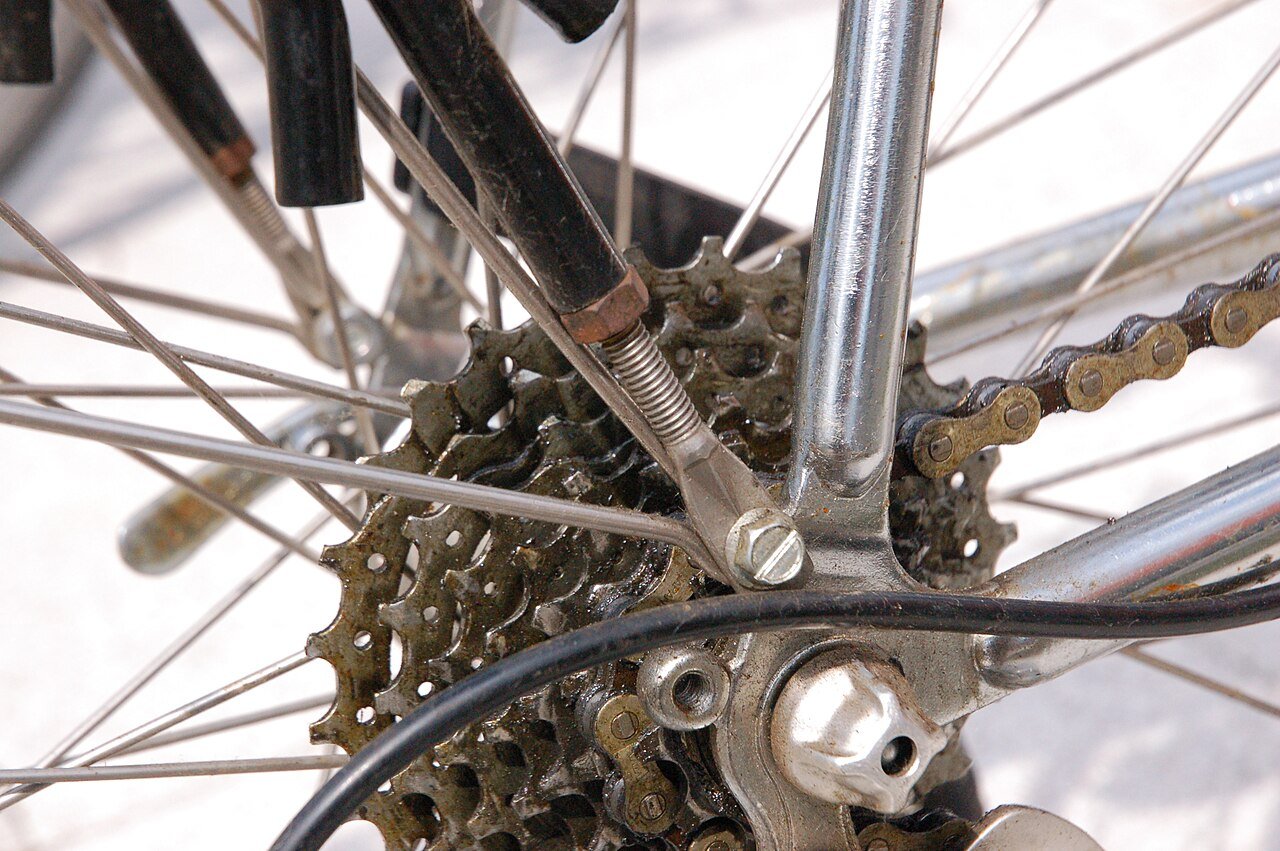
Bike B — a classic road bike: 34-tooth small ring, 34-tooth cog, 700c wheels (≈ 27″). (34 ÷ 34) × 27 = 27.
Bike A is far easier to pedal uphill despite its bigger wheels — 18 sits in the steep-climbing band while 27 sits in the everyday band. The raw ratios (0.63 vs 1.00) suggest roughly a 37% gap, but only this calculation gives the true figure with wheel size baked in. To check every gear of a full drivetrain at once, Sheldon Brown’s gear calculator runs inches, development, and gain ratios side by side.
Gear inches vs development vs gain ratio
All three systems start from the same gear ratio you work out from the tooth counts — they just express it differently.
- Gear inches — the shortcut above. Imperial, easy to memorize and compare (74, 96, 123…).
- Development (rollout) — how far the bike actually travels per pedal revolution. Development = the gear-inch figure × π. Our 74-inch example: 74 × 3.1416 = 233 inches ≈ 5.9 meters per pedal turn. Multiply by 0.0798 to get meters directly (74 × 0.0798 = 5.9).
- Gain ratio — the purist’s measure: (wheel radius ÷ crank length) × ratio. For the 44×16 on 27″ wheels with 170 mm cranks (6.69″): (13.5 ÷ 6.69) × 2.75 = 2.018 × 2.75 = 5.55. Unitless, and it accounts for crank length too — a genuinely fair comparison between any two bikes.
Use the shortcut for quick comparisons, development when you want to know actual distance per stroke, and gain ratio when crank lengths differ.
How crank length shifts the gain ratio
Gain ratio is the only one of the three systems that notices crank length. Longer cranks add leverage, which slightly lowers the gain ratio on identical gears:
| Crank length | Wheel radius ÷ crank length | Gain ratio (44×16, 27″ wheels) |
|---|---|---|
| 170 mm (6.69″) | 13.5 ÷ 6.69 = 2.018 | 2.018 × 2.75 = 5.55 |
| 175 mm (6.89″) | 13.5 ÷ 6.89 = 1.959 | 1.959 × 2.75 = 5.39 |
The 175 mm crank adds roughly 3% more leverage, so the gain ratio drops from 5.55 to 5.39 — a small but real difference that gear inches alone can never show.
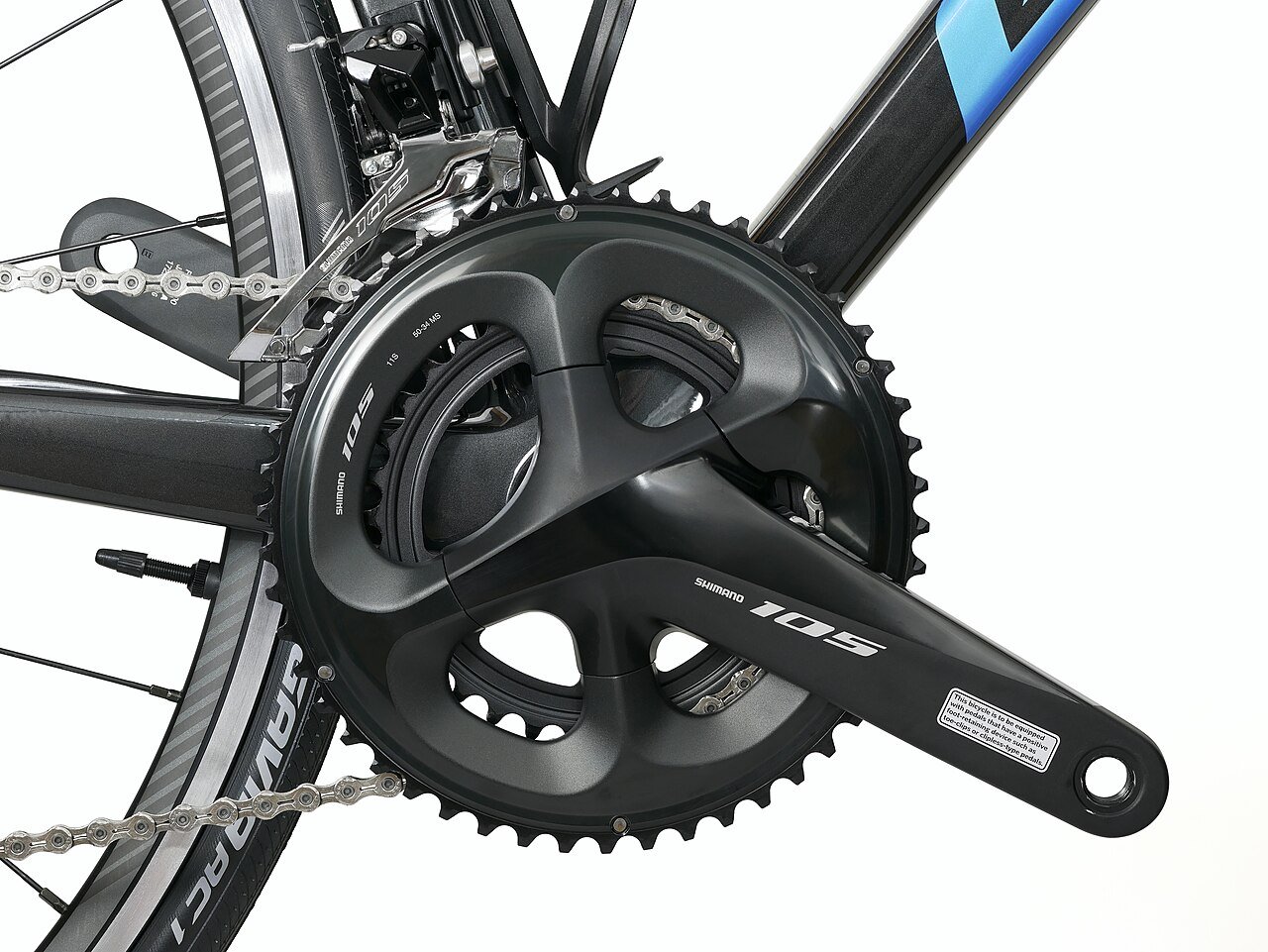
Worked example: every gear of one cassette
To see the measure do its real job, run a full cassette. Here is the small ring of a compact road setup — 34-tooth chainring, 11–28 cassette, 27″ wheels — gear by gear:
| Cog | Ratio (34 ÷ cog) | Gear inches |
|---|---|---|
| 11 | 3.09 | 83 |
| 12 | 2.83 | 77 |
| 13 | 2.62 | 71 |
| 14 | 2.43 | 66 |
| 15 | 2.27 | 61 |
| 17 | 2.00 | 54 |
| 19 | 1.79 | 48 |
| 21 | 1.62 | 44 |
| 23 | 1.48 | 40 |
| 25 | 1.36 | 37 |
| 28 | 1.21 | 33 |
Two things stand out. First, the steps shrink as you climb the cassette — 6–7 inches apart at the fast end, 3–4 at the climbing end — which is why the easy gears feel closely spaced. Second, the big 50-tooth ring overlaps most of this table (its range runs 48–123), so the small ring’s unique contribution is really just the bottom few gears: 33–44 inches, the climbing zone.
Picking the right gear-inch range for your bike
Start from your lowest gear — it matters more than your highest. If you regularly ride hills, make sure your easiest combination lands under 30 (a 34×34 on 700c wheels is about 27). Commuters on flat ground can live happily with a lowest gear around 35–40. Your top gear only matters if you routinely spin out: if you never feel the need to pedal faster downhill, a top gear near 100 is plenty, and racers are the main audience for 110+.
A quick sanity check for a drivetrain you’re considering: compute the lowest and highest figures, then the range (highest ÷ lowest). A range of 300%+ with well-spaced middle gears suits mixed riding; below 250% is fine only for flat terrain. And when comparing two bikes, always compare gear inches — never raw ratios — because wheel size is baked in.
For the 1x drivetrain numbers worked out, see the mountain bike gear ratio chart.
Frequently asked questions
Is a higher gear inch number better?
No — higher is just harder and faster. “Better” is the gear that lets you hold your preferred cadence (usually 80–95 RPM) on your terrain. Too high and your knees suffer; too low and you spin out on descents.
How do I convert gear inches to development?
Multiply by π: 74 × 3.1416 = 233 inches per pedal revolution, or multiply by 0.0798 for meters (74 × 0.0798 ≈ 5.9 m). Distance per stroke = development, period.
Do gear inches work for internal-gear hubs?
Yes. Hub manufacturers publish each gear’s equivalent ratio; multiply by wheel diameter exactly as with a derailleur. A hub gear listed as “0.73” on 28″ wheels = 0.73 × 28 = 20. Wikipedia’s overview of bicycle gearing covers hub, shaft-drive, and gearbox variants in more depth.
What’s a good gear-inch range for a commuter?
Roughly a 30–90 range handles city riding well: easy enough for loaded starts and hills, tall enough for descents and tailwinds. Flat cities can get away with a narrower band.
What gear inches do touring bikes use?
Loaded tourers aim for a lowest gear of roughly 17–22. A 22-tooth granny ring with a 34-tooth cog on 700c wheels gives (22 ÷ 34) × 27 = 0.647 × 27 ≈ 17.5 — low enough to crawl up steep grades with full panniers without wrecking your knees. The high end matters less on a tourer; few exceed 100.
Are gear inches used for e-bikes?
Rarely, though the math works identically — an e-bike derailleur still multiplies teeth by wheel diameter. The difference is that motor torque (measured in newton-meters) and battery range dominate how an e-bike climbs, so the measurement just isn’t the headline number. It still applies mechanically if you ever compare two e-bike drivetrains side by side.
See all three measures for your own drivetrain in the bicycle section of the free gear ratio calculator — ratio, inches, development, and speed at your cadence.
Related reading: single speed bike gear ratio — the full chart for 44–50T chainrings and 14–19T cogs, with gear inches and skid patches worked out.
For a worked hybrid example using gear inches throughout, see the hybrid bike gear ratio chart — a full chainring by cassette grid, with speeds at 80 and 90 RPM cadence.