

Short answer: The best gear ratio for 33 inch tires is 4.10 for a daily driver and 4.56 if you tow or wheel on weekends — and the good news is many trucks don’t need a re-gear at all. 33s are a small enough jump from stock that many drivers don’t strictly need to re-gear — especially if you already have 3.73 or 4.10 gears. This guide shows the exact numbers for each stock setup so you can decide whether the money is worth it.
Restore table: stock gears → 33-inch tires
Restore ratio = stock ratio × 33 ÷ stock tire diameter (31.5″ baseline):
| Your stock ratio | Restore ratio (exact) | Buyable set to pick | If you keep stock gears, you effectively have |
|---|---|---|---|
| 3.21 | 3.36 | 3.42 | 3.06 — re-gear strongly advised |
| 3.45 | 3.61 | 3.55 or 3.73 | 3.29 — re-gear recommended |
| 3.73 | 3.91 | 3.91 | 3.56 — acceptable for most daily drivers |
| 4.10 | 4.30 | 4.30 | 3.91 — many skip the re-gear entirely |
These restore numbers are the foundation of any honest answer about the gear ratio for 33 inch tires: they tell you what to buy, not just what you have.
When is a re-gear optional vs needed?
- Stock 4.10 → usually skip it. Dropping to an effective 3.91 is a ~5% change — most drivers barely notice, and 4.30 gears cost $1,500+ to install for a marginal gain.
- Stock 3.73 → optional for daily driving, yes for towing. An effective 3.56 is fine around town, but if you tow or carry a camper, restoring to 3.91 puts the engine back in its happy zone on grades.
- Stock 3.45 or 3.21 → re-gear. Effective ratios in the 3.0s turn a truck into a slug off the line and make the transmission hunt on every hill. This is the case where re-gearing pays for itself in drivability.
The gear ratio for 33 inch tires decision tree: re-gear or skip it?
If you’re still undecided about a gear ratio for 33 inch tires, work this three-step flow — it takes two minutes and uses only numbers you already know.
Step 1 — find your stock ratio. It’s on the axle tag, the build sheet, or the door sticker. If none of those are available, the two-jack rotation test in our find-your-gear-ratio guide gets it right every time.
Step 2 — compute your effective ratio. Effective ratio = stock ratio × 31.5 ÷ 33. For the four most common stock sets: 3.21 → 3.06, 3.45 → 3.29, 3.73 → 3.56, 4.10 → 3.91.
Step 3 — apply the verdict. Effective 3.06 or 3.29? Re-gear — you’ll feel it at every stoplight. Effective 3.56? Daily driving is fine; re-gear only if you tow or load heavy. Effective 3.91? Keep your money — that’s within 5% of stock behavior. Run those three steps and the gear ratio for 33 inch tires question answers itself.
The logic behind the tree is the same one Yukon Gear & Axle spells out in their re-gearing explainer: bigger tires technically re-gear the truck already, so the question is never “do gears change?” — it’s “is the change small enough to live with?”
Worked example: Jeep JL on 33s from stock 3.45s
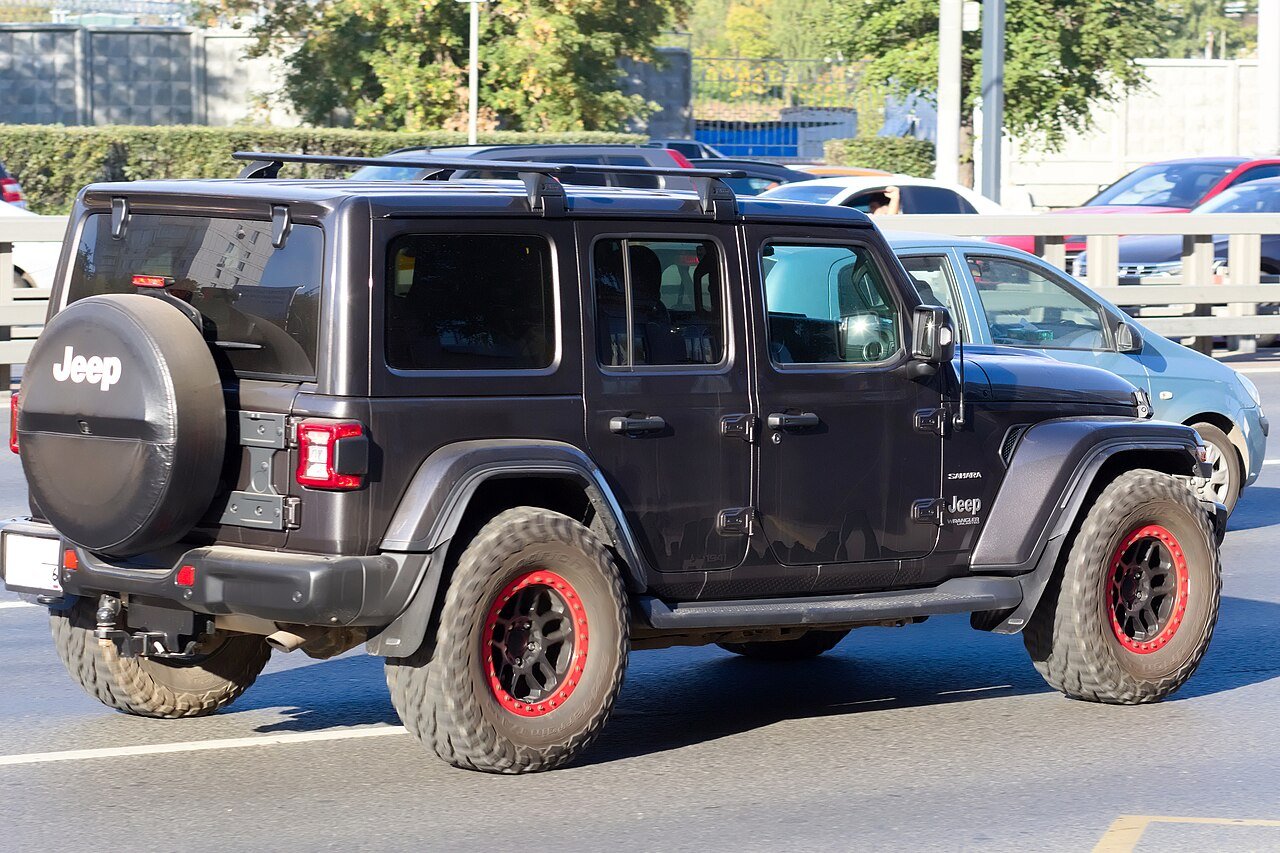
Let’s run a real-world gear ratio for 33 inch tires scenario end to end: a Jeep JL on stock 3.45s moving up from ~31.5″ tires to 33s.
Restore: 3.45 × 33 ÷ 31.5 = 3.61. The nearest buyable sets are 3.55 or 3.73, and 3.73 is the common pick — it slightly over-restores, which is exactly what you want if towing or trail use is in your future.
Highway reality: with 3.73s and 33s, cruising at 65 mph in 1:1 is 65 × 3.73 × 336.13 ÷ 33 = 2,470 RPM. Stepping to 4.56s instead puts that same cruise at 3,019 RPM (2,113 in a 0.70 overdrive) — noticeably busier on the highway.
Verdict: for a pure daily driver on 33s, keeping the stock 3.45s (effective 3.29) is livable around town — the JL’s 8-speed masks tall gearing well. If weekends involve trails or a loaded trailer, 3.73 restores the factory feel. Choose 4.56 only when crawling or heavy towing dominates the miles. Cross-check your own numbers against ExtremeTerrain’s gear-ratio chart for larger tires before ordering.
RPM at 65 mph on 33s (1:1 top gear)
Reference numbers: 3.73 = 2,470 RPM · 4.10 = 2,715 RPM · 4.56 = 3,019 RPM. With a typical overdrive (0.70), those become 1,729 / 1,901 / 2,113 RPM — calm cruising even on 4.56s. Cross-check your own tire size and overdrive gear on the gear ratio chart, which covers 26–44″ tires across eight ratios. Keep these three numbers in mind — they frame every gear ratio for 33 inch tires choice in this guide.
What about in-between sizes: 34s?
Not every upgrade lands on a round number. For a 34″ tire from the same 31.5″ baseline, the restore ratio is stock × 34 ÷ 31.5 — for a 3.73 truck that’s 4.03, so 4.10 gears are the buy. The effective drop without re-gearing is 31.5 ÷ 34 = 0.926, or about 7.4% — right on the borderline where daily drivers feel it and towers definitely do. Any non-standard size works the same way; the effective gear ratio guide covers the general math.
What a re-gear actually costs
Budget roughly $1,500–$3,000 for both axles (parts plus professional labor), depending on the axle and your area. On a 4×4, the front and rear ratios must match — mismatched gears will destroy the transfer case the first time you engage 4WD. That’s also why a re-gear is the ideal moment to add lockers: the differential is already apart, so the extra labor cost is minimal compared with opening it twice.
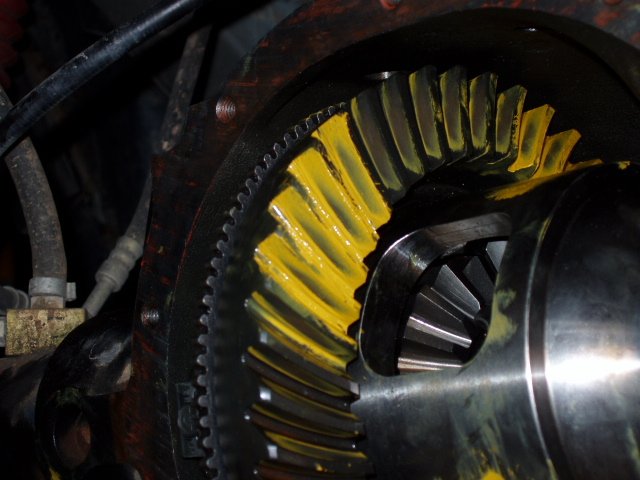
For price context, Quadratec’s ring-and-pinion gear packages for Jeep axles list front-and-rear sets from 4.11 up to 5.38 — 4.10 and 4.56 fall comfortably inside that range, so availability is never the blocker; the labor bill is. Whatever gear ratio for 33 inch tires you settle on, the front and rear sets must be identical.
Jeep notes
Jeep TJ/XJ owners commonly run 4.10 with an automatic and 4.56 with a manual on 33s — the manual has no torque converter to mask tall gearing, so it wants the deeper set. Jeep JK/JL with the 8-speed automatic is very forgiving: 4.10 feels stock-like, and even the 3.45-geared JL drives acceptably on 33s for pure street use. Before spending on gears, check whether your Jeep already has the ratio you want with the rotation test in our find-your-gear-ratio guide. For Jeep owners, the best gear ratio for 33 inch tires is often the one you already own — check before you spend.
Towing with 33s: the case for 4.10
If you tow, the re-gear math changes from optional to worthwhile. A 3.73 truck on 33s cruises at 65 mph in a 0.75 overdrive at about 1,852 RPM (65 × 3.73 × 336.13 × 0.75 ÷ 33) — fine unloaded, but a trailer drags it below the torque band and the transmission starts hunting. With 4.10s that becomes 2,036 RPM — roughly 185 RPM higher, right where most truck engines hold a grade without downshifting.
That small RPM cushion is also what keeps the torque converter locked on long climbs instead of unlocking and building heat. The fuel you “lose” to the extra RPM is usually recovered by staying in top gear instead of dropping to direct drive on every hill.
Towing in the mountains: where 33s change the gearing math
Flat-land towing forgives a lot; mountain grades forgive nothing, and that’s where the gear ratio for 33 inch tires decision gets sharper for towers.
Take the numbers from the towing section: 1,852 RPM vs 2,036 RPM at 65 mph in overdrive — both on 33s, the only difference being 3.73 vs 4.10 gears. That ~184-RPM gap is the whole story on a long grade.
With a trailer behind you, the truck needs more torque to hold speed on the climb. If 33s have the engine turning too slowly, the transmission drops out of overdrive to find power — or the torque converter unlocks to multiply torque. An unlocked converter is a fluid coupling slipping under full load: it builds heat fast, and heat is what kills transmissions.
At 2,036 RPM, most truck V8s sit right in their torque curve, so the transmission stays locked in top gear and the converter stays cool. That’s the real payoff of 4.10s for a tower on 33s — not the launch, but the climb: fewer downshifts, a locked converter, and cooler fluid over every pass.
Frequently asked questions
The most common questions about the gear ratio for 33 inch tires:
Do I have to re-gear for 33-inch tires?
No — but it depends on your stock gears. 4.10 stock gears hold up well (effective 3.91); 3.21 stock gears feel terrible (effective 3.06) and a re-gear is worth the money.
What is the best gear ratio for 33s and daily driving?
4.10. It keeps highway RPM reasonable while recovering most of the torque lost to the bigger tires. Choose 4.56 only if towing, heavy loads, or weekend wheeling dominate your miles.
Will 33s mess up my speedometer?
Yes, slightly — about 4.8% low (65 mph indicated is about 68 actual). That’s under the threshold most people bother recalibrating for, but it’s a 5-minute fix on most modern trucks. See how to recalibrate your speedometer.
How does 33-inch tire gearing compare to 35s?
35s demand a deeper jump — 4.56 to 4.88 in most cases — because the diameter change is 11% instead of ~5%. See the full breakdown for 35s in best gear ratio for 35-inch tires, or compute your effective gear ratio for any swap.
Can I run 33s with a leveling kit and stock gears?
Yes — and many people do. A leveling kit changes ride height, not gearing, so the math is identical: with stock 3.73s, your effective gear ratio for 33 inch tires becomes 3.73 × 31.5 ÷ 33 = 3.56, which is perfectly livable for a daily driver.
What a leveling kit does change is fitment: it buys the fender clearance 33s need without a full lift. Just don’t expect the taller stance to change how the truck pulls — drivability follows the effective ratio (3.56), not the lift height. On gearing, the right gear ratio for 33 inch tires matters more than any lift for how the truck feels.
Do I need a lift to fit 33s?
Usually not a full lift — but it depends on the truck and the tire. Many full-size trucks (F-150, Silverado 1500, Ram 1500) clear 33s with stock suspension or just a leveling kit, provided the tire isn’t excessively wide and the wheel offset is sensible. Midsize trucks like the Tacoma typically want at least a 2-inch leveling kit, while older Jeep Wranglers often need around 3 inches of lift for 33s.
Fitment and gearing are separate questions, so settle both before you buy: confirm your truck clears the specific tire size, then confirm your effective ratio with the decision tree above.
Enter your stock ratio and tire sizes in the tire gear ratio calculator — it shows your effective ratio, the restore ratio, and the nearest gear sets you can buy.