

Effective gear ratio is your axle ratio adjusted for tire size: axle ratio × old tire diameter ÷ new tire diameter. It’s the single number that tells you what your engine “feels” after any tire change — a 3.73 axle on 35-inch tires behaves like 3.37 gears on the original tires. Everything below follows from this one formula.
The formula
Effective ratio = real axle ratio × old tire diameter ÷ new tire diameter
Bigger new tires → the ratio gets numerically smaller (taller gearing). Smaller new tires → numerically larger (shorter gearing). The percentage change in effective ratio is exactly the percentage change in engine RPM at any given speed — the two move in lockstep.
Memorize that one line and you can compute the effective gear ratio for any truck and any tire in your head, in about ten seconds.
Worked example: 265/70R17 → 285/75R17 on a 3.73 truck
First the diameters: a 265/70R17 is ((265 × 0.70 × 2) ÷ 25.4) + 17 = 31.61″; a 285/75R17 is ((285 × 0.75 × 2) ÷ 25.4) + 17 = 33.83″.
- Effective ratio: 3.73 × 31.61 ÷ 33.83 = 3.48
- RPM change: the same 31.61 ÷ 33.83 = 0.934 factor — RPM at every speed drops 6.6% (about 170 RPM off a 2,578 highway cruise)
- Restore ratio (what gears bring back stock feel): 3.73 × 33.83 ÷ 31.61 = 3.99 → buy 4.10 gears (or 3.91 if they exist for your axle)
- Run it yourself in the tire gear ratio calculator
Common-swap table (3.73 stock axle)
| Tire swap | Effective ratio | Feels like | Restore with |
|---|---|---|---|
| 31″ → 33″ | 3.50 | Downshifting half a gear range | 3.97 (buy 4.10) |
| 31″ → 35″ | 3.30 | A full factory step taller | 4.21 (buy 4.10 or 4.30) |
| 33″ → 35″ | 3.52 | Losing one towing grade | 3.96 (buy 4.10) |
| 33″ → 37″ | 3.33 | Two steps taller — re-gear advised | 4.18 (buy 4.30) |
Effective gear ratio worked examples: three real swaps
The pattern never changes — axle ratio × old diameter ÷ new diameter — and all three sidewall numbers come straight off the tire (width, aspect ratio, wheel diameter, in the standard tire code format). Here are three swaps drivers actually ask about, each showing the resulting ratio and the cruise-RPM change.
Plus-sizing: 245/75R16 → 285/50R20 on a 3.21 axle
Bigger wheels don’t always mean bigger tires. A 245/75R16 measures ((245 × 0.75 × 2) ÷ 25.4) + 16 = 30.47″; a 285/50R20 measures ((285 × 0.50 × 2) ÷ 25.4) + 20 = 31.22″. Effective ratio: 3.21 × 30.47 ÷ 31.22 = 3.13 — only a 2.4% change. At 65 mph, cruise RPM moves from 65 × 336.13 × 3.21 ÷ 30.47 = 2,302 to 65 × 336.13 × 3.21 ÷ 31.22 = 2,246 RPM: a 56-RPM difference you’ll never feel. Done right, plus-sizing barely moves the number at all.
Winter downsizing: 33″ → 31″ on a 3.73 axle
Smaller tires push the effective ratio the other way: 3.73 × 33 ÷ 31 = 3.97, a 6.5% increase in RPM at every speed. Cruise RPM at 65 mph climbs from 65 × 336.13 × 3.73 ÷ 33 = 2,470 to 65 × 336.13 × 3.73 ÷ 31 = 2,629 RPM. That’s the trade for cheaper, narrower winter rubber: the truck feels peppier, and the speedometer reads slightly high.
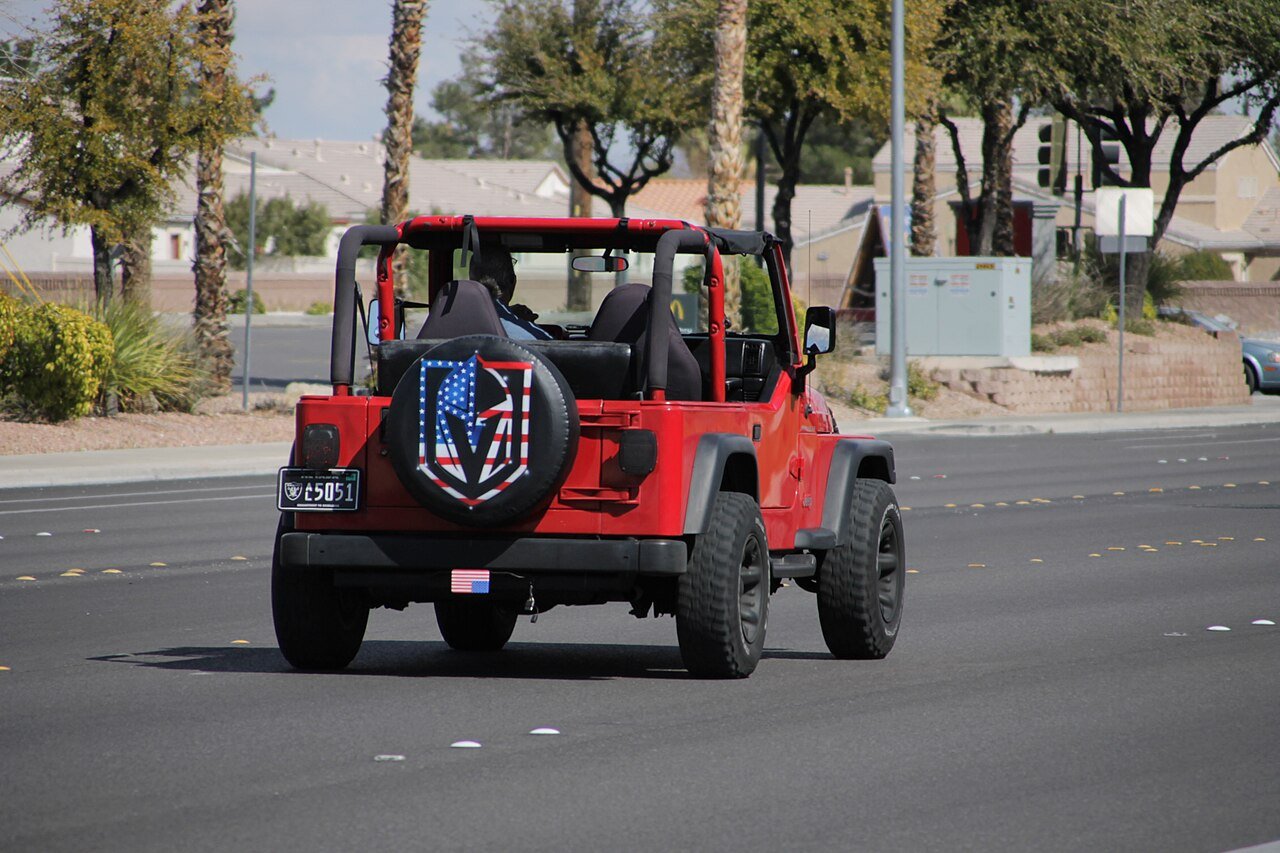
Wrangler Rubicon on 37s: 4.10 axle, stock 285/70R17 (32.71″) → 37″
The classic Jeep scenario. Stock diameter: ((285 × 0.70 × 2) ÷ 25.4) + 17 = 32.71″. Effective ratio on 37s: 4.10 × 32.71 ÷ 37 = 3.62 — an 11.6% drop, the kind that makes first gear feel gone. Cruise RPM at 65 mph falls from 65 × 336.13 × 4.10 ÷ 32.71 = 2,739 to 65 × 336.13 × 4.10 ÷ 37 = 2,421 RPM. To restore stock feel: 4.10 × 37 ÷ 32.71 = 4.64 → buy 4.56 or 4.88 gears.
| Swap | Axle | Effective ratio | 65-mph RPM: before → after |
|---|---|---|---|
| 245/75R16 → 285/50R20 | 3.21 | 3.13 | 2,302 → 2,246 |
| 33″ → 31″ | 3.73 | 3.97 | 2,470 → 2,629 |
| 32.71″ → 37″ | 4.10 | 3.62 | 2,739 → 2,421 |
Stock baselines: what popular trucks start from
The same tire size means very different things depending on what you start with. Here are common factory setups — stock tire with true diameter, typical axle options — and what each one lands on with 35″ tires. These are typical configurations, so always confirm your own axle code and tire size on the door-jamb placard.
| Vehicle | Stock tire (diameter) | Axle options | Effective ratio on 35″ tires |
|---|---|---|---|
| Ford F-150 | 275/65R18 (32.07″) | 3.31 / 3.55 / 3.73 | 3.03 / 3.25 / 3.42 |
| Ram 1500 | 275/65R18 (32.07″) | 3.21 / 3.92 | 2.94 / 3.59 |
| Wrangler JL Sport | 245/75R17 (31.47″) | 3.45 | 3.10 |
| Wrangler Rubicon | 285/70R17 (32.71″) | 4.10 | 3.83 |
The takeaway: on identical 35s, a 3.21 Ram feels like 2.94 gears while a 4.10 Rubicon still feels like 3.83. Same tires, totally different trucks — which is exactly why the effective number, not the sticker number, is the one to plan around. That is the whole point of tracking effective gear ratio instead of the factory axle number.
How to use effective ratio when planning
Your effective gear ratio is the number to plan around — not the axle ratio printed on the sticker. Four jobs it does well:
- Choosing gears for new tires: compute the restore ratio, then buy the nearest ratio your axle offers. Exactness doesn’t matter — landing within ~5% is fine.
- Comparing two trucks: a truck with 4.10s on 35s (effective 3.69) and one with 3.73s on 33s (effective 3.56) will feel surprisingly similar — the effective number, not the door-sticker number, predicts behavior.
- Deciding whether to re-gear at all: changes under ~5% (one tire size up) are barely felt; changes over ~8% transform the truck. Michelin’s guidance treats diameter changes around 2% as negligible and suggests discussing anything over 3% with the vehicle maker.
- Predicting RPM: new RPM = old RPM × (old diameter ÷ new diameter). No calculator needed for a quick sanity check.
Bring the transmission into it: overall effective reduction
The tire-corrected axle ratio is only half the drivetrain. Total multiplication from the engine is transmission gear × axle ratio, and you can tire-correct the whole thing. Example: 1st gear 3.27 × 4.10 axle = 13.41:1 of total reduction. At 20 mph in that gear, engine RPM is 20 × 13.41 × 336.13 ÷ 35 = 2,576 RPM on 35s versus 2,862 RPM on the stock 31.5s — the same ~10% drop the effective-ratio formula predicts, now visible in a real driving gear. This is why the truck feels like it “lost first gear” after big tires: it did, by exactly the tire percentage.
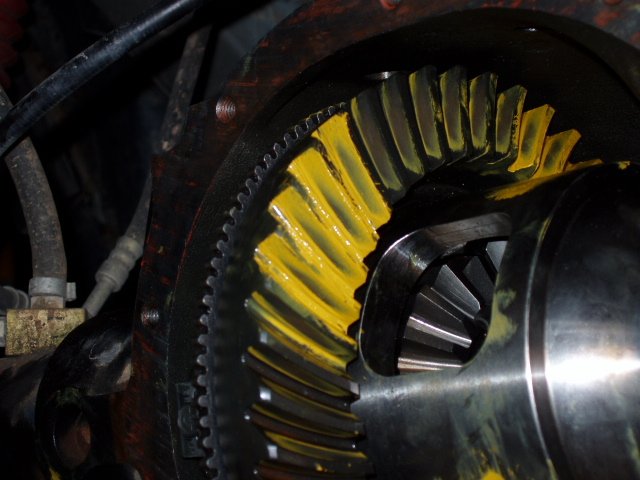
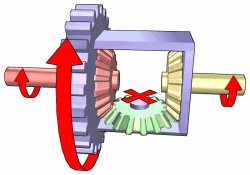
The ring gear and pinion inside the differential are where the axle ratio physically lives — the small pinion drives the much larger ring gear, and the tooth-count difference is the reduction. HowStuffWorks’ differential guide walks through those parts — pinion, ring gear, side gears — with labeled diagrams if you want the full mechanical picture.
Three ways to compute it: formula, percentage, calculator
The formula above is the anchor, but there are three practical ways to get the number:
1. The direct formula — axle × old ÷ new. Exact, and the answer comes out in the unit you actually think in (“my 3.73s feel like 3.48s now”). This is the one to use before spending money on gears.
2. The percentage shortcut — tire diameter and RPM move in lockstep, so a 5% taller tire means roughly 5% lower RPM and 5% less effective ratio. Example: 3.73 gears with tires growing 5% (31.61″ → 33.20″): the exact math gives 3.73 × 31.61 ÷ 33.20 = 3.55, while the shortcut gives 3.73 × 0.95 = 3.54. Close enough for parking-lot debates, not for ordering gears.
3. A calculator — for odd sizes, mixed swaps, or when you want RPM at a specific speed and gear, run the numbers in our tire gear ratio calculator, or double-check your diameters against an independent tire size comparison chart. Use the formula to plan; use the calculator to verify — both roads lead to the same effective gear ratio.
Getting diameters right: the metric formula
Sidewall sizes are nominal — a “35” often measures 34.5″ mounted and loaded — but for planning, the metric formula is exact enough: diameter (inches) = (width mm × aspect ratio × 2 ÷ 25.4) + wheel diameter. A 285/75R17 is (285 × 0.75 × 2 ÷ 25.4) + 17 = 33.83″. Measure your actual tires with a tape for the final answer; advertised sizes run small, especially under vehicle weight.
Effective ratio vs “overall” gear ratio — don’t confuse them
“Effective gear ratio” in the tire context means axle ratio corrected for tire size. Some sources also use it to mean transmission gear × axle ratio (e.g. a 3.27 first gear × 4.10 axle = 13.41:1 of total multiplication). Both are valid — just note which one a chart or calculator means. Our homepage gear ratio calculator shows the full picture: per-gear totals including the axle, on your tire size.
Common effective gear ratio mistakes
Most bad re-gear decisions come from a shaky grasp of what the number actually means — usually one of these:
- Inverting the fraction. Axle × new ÷ old gives the restore ratio — the gears you’d buy to get stock feel back — not the effective ratio. Same numbers, different question. Keep them straight: effective describes what the truck feels like now; restore prescribes the fix.
- Using the wheel diameter instead of the tire diameter. The 17 in 285/75R17 is the rim; the tire’s rolling diameter is 33.83″. It’s the outer diameter that moves the truck down the road.
- Mixing units. Both diameters must be in the same unit — inches with inches, millimeters with millimeters. And don’t treat the nominal size as gospel: a “35” often measures 34.5″ mounted and loaded, so a tape measure beats the sidewall for the final answer.
- Forgetting the speedometer and odometer. They shift by the same percentage as the effective ratio, so your miles and fuel math silently drift until you recalibrate.
- Confusing it with overall reduction. Effective ratio (tire-corrected axle) tells you what the engine feels; transmission gear × axle tells you total multiplication. Both are useful, but they answer different questions — see the comparison section above.
- Assuming any bigger tire “needs” gears. Changes under ~5% are barely felt; that re-gear money is better saved until the effective ratio actually drops you out of the engine’s happy place.
Frequently asked questions
What is the effective gear ratio formula?
Effective ratio = axle ratio × old tire diameter ÷ new tire diameter. Use the true diameters (sidewall size or measured), in the same unit on both sides.
Does effective gear ratio affect my speedometer?
Yes — a speedometer calibrated to the original tires reads low by the same percentage the effective ratio dropped. A 31.6″ → 35″ swap (10.8% diameter change) makes 65 mph indicated read as about 72 mph actual.
Does a lower effective ratio improve MPG?
Not automatically. Lower cruise RPM helps only if the engine stays in its efficient band. Drop too far and the engine lugs, the transmission downshifts constantly, and MPG gets worse — which is why restoring with deeper gears often improves real-world economy.
Is effective ratio the same as final drive ratio?
Close but not identical. Final drive ratio is the mechanical total (transmission gear × axle ratio). Effective gear ratio adjusts the axle part for tire size, telling you how the truck actually behaves on the road.
What is a good effective gear ratio?
There is no universal number — the best target is usually your truck’s stock number, because the engineers tuned the powertrain around it. If you tow heavy, aim a touch shorter (numerically higher) than stock; if you mostly highway-cruise, a touch taller is fine. As a rule of thumb, keep the change within about 5–8% of stock before considering a re-gear.
How do I find my stock axle ratio?
Check the door-jamb sticker for the axle code, the original window sticker, or the small metal tag bolted to the differential cover. The door placard also lists the stock tire size — with those two numbers you can compute the effective ratio for any tire you are considering.
Does a lift kit change my effective gear ratio?
No. A lift alone changes nothing about gearing — only the tire diameter change that usually comes with the lift moves the effective ratio. Same tires at any lift height give the same number.
See also: best gear ratio for 35-inch tires, best gear ratio for 33-inch tires, and the RPM chart by tire size. Run any swap in the tire gear ratio calculator.