

Wondering what your RPM at 70 mph should be? For most modern cars, 1,800–2,500 RPM at a steady 70 mph in top gear is normal. Big V8s and diesels sit lower, small high-revving engines and older gearboxes sit higher — and anything persistently above about 3,000 at 70 in top gear deserves a look. Here is what is normal for your type of vehicle, how to compute your exact number, and what to check if yours reads high.
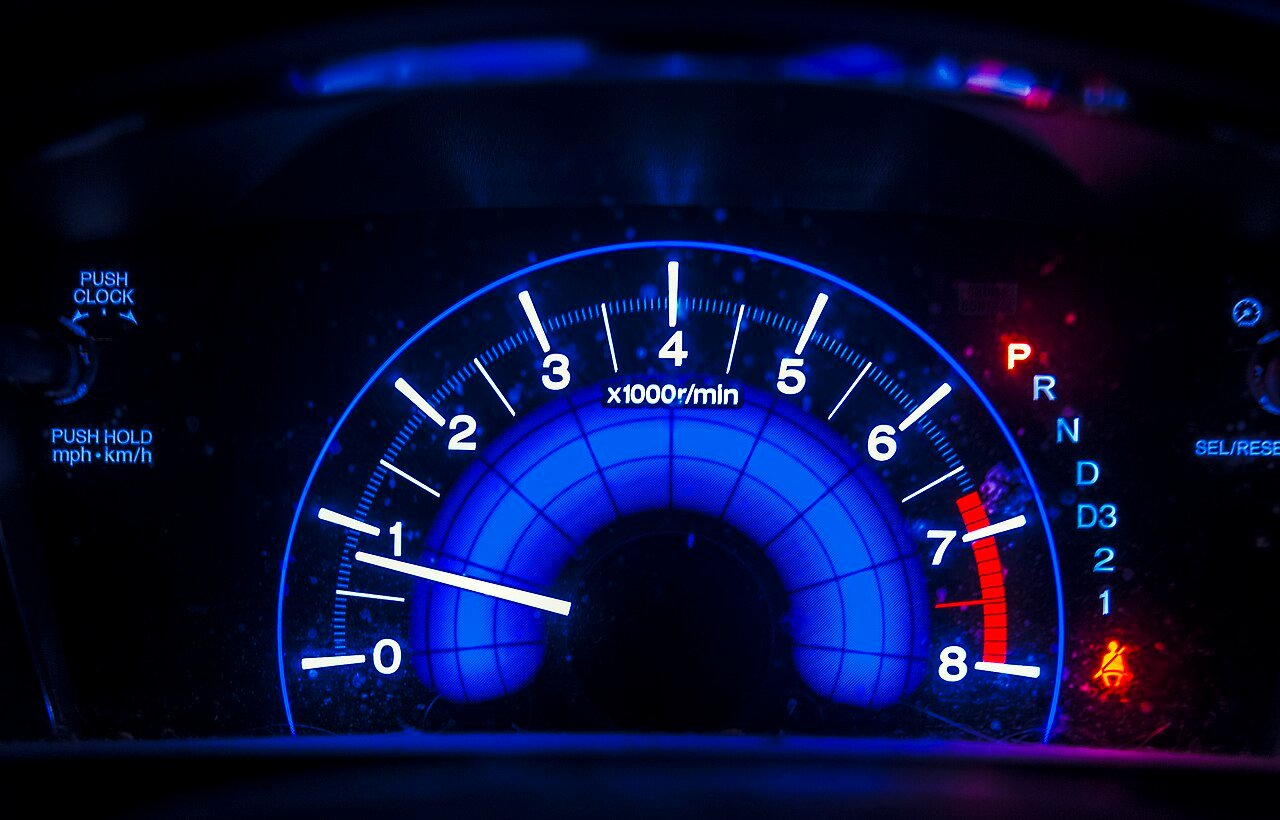
Normal RPM at 70 mph by vehicle type
| Vehicle type | Typical RPM at 70 mph | Why |
|---|---|---|
| Compact sedan (modern) | 1,700–2,200 | Tall overdrive + small efficient engine |
| Midsize sedan / crossover | 1,900–2,400 | Overdrive top gear, mid-size engine |
| Pickup truck / large SUV | 1,800–2,400 | Torquey engine, tall gearing for towing economy |
| Sports car | 2,500–3,500 | Shorter gearing for response, high-revving engine |
| Older 4-speed automatic | 2,600–3,000 | No deep overdrive; 1:1 top gear |
| Diesel (any modern) | 1,500–2,000 | Torque peaks low, gearing matched to it |
How to calculate your RPM at 70 mph
The formula is RPM = (70 × overall gear ratio × 336.13) ÷ tire diameter in inches, where overall ratio = top-gear ratio × axle ratio. The top gear is usually an overdrive gear — a ratio below 1:1, per Wikipedia — which is exactly why it pulls cruise RPM down so far. You need three numbers from your own car, and each one takes about a minute to find:
- Top-gear ratio: check your owner’s manual or the manufacturer’s spec sheet for your exact transmission — look for the tallest gear (5th, 6th, 8th, whatever your top gear is). Typical values run from about 0.85 on an older 5-speed down to 0.60 on a modern 10-speed.
- Axle ratio: look for the axle code on the driver’s door-jamb sticker or your build sheet, then decode it — a quick search for your make plus the code usually does it. Common values: 2.73, 3.08, 3.31, 3.55, 3.73, 4.10.
- Tire diameter in inches: read the size off your sidewall (for example 265/70R17) and convert it to an overall diameter. Tremec’s guide to reading your tire’s sidewall walks through what each number means, and our tire gear ratio calculator does the conversion for you.
Now work it through for a typical midsize sedan — top gear 0.67, axle 3.31, 28-inch tires:
- Overall ratio = 0.67 × 3.31 = 2.2177
- 70 × 2.2177 = 155.239
- 155.239 × 336.13 = 52,181
- 52,181 ÷ 28 = 1,864 RPM
So this car’s RPM at 70 mph is ≈1,864 — right in the sedan band of the table above. Run your own three numbers the same way and you will know your exact cruise RPM instead of guessing.
| Setup | Top gear × axle | Overall | Tire | RPM at 70 |
|---|---|---|---|---|
| Compact sedan, 6-speed auto | 0.67 × 2.79 | 1.869 | 26″ | ~1,690 |
| Midsize sedan | 0.70 × 3.08 | 2.156 | 27″ | ~1,880 |
| Pickup, 6-speed auto | 0.70 × 3.73 | 2.611 | 32″ | ~1,920 |
| Older 4-speed auto | 1.00 × 3.23 | 3.230 | 27″ | ~2,815 |
Check the math on the pickup: 70 × 2.611 × 336.13 = 61,435; divided by 32 = 1,920 RPM. Our RPM calculator does this instantly for any speed — and the gear ratio chart shows cruise RPM across dozens of tire-and-gear combinations at 65 mph.
Quick sanity check that shows why gear selection matters so much: take the same sedan from the step-by-step example but stuck in 4th gear (1.00 × 3.31 = 3.31 overall). The math becomes 70 × 3.31 × 336.13 ÷ 28 = ~2,782 RPM — nearly 1,000 RPM higher than in top gear. That is the difference between relaxed cruising and a buzzy, thirsty highway run, and it is exactly what you feel when an automatic refuses to shift up.
Tire size and your RPM at 70 mph
Tires are the third gear in your drivetrain, and they are the one most people overlook. Hold the gearing fixed — a truck with a 0.70 top gear and a 3.73 axle (2.611 overall) — and watch what tire diameter alone does to cruise RPM at 70:
| Tire diameter | RPM at 70 mph | Change vs 28″ |
|---|---|---|
| 28″ | 2,194 | — |
| 30″ | 2,048 | −146 (−6.7%) |
| 32″ | 1,920 | −274 (−12.5%) |
| 35″ | 1,755 | −439 (−20.0%) |
The working: 70 × 2.611 × 336.13 = 61,435; divide by each diameter (61,435 ÷ 28 = 2,194; ÷ 30 = 2,048; ÷ 32 = 1,920; ÷ 35 = 1,755). The pattern is clean — each added inch of diameter cuts RPM roughly 3–4%, and stepping from stock 28-inch tires to 35s drops cruise RPM a full 20%. For the full story on how sidewall codes translate to diameter, see how tire size codes work (Wikipedia).
Diesel vs gasoline RPM at 70 mph
Diesels cruise noticeably lower — typically 1,500–2,000 RPM at 70 mph — because their torque peaks very low, often between 1,400 and 1,800 RPM, and the gearing is deliberately matched to hold the engine in that fat part of the torque curve. Their redlines sit near 4,000–4,500 RPM, so 1,700 RPM is barely off idle for a diesel.
A gasoline engine, by contrast, usually makes peak torque between 3,500 and 4,500 RPM and revs to 6,000+, so cruising at 1,900–2,400 puts it proportionally in the same relaxed zone. Neither number is “better” — it only matters relative to where your engine is happy. If your diesel is spinning 2,600 at 70, that is high for a diesel even though a gas sports car would call it perfectly normal.
Why is my RPM so high at 70?
- You are not in top gear. The most common cause. Manual drivers sitting in 5th instead of 6th, or an automatic that has not shifted up yet — give it a few seconds of steady throttle.
- The torque converter is not locking up. Older automatics run a few hundred RPM higher until lockup engages; a failing lockup clutch keeps cruise RPM permanently elevated.
- Shorter gears were installed. A re-gear from 3.42 to 4.10 raises cruise RPM by about 20% at every speed — great for towing, loud on the highway.
- Smaller tires than stock. Each inch of lost diameter raises RPM roughly 3–4% at the same speed.
- Load, hills, and headwind. The transmission downshifts under load — a temporary jump is normal and healthy.
- Slipping transmission. If RPM flares without matching acceleration, or cruise RPM has crept up over time with no changes to the car, get it diagnosed — that is not gearing, that is wear.
Common mistakes when reading your RPM at 70 mph
- Reading it cold. Before the transmission warms up, shift points are delayed and the torque converter stays unlocked — the tachometer can read 300–500 RPM higher at 70 than it will after ten minutes of driving.
- Reading it on a grade or in wind. Any load makes the transmission downshift or unlock the converter. Check the number on flat ground at steady throttle.
- Comparing against the wrong tire size. If the chart assumes stock 28-inch tires and you are running 33s, your reading will sit about 15% lower — that is gearing, not a problem.
- Trusting a tired tachometer. Old cable-driven and early electronic tachs drift with age. If the number looks wrong for your gearing, verify it with an OBD-II scanner or a phone app before spending money on the car.
How to lower your cruise RPM
- Make sure you are actually using the tallest gear — learn what overdrive does and when your car engages it.
- Taller axle gears or a slightly taller tire both drop cruise RPM — but budget for a speedometer recalibration after either change.
- Fix lockup and shift issues first; they are cheaper than a gear swap and often the real culprit.
- Do not chase ultra-low RPM blindly: lugging the engine below about 1,500 RPM under load hurts fuel economy and can damage bearings over time.
The gearing side of the equation — what each axle ratio actually means for your driving — is covered in our final drive ratio guide.
How modifications move the number
Every gearing change shifts your 70-mph RPM by a predictable percentage. Re-gearing the axle from 3.42 to 4.10 multiplies cruise RPM by 4.10 ÷ 3.42 = 1.199 — a ~20% jump at every speed, so 2,000 RPM becomes 2,400. Going the other way, swapping 4.10s for 3.55s drops it by 4.10 ÷ 3.55 = 1.155, about 13%. Tires work the same way in reverse: each added inch of diameter cuts RPM roughly 3–4%. A truck moving from 31-inch to 35-inch tires sees about an 11% drop — 2,400 RPM becomes roughly 2,125.
The catch: taller tires or taller gears that drop RPM also dull acceleration by the same percentage, and both changes throw off the speedometer until you recalibrate it. Run any combination through the tire gear ratio calculator to see the effective-ratio change before spending money.
Frequently asked questions
Is 3,000 RPM at 70 mph bad for the engine?
Not mechanically — engines are built to spin far faster. It just costs fuel and noise. If your car did not always do it, though, find out what changed (gear selection, tires, or transmission health).
Does higher RPM always mean worse fuel economy?
At steady cruise, yes, broadly: more revolutions per mile means more friction and pumping losses per mile. But an engine lugging at very low RPM can be less efficient than one spinning freely a few hundred RPM higher.
Why does my RPM jump up on hills at the same speed?
The transmission downshifts to keep the engine in its power band under load. Cruise control holding speed uphill will do this constantly — it is normal behavior, not a fault.
Will bigger tires lower my RPM at 70?
Yes — a taller tire covers more ground per revolution, so the engine turns fewer RPM at the same speed. Expect roughly a 3–4% drop per added inch of diameter, plus a speedometer error you will need to correct.
What should a truck’s RPM at 70 mph be?
Most half-ton pickups cruise at 1,800–2,400 RPM in top gear at highway speed; diesel trucks sit lower at 1,400–1,800. If yours reads 2,600+ empty on flat ground, work through the “why is my RPM high” checklist above — and remember that tow/haul mode deliberately locks out the tallest gears, so only engage it when you are actually towing.
Why is my RPM at 70 mph higher than the chart?
Nine times out of ten it is one of four things: you are not in top gear, the torque converter has not locked up, a previous owner re-geared the truck, or the tires are smaller than stock. The fifth possibility — a slipping transmission — shows up as RPM that has crept up over time with no changes to the vehicle. That one needs a shop, not a chart.
Run your own numbers: the free RPM calculator gives your cruise RPM at any speed from your gearing and tires — no guessing.