

What is overdrive? In short: it is any transmission gear with a ratio below 1:1 — for example 0.70:1 — which means the transmission’s output shaft spins faster than the engine. It has one job: drop your engine RPM at highway speed so you burn less fuel, hear less noise, and wear the engine less. That is the entire story, and everything else on this page is the useful detail.
The definition, precisely
In a direct-drive gear (1:1), the input and output of the transmission turn together. In an overdrive gear like 0.70:1, one turn of the engine produces about 1.43 turns of the driveshaft (1 ÷ 0.70). Because the wheels need fewer engine revolutions per mile, cruise RPM falls in direct proportion. Note the trade: the engine also gets less torque multiplication, which is why overdrive feels lazy when you ask for acceleration — the transmission simply downshifts out of it.
So what is overdrive, precisely? It is a ratio, not a mode or a button. Any gear — in a manual, an automatic, or a CVT’s simulated steps — with a ratio below 1:1 is an overdrive gear, and a car can carry several of them at once. The technical definition on Wikipedia puts it the same way: the output shaft is “over-driven,” turning faster than the input shaft.
The math: what overdrive does to your effective gearing
Your final drive ratio in any gear is transmission gear × axle ratio. Take a 3.73 axle:
- 4th gear (1.00): overall = 1.00 × 3.73 = 3.73
- Overdrive (0.70): overall = 0.70 × 3.73 = 2.61
At 70 mph on 30-inch tires, that is the difference between 2,925 RPM and 2,048 RPM — nearly 900 fewer revolutions every minute, using RPM = (mph × ratio × 336.13) ÷ tire diameter. Try your own combination in the RPM calculator to see the drop.
Ask what is overdrive worth in RPM, and those two numbers are the answer: the same truck, the same axle, the same tires — nearly 900 fewer revolutions every minute at the same road speed, from nothing but a different gear ratio.
A short history
Overdrive started in the 1930s as a bolt-on Borg-Warner unit behind the transmissions of American cars — a separate little gearbox you engaged on the highway. By the 1980s it was built into 4-speed automatics (the TH700R4’s 0.70 fourth gear is the famous one), and today it is simply how the tallest gears of 8- and 10-speed transmissions are cut. The word survives mostly as shorthand for “the tall cruising gears.”
What is overdrive lockup?
Strictly speaking, there is no such thing as “overdrive lockup” — the phrase mashes together two separate mechanisms that drivers constantly confuse. What is overdrive? A gear ratio below 1:1. What is lockup? A clutch inside the torque converter that mechanically links its impeller and turbine, eliminating the 4–6% slip a fluid coupling always has. They do different jobs, and they stack: a 4-speed automatic can be in overdrive and locked up at the same time.
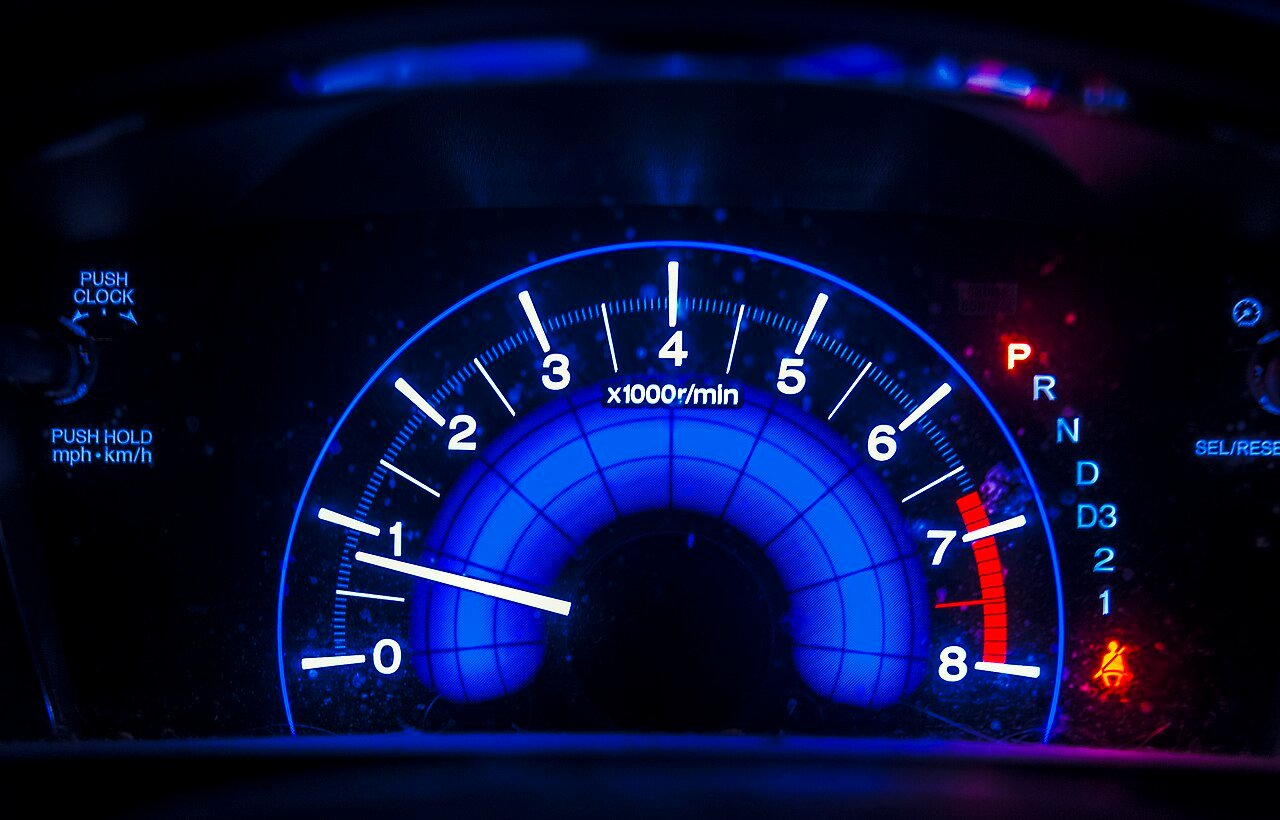
Here is what each mechanism is worth, on the same 3.73 axle and 30-inch tires at 70 mph:
- 3rd gear (1.00), converter unlocked: 2,925 × 1.05 ≈ 3,071 RPM — fluid slip costs about 5%
- Overdrive (0.70), converter unlocked: 2,048 × 1.05 ≈ 2,150 RPM
- Overdrive (0.70), converter locked: 2,048 RPM — slip gone
Of the roughly 1,000 RPM drop from 3,071 to 2,048, about 900 comes from the overdrive gear and 100 from lockup. You can feel lockup engage as a tiny extra RPM dip — 200 to 300 RPM — a few seconds after the last shift, with no change in road speed. If your cruise RPM never settles to the locked-up number, the lockup clutch (or its solenoid) is the suspect, not the gearing. The lock-up torque converter section on Wikipedia explains the mechanism in detail.
When to turn overdrive OFF
Most cars engage overdrive automatically and you should leave it alone. Switch it off (the “O/D OFF” button or tow/haul mode) when:
- Towing or hauling heavy: the transmission “hunts” between overdrive and the next gear, and that constant shifting builds heat — heat kills automatics.
- Steep or rolling hills: same hunting problem; locking out the top gear keeps the engine in its power band.
- The engine is lugging: if it feels like it is shuddering below ~1,500 RPM under load, drop out of overdrive rather than forcing it.
- You want engine braking downhill: a lower gear holds speed without cooking the brakes.
Overdrive in modern multi-speed transmissions
A modern 10-speed automatic may have three overdrive gears (roughly 0.85, 0.69, and 0.64). The concept has not changed — each one trades torque for lower cruise RPM — but the steps are so close together that you never feel the shift. CVTs take it further: with no fixed gears at all, they hold the engine at its most efficient RPM continuously, which is effectively an infinitely variable overdrive. See what your RPM should be at 70 mph to find where your car lands.
What is overdrive in a CVT or EV?
In a CVT there are no fixed gears at all, so the answer to what is overdrive in a CVT is: whatever ratio the computer wants at that moment. At a light highway cruise it holds the engine at its most efficient RPM — the equivalent of a 0.40–0.50 “gear” — which is effectively an infinitely variable overdrive that never needs to shift.
EVs go a step further: most use a single-speed reduction gear (commonly around 8–10:1) with no shifting at all, so there is no overdrive — there is no “drive” gear to be over. The motor simply spins faster as road speed rises. The exceptions prove the rule: the Porsche Taycan and Audi e-tron GT use a two-speed rear gearbox whose tall second gear is, functionally, an overdrive for autobahn cruising.
Overdrive and fuel economy
So what is overdrive actually worth at the pump? Work it from the numbers above. At 70 mph — 1.1667 miles per minute — the engine turns 2,925 ÷ 1.1667 ≈ 2,507 revolutions per mile in direct drive, versus 2,048 ÷ 1.1667 ≈ 1,755 in overdrive. That is 752 fewer revolutions for every mile traveled. Each skipped revolution is one less intake stroke pumping air through the engine and one less trip of the piston rings against the cylinder walls, so friction and pumping losses fall roughly in proportion to the RPM drop.
A common engineering rule of thumb: about 10% lower cruise RPM is worth roughly 3–5% better steady-state highway fuel economy. The 0.70 overdrive above cuts cruise RPM by about 30% (2,925 → 2,048), which suggests a theoretical highway-mpg gain in the high single digits to low teens — before real-world factors like aerodynamics, rolling resistance, and accessory load dilute it.
Put it in dollars: 12,000 highway miles a year at 25 mpg burns 480 gallons; a 10% improvement to 27.5 mpg burns about 436 — 44 gallons saved, or roughly $150 a year at $3.50 a gallon. That is why nearly every modern transmission carries at least one overdrive gear: it is the cheapest efficiency gain in the gearbox.
Same truck, three transmissions: a worked comparison
Watch what successive generations of overdrive gearing did to the same vehicle — a pickup with a 3.73 axle on 30-inch tires at 70 mph. The constant here is 70 × 336.13 ÷ 30 = 784.3, multiplied by each overall ratio:
| Transmission | Top gear × axle | Overall | RPM at 70 mph |
|---|---|---|---|
| 4-speed auto (1980s) | 0.70 × 3.73 | 2.61 | 2,048 |
| 6-speed auto (2000s) | 0.67 × 3.73 | 2.50 | 1,960 |
| 10-speed auto (modern) | 0.64 × 3.73 | 2.39 | 1,872 |
The working: 784.3 × 2.61 = 2,048; × 2.50 = 1,960; × 2.39 = 1,872. Four decades of transmission development bought about 175 RPM at cruise — a modest gain per generation, but it stacks with engine improvements and explains why a new truck sips fuel where an old one gulped it.
Typical overdrive ratios
| Transmission type | Typical top gear | 3.73 axle becomes… |
|---|---|---|
| Old 3-speed auto | 1.00 (no overdrive) | 3.73 |
| 4-speed auto (1980s–2000s) | 0.70 | 2.61 |
| 6-speed auto | 0.67 | 2.50 |
| 8/10-speed auto | 0.65 | 2.42 |
| 6-speed manual | 0.80–0.85 | 2.98–3.17 |
Does overdrive engage automatically?
In virtually every modern automatic, yes — the transmission shifts into its overdrive gear(s) on its own once speed, throttle, and load conditions are right, usually somewhere above 40–50 mph on light throttle. You do not need to do anything, and there is no separate “overdrive mode” to turn on; the O/D OFF button found on some older trucks and SUVs does the opposite of what the name suggests, locking out the top gear rather than engaging it.
In a manual, “engaging overdrive” just means shifting into top gear yourself. Either way, if your cruise RPM at highway speed looks far higher than the normal range for 70 mph, the first thing to check is whether the transmission is actually reaching its tallest gear.
Overdrive vs. a tall final drive — same thing?
Functionally, yes: what matters for cruise RPM is the overall ratio, not where the tallness lives. A 0.70 overdrive with a 3.73 axle (2.61 overall) cruises identically to a 1.00 direct gear with a 2.61 axle.
Manufacturers split the tallness between the gearbox and the axle for packaging, strength, and ratio-spread reasons — the axle still needs short enough gearing for first-gear launch, so the transmission carries the overdrive. This is also why the term has faded: with 8–10 closely spaced gears, engineers just talk about the overall ratio in top gear rather than labeling one gear “the overdrive.”
That fading label is worth remembering: if you ask what is overdrive on a modern spec sheet, you may not find the word at all — engineers simply quote the top-gear overall ratio, and any of the tallest gears sitting below 1:1 is doing overdrive’s job whether it is called that or not.
Frequently asked questions
Is overdrive bad for the engine or transmission?
No — it is the gentlest thing you can do to both. Problems only come from misuse: towing heavy in overdrive, where the constant shifting overheats the transmission.
Should I drive with overdrive on or off?
On, for normal driving — that is how the car was designed to cruise. Off when towing, in hilly terrain, or any time the transmission keeps shifting in and out of the top gear.
Do manual transmissions have overdrive?
Yes. Most 5- and 6-speed manuals have an overdrive top gear (commonly 0.80–0.85). It works exactly the same way; you just select it yourself instead of the computer doing it.
Does overdrive actually save gas?
Yes — measurably. Dropping cruise RPM by 25–30% cuts friction and pumping losses proportionally at steady highway speed, which is why nearly every modern transmission has at least one overdrive gear.
Why does my car hunt in and out of overdrive?
Hunting means the load sits right on the shift threshold: the transmission shifts into overdrive, the engine bogs slightly, load rises, and it shifts back down — sometimes every few seconds on rolling hills.
It is the transmission telling you the engine cannot comfortably hold overdrive at this load, which is also the honest answer to what is overdrive for: steady cruising, not climbing. Switch overdrive off (or use tow/haul mode) and the hunting stops. If it hunts on flat ground at steady speed, check the transmission fluid level and condition first; a tired throttle-position sensor can cause it too.
Can I add overdrive to an old 3-speed?
Yes — the aftermarket solved this decades ago with the bolt-on answer to the question of what is overdrive for in a classic car. A Gear Vendors auxiliary overdrive unit mounts behind a TH350, TH400, TorqueFlite 727, or similar 3-speed and gives you a ~0.78 overdrive ratio — a 22% RPM drop — in every gear, effectively turning a 3-speed into a 6-speed.
The alternatives are swapping to a 4-speed automatic with a built-in overdrive (like the 700R4) or a modern 5/6-speed manual. All three routes need driveshaft and sometimes crossmember work, so budget the installation, not just the unit.
See the difference on your own setup: enter your gears in the free RPM calculator and compare cruise RPM with and without overdrive.
Bottom line: you now know what is overdrive, what it is not, and when to leave it alone — which covers about 95% of what any driver will ever need on the subject.