

Learning how to calculate pulley ratio takes a single division: divide the driven pulley’s diameter by the driver’s, and you know exactly how much the belt drive slows down or speeds up the shaft — the same division gives you the new RPM and the torque change. Here is the formula, five worked examples, and the details that trip people up.
Want the answer now? Our free pulley RPM calculator runs the ratio, output speed, belt speed, and torque from your two pulley sizes.
How to calculate pulley ratio: the one formula
Pulley ratio = driven pulley diameter ÷ driver pulley diameter
The driver is the pulley on the power source (motor, engine). The driven is the pulley being turned (spindle, fan, pump). Because the belt’s linear speed is identical on both pulleys, rotational speed is inversely proportional to diameter — that is the whole formula in one sentence. Once you see it worked through below, you’ll find how to calculate pulley ratio is the easiest ratio math in the shop: a bigger driven pulley means slower output, a bigger driver means faster output.
Worked example 1: slowing down (3:1 reduction)
A 1,750 RPM motor drives a 2-inch motor pulley, belted to a 6-inch machine pulley:
- Ratio = 6 ÷ 2 = 3:1
- Output RPM = 1,750 ÷ 3 = 583 RPM (1750/3 = 583.3)
- Output torque is multiplied by roughly 3× (minus ~3–5% belt-slip and friction loss)
Worked example 2: speeding up
The same 1,750 RPM motor with an 8-inch driver and a 4-inch driven pulley:
- Ratio = 4 ÷ 8 = 0.5:1 — a ratio below 1 means speed increase
- Output RPM = 1,750 ÷ 0.5 = 3,500 RPM
- Torque drops by roughly half — speed is never free; you trade torque for it
From ratio to output RPM (the one line you need)
Output RPM = input RPM × (driver diameter ÷ driven diameter)
This is the same formula rearranged. It also works when you know the ratio you want and need to size a pulley: needed driven diameter = driver diameter × (input RPM ÷ target RPM). Want 1,150 RPM out of a 1,750 RPM motor with a 4-inch driver? 1,750 ÷ 1,150 = 1.52, so the driven pulley must be 4 × 1.52 = 6.1 inches (a stock 6-inch pulley lands at 1,167 RPM — close enough for a fan).
Measure the diameter correctly
The formula wants the pitch diameter — where the belt rides inside the groove — not the outside diameter. For V-belts this sits slightly below the outer edge. Measuring across the outside and ignoring the difference can throw the result off by 2–4%. On toothed (timing) pulleys, count teeth instead and use ratio = driven teeth ÷ driver teeth, which is exact. Our pulley RPM calculator accepts diameters in inches or millimeters plus a belt-slip percentage.
Torque and belt speed
- Output torque = input torque × ratio × efficiency. A 3:1 reduction roughly triples torque. Belt drives typically run 95–98% efficient per stage.
- Belt speed = π × driver diameter × input RPM. For the 2-inch, 1,750 RPM example: 3.1416 × 2 × 1,750 = 10,996 in/min ≈ 917 ft/min. Same belt speed on both pulleys — check: π × 6 × 583.3 = 10,996 ✓.
- Multi-stage drives multiply. Two 3:1 stages in series give 9:1 total; 1,750 RPM in becomes 1,750 ÷ 9 = 194 RPM out.
Common mistakes
- Inverting driver and driven. The most common error when people work out how to calculate pulley ratio — a 3:1 reduction becomes a 0.33:1 overdrive. Always driven ÷ driver (see our gear ratio calculation guide for the same pitfall).
- Mixing units. Inches vs millimeters must be consistent on both pulleys; the ratio itself is unitless.
- Forgetting slip. V-belts slip ~1–3% under load, so real output RPM runs a touch below the math — plan for it on precision work.
- Over-speeding small pulleys. Doubling speed doubles belt centrifugal load; check the pulley’s rated max RPM before a speed-up swap.
Worked example 3: toothed (timing) pulleys
Toothed belts don’t slip, so tooth counts give an exact ratio — no diameter judgment calls. A 28-tooth driver at 1,725 RPM driving an 84-tooth pulley:
- Ratio = 84 ÷ 28 = 3:1
- Output RPM = 1,725 ÷ 3 = 575 RPM — exact, slip-free
- Belt length comes from tooth pitch × tooth count: a belt marked 8M-640, for instance, has 640 ÷ 8 = 80 teeth of 8 mm pitch — match the tooth count and pitch, and the fit is guaranteed
Worked example 4: HVAC fan sizing
A workshop ventilation fan needs about 525 RPM, and you have a standard 1,750 RPM motor with a 3-inch motor pulley. What fan pulley gets you there? Work backward: needed ratio = 1,750 ÷ 525 = 3.333, so the driven pulley must be 3 × 3.333 = 10 inches. Check: ratio = 10 ÷ 3 = 3.33:1, output = 1,750 ÷ 3.333 = 525 RPM exactly. A stock 10-inch V-belt pulley is a standard size, so this is a clean real-world setup with no custom machining.
This is the pattern you’ll use most often whenever you need to know how to calculate pulley ratio for a real machine: motor RPM ÷ target RPM gives the ratio, then multiply by the driver diameter to size the driven pulley.
Worked example 5: drill press speed change
Your drill press runs its 1,725 RPM motor straight to the spindle, and large drill bits chatter — you want about 900 RPM at the chuck. With a 4-inch motor pulley: needed ratio = 1,725 ÷ 900 = 1.917, so the driven pulley must be 4 × 1.917 = 7.67 inches. The closest stock size is an 8-inch pulley, which gives a true 8 ÷ 4 = 2:1 ratio and 1,725 ÷ 2 = 862.5 RPM — close enough for drilling, and torque roughly doubles, which is exactly what big bits want. This is the most practical reason to learn how to calculate pulley ratio: one swapped pulley instead of a new motor.
Wikipedia’s pulley article notes that V-belt step pulleys are the most common way drill presses deliver a range of spindle speeds — the same math, repeated across each step.
V-belt vs timing vs flat belt: does the belt change the math?
The ratio formula never changes — driven ÷ driver — but what you measure depends on the belt type. Here is how to calculate pulley ratio for each of the three common belts:
| Belt type | Measure this | Slip | Best for |
|---|---|---|---|
| V-belt | Pitch diameter (where the belt sits in the groove) | ~1–3% under load | Motors, fans, compressors — the common case |
| Timing (toothed) | Tooth counts: driven teeth ÷ driver teeth | None — exact | CNC machines, engines, indexing drives |
| Flat belt | Outside diameter (belt rides on the crown) | Higher and less predictable under load | Long center distances, vintage line shafts |
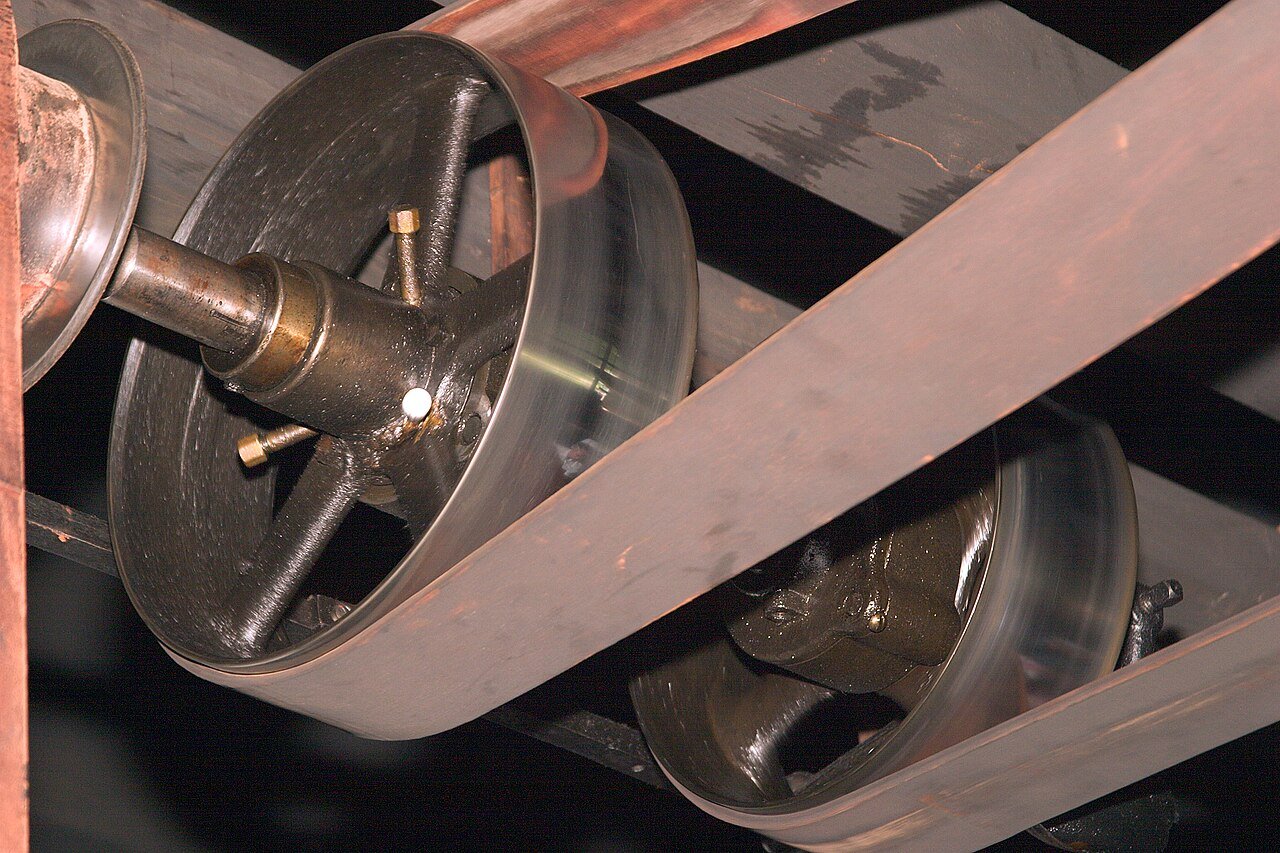
V-belts (the wedge-shaped belts on most motors) ride down inside a groove, so measure the pitch diameter — not the outside edge — and budget a few percent of slip under load.
Timing belts mesh with toothed pulleys, so counting teeth replaces diameter measurement entirely: the ratio is exact and slip is zero, which is why they’re used where position matters.
Flat belts ride on the outer surface of a slightly crowned pulley, so the outside diameter is what counts; slip tends to be higher and less predictable under heavy load than with a V-belt. Wikipedia’s belt drive overview covers the V-belt wedging action, the crowning of flat-belt pulleys, and the no-slip behavior of toothed belts if you want the full engineering treatment.
How to calculate pulley ratio from RPM alone
No calipers handy? If you can measure both shaft speeds with a tachometer, the ratio falls straight out:
Pulley ratio = input RPM ÷ output RPM
A motor spinning 1,750 RPM with the driven shaft turning 583 RPM is running through a 1,750 ÷ 583 = 3:1 reduction — the same 3:1 as the first worked example, with no diameter measurements needed. This is the fastest way to learn how to calculate pulley ratio on an existing machine: measure, divide, done. Then use the measured ratio in the pulley-sizing formula above to order a replacement that matches.
Correcting for belt slip
V-belts lose roughly 1–3% of speed to slip under load. If your 3:1 example above measures 570 RPM instead of the calculated 583, that’s not a wrong formula — that’s ~2.3% slip (583.3 × 0.977 ≈ 570). Either size slightly under your target (aim 2% high), or measure actual RPM with a tachometer and use the measured output in any downstream calculations. To keep slip at the low end of that range, these belt maintenance tips from Gates engineers cover tension, alignment, and installation. Correcting for slip is the last step in how to calculate pulley ratio honestly — the formula gives the ideal, the tachometer gives the truth.
Frequently asked questions
Does belt length affect the pulley ratio?
No. The ratio depends only on the two diameters and the input RPM. Belt length sets the center distance and tension — measure it separately with the formula in our belt length guide.
How do I make the driven pulley spin faster?
Make the driver bigger or the driven smaller — the ratio drops below 1 and output RPM rises. Our guide to changing machine speed with pulleys walks through sizing the swap and the safety checks.
Can I use the same math for chain drives?
Yes — replace diameters with sprocket tooth counts. The ratio and output-RPM formulas are identical to gear ratios.
Why is my real RPM lower than calculated?
Belt slip under load (1–3%) is the usual cause. Toothed belts don’t slip, so measure there with tooth counts instead of diameters.
Does pulley width or an idler pulley change the ratio?
Neither changes the ratio. Pulley width has no effect — only the working diameter counts, so a wide 6-inch pulley and a narrow 6-inch pulley give the same ratio. An idler or tensioner pulley changes belt direction and tension, not speed: it doesn’t enter how to calculate pulley ratio at all, because the ratio depends only on the driver and the final driven pulley. (Idlers do help grip by increasing the wrap angle on small pulleys.)
What if both pulleys are the same size?
You get a 1:1 ratio — input and output turn at the same RPM, which is called direct drive. The pulleys act as a flexible coupling: no speed change, no torque change (just the small belt efficiency loss). To actually change speed, one pulley must be larger than the other.
Now you know how to calculate pulley ratio — run your own numbers in the free pulley RPM calculator: ratio, output RPM, belt speed, and torque, with every formula shown.