

To increase pulley RPM on a workshop machine, swapping pulleys is the cheapest speed control available: no VFD, no new motor — just a different pair of diameters. Whether you want to spin a drill press faster for small bits, slow a lathe for large work, or squeeze more CFM from a fan, the sizing math is one division, and this guide walks through real examples plus the safety checks people skip.
How to increase pulley RPM: the core rule
Every method to increase pulley RPM is an application of one formula:
Output RPM = input RPM × (driver diameter ÷ driven diameter)
- To speed up the driven shaft: make the driver bigger or the driven smaller (ratio drops below 1).
- To slow down: make the driver smaller or the driven bigger (ratio rises above 1).
The lawn-mower world knows this cold: a larger engine pulley or a smaller transmission pulley means more ground speed — and the reverse gives more torque. (New to the underlying math? Our pulley ratio guide covers the formula and output-RPM calculation in detail.)
Worked example 1: speeding up a drill press
Motor: 1,725 RPM with a 3-inch motor pulley, driving a 6-inch spindle pulley → 1,725 × 3/6 = 862.5 RPM at the chuck. You want ~1,700 RPM for small twist drills. Options:
- Swap the spindle pulley 6″ → 3″: 1,725 × 3/3 = 1,725 RPM — doubled.
- Swap the motor pulley 3″ → 6″: 1,725 × 6/6 = 1,725 RPM — same result, but now the small pulley spins twice as fast; check belt speed and balance.
- Split the change 4″ motor + 5″ spindle: 1,725 × 4/5 = 1,380 RPM — a gentler step up.
Small twist drills need high spindle speed, which is exactly why the drill press is the machine most people want to increase pulley RPM on.
Worked example 2: more airflow from a fan
A 1,725 RPM motor with a 4-inch driver and a 6-inch driven pulley gives the fan 1,725 × 4/6 = 1,150 RPM. Swap the driver to 5 inches: 1,725 × 5/6 = 1,437.5 RPM — a 25% speed increase, which means roughly 25% more airflow. Fan power demand rises with the cube of speed though: a 25% speed-up needs roughly 95% more power (1.25³ ≈ 1.95), so the motor works noticeably harder.
If your goal is to increase pulley RPM on a fan or blower, the same math applies — just make sure the motor has the thermal and current margin for the extra load.
Worked example 3: speeding up an air compressor
A 1,725 RPM motor with a 4-inch driver and an 8-inch driven pulley runs the pump at 1,725 × 4/8 = 862.5 RPM. The pump is rated for 1,050 RPM maximum, and you want more CFM. Two candidate swaps:
- Driven pulley 8″ → 7″: 1,725 × 4/7 = 985.7 RPM — a 14.3% speed increase, safely under the pump’s maximum.
- Driver pulley 4″ → 5″: 1,725 × 5/8 = 1,078 RPM — too fast; it exceeds the pump’s 1,050 RPM rating.
This is the key lesson when you increase pulley RPM: always check the driven machine’s rated maximum before choosing pulleys. The math will happily give you speeds the machine cannot survive.
Sizing a swap from a target RPM
Work backwards when you want to increase pulley RPM to hit a specific target: needed driven diameter = driver diameter × (input RPM ÷ target RPM). Want that 1,725 RPM motor to turn a pump at exactly 1,000 RPM with its 3-inch driver? 3 × (1,725/1,000) = 5.18 inches — a stock 5-inch pulley gives 1,035 RPM. Close enough, or nudge the driver down a hair.
What else changes when you swap
- Belt length. Bigger pulleys need a longer belt. Re-run the measurement with our belt length guide before ordering — don’t discover it mid-swap.
- Torque. Speeding up halves your torque margin for the same load. If the machine was already working hard, the motor may stall or overheat.
- Bearing and pulley limits. Small driven pulleys spinning fast have real centrifugal limits — check the pulley’s rated max RPM.
- Multi-step (jackshaft) drives multiply. Two stages of 2:1 give 4:1 total; size each stage with the same formula.
Belt speed: the safety limit on every RPM increase
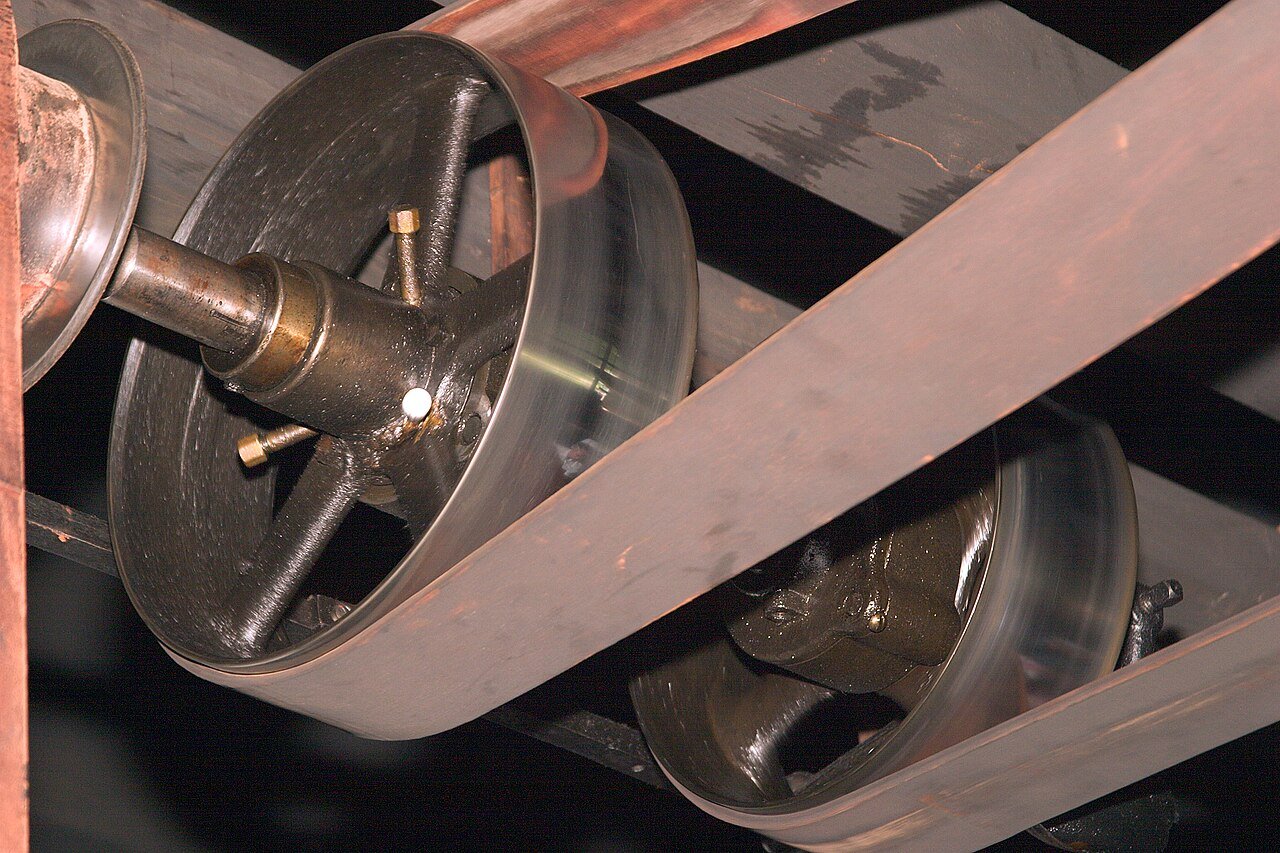
When you increase pulley RPM, the belt itself has a speed limit. Belt speed in feet per minute is π × pulley diameter (inches) × RPM ÷ 12. V-belts are generally limited to about 6,500 ft/min of rim speed — Gates’ Heavy Duty V-Belt Drive Design Manual (PDF) lists 6,500 ft/min as the sheave limit. Past that, centrifugal force starts throwing the belt out of its groove and heat kills it quickly.
Check the fastest pulley in your new setup — usually the small driver on the motor. In the drill-press example, the 6-inch motor pulley at 1,725 RPM runs at π × 6 × 1,725 ÷ 12 ≈ 2,710 ft/min, less than half the limit, so there is plenty of headroom. The compressor’s new 7-inch driven pulley at 986 RPM runs at ≈ 1,806 ft/min — also fine. For quick reference, here is the maximum RPM for common pulley sizes before hitting 6,500 ft/min:
| Pulley diameter | Max RPM at 6,500 ft/min |
|---|---|
| 3″ | 8,276 |
| 4″ | 6,207 |
| 5″ | 4,966 |
| 6″ | 4,138 |
| 8″ | 3,104 |
| 10″ | 2,483 |
The belt is not the only spinning part with a limit. Blade tip speed is the classic second check: tip speed (ft/min) = π × blade diameter (in) × RPM ÷ 12. A 6-inch blade at 3,450 RPM gives π × 6 × 3,450 ÷ 12 ≈ 5,419 ft/min.
Most mower makers cap blade tip speed near 19,000 ft/min — if your pulley swap pushes any rotating part past the machine’s rated speed, the swap is off the table no matter what the belt math says. If you’re unsure which belt type suits the new speed, Wikipedia’s overview of belt drive types covers V-belts, flat belts, and timing belts with their speed ranges.
Step pulleys and variable-speed drives
Not every speed change needs a parts order. Many drill presses and lathes ship with stepped (cone) pulleys: shift the belt to a different step and the ratio changes instantly, using the same driver ÷ driven math — just built into the machine. A machine-shop guide to drill-press speed changes shows the standard procedure: open the cover, release belt tension, move the belt across the steps, re-tension.
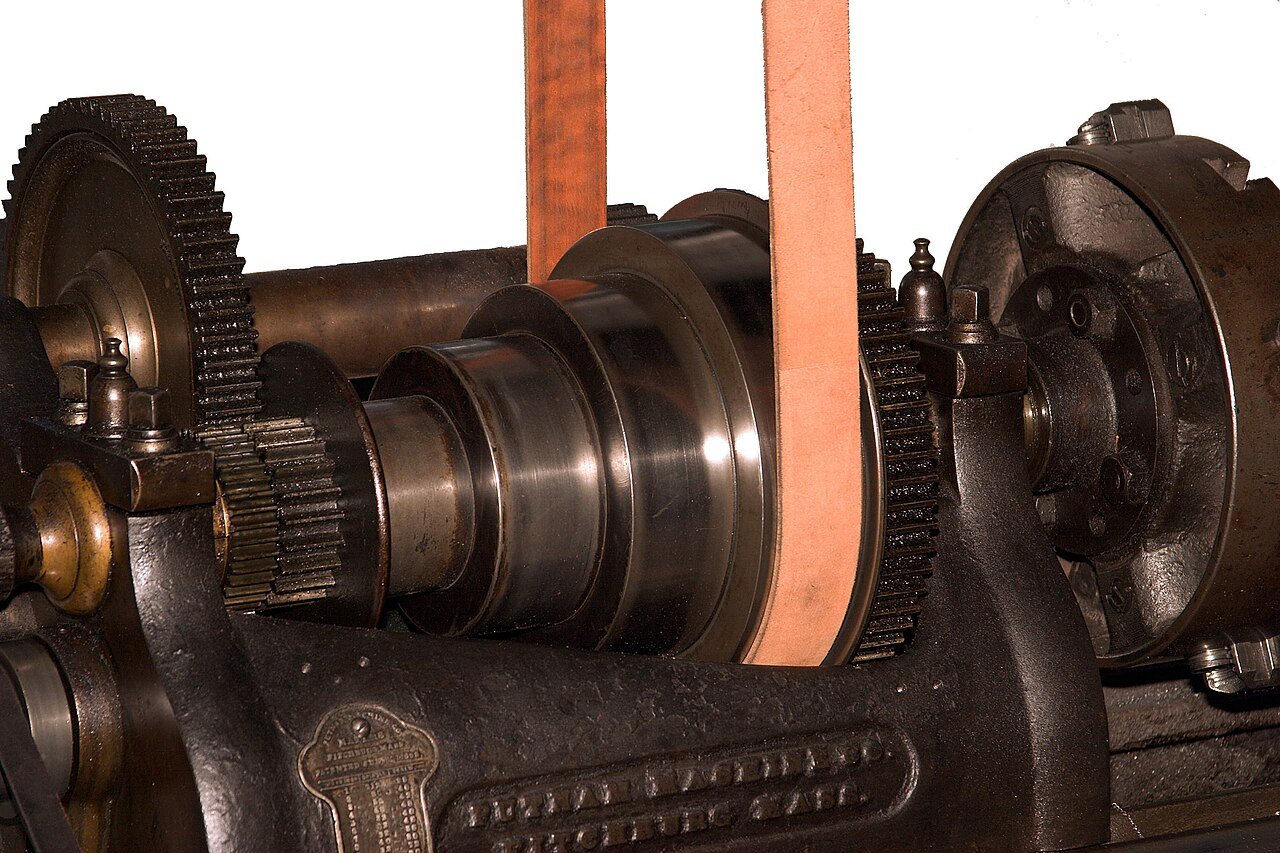
Variable-speed drives go a step further, with spring-loaded pulleys that change effective diameter while the machine runs, giving infinite adjustment between minimum and maximum. If your machine already has stepped or variable pulleys, use them before buying new pulleys — and the swap math in this guide still tells you exactly what RPM each step produces.
Safety checklist
- Refit the guard. Every pulley swap ends with the belt guard back on before power-up.
- Disconnect power (lockout if you have it) before touching the drive.
- Check belt tension and alignment after the swap — misalignment eats belts in days.
- Don’t over-speed the machine. Spindles, arbors, and grinding wheels have rated maximums; exceeding them is how parts fail explosively.
- Watch motor temperature on the first long run after a speed-up — heat is the first warning of overload.
Worked example 4: slowing down a lathe
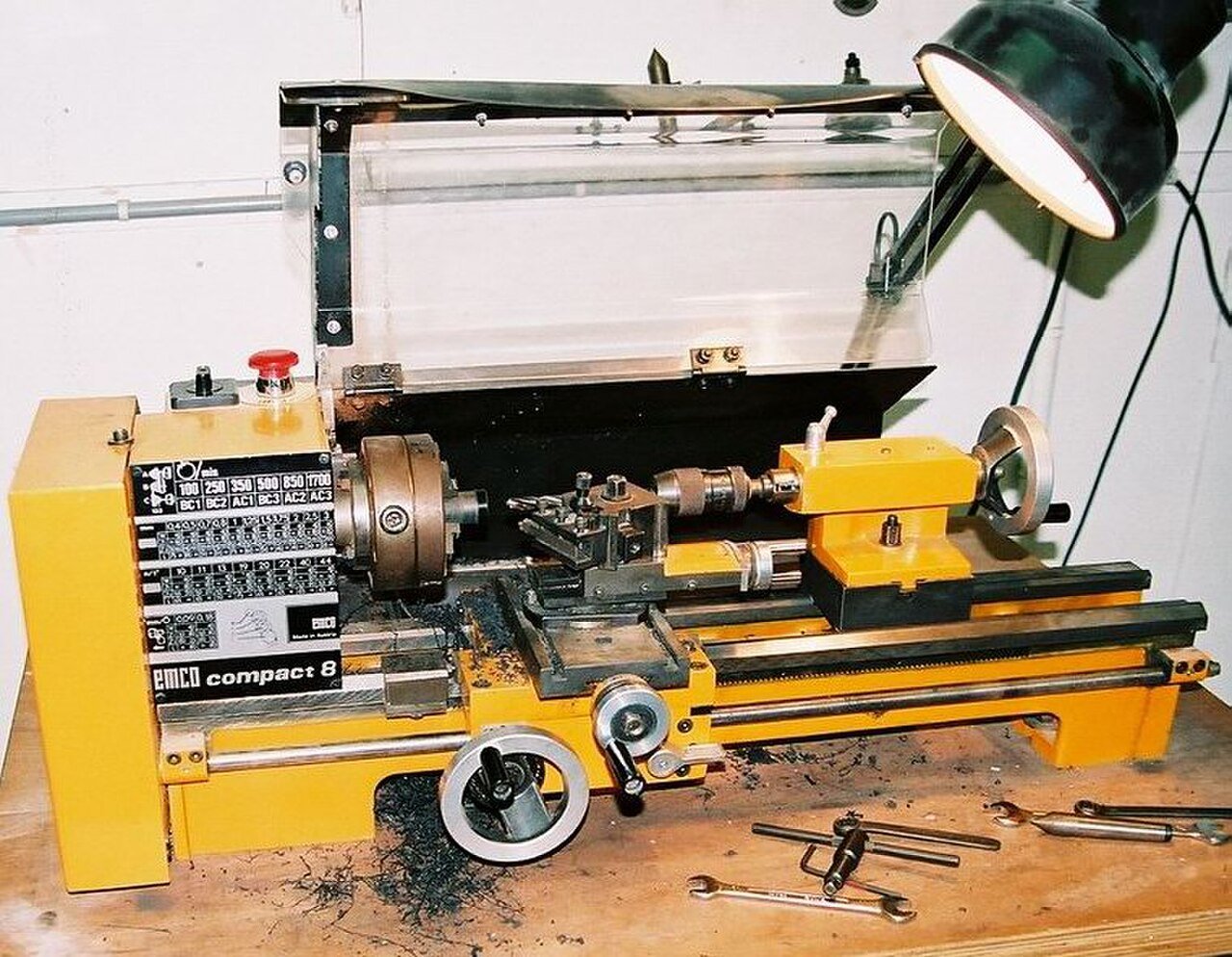
Same 1,725 RPM motor, now with a 2-inch motor pulley driving an 8-inch spindle pulley: 1,725 × 2/8 = 431 RPM at the chuck — perfect for large-diameter work or threading, with torque multiplied roughly 4×. Want ~600 RPM instead? Try a 6-inch spindle pulley: 1,725 × 2/6 = 575 RPM, or a 3-inch motor pulley with the 8-inch spindle: 1,725 × 3/8 = 647 RPM. Small diameter changes on the motor side make fine adjustments easy because the driver side is the sensitive one.
Two-stage speed increases
When you need to increase pulley RPM by a big factor — say 150 RPM up to 2,600 — split it across two belt stages on a jackshaft: one huge single step forces extreme pulley sizes and terrible belt wrap on the small pulley. The rule: total ratio = stage 1 × stage 2. Two 4.16:1 increase stages turn 150 RPM into 150 × 4.16 × 4.16 ≈ 2,596 RPM. Split the gain and both stages stay within sane pulley sizes with good belt contact.
Frequently asked questions
Which pulley do I change to go faster — motor or machine?
Either works: bigger on the motor side or smaller on the machine side both raise output speed. Change whichever side has room and keeps belt geometry sane.
Will a bigger motor pulley overload the motor?
It can, if the load stays the same — the motor delivers more speed but less torque margin. Watch current draw and temperature after any speed-up.
How much speed does one inch buy me?
It depends on the starting ratio: on a 1:1 drive, one inch is a big change; on a 3:1 reduction, much less. Run the exact numbers in our pulley RPM calculator.
Do I need a new belt?
Usually, yes — unless the motor slide can absorb the length change. Measure first with the belt length formula.
How much faster can I safely go?
As fast as the weakest link allows: the driven machine’s rated max RPM, the ~6,500 ft/min V-belt limit, and the motor’s thermal margin must all clear the new speed. In practice, trying to increase pulley RPM by up to ~50% in a single stage is usually fine when every component stays within its rating; past about 2×, split the gain across two stages and re-check belt speed, belt wrap, and torque.
Do I need a different belt type for a big speed-up?
Usually you just need the right length, not a different type — measure with the belt length formula before ordering. But big speed-ups raise belt speed and shrink wrap on the small pulley; if you are near the 6,500 ft/min limit or the small pulley is under about 3 inches, consider a cogged (notched) V-belt, which handles small pulleys and heat better, and confirm the speed rating in the belt maker’s catalog.
Ready to increase pulley RPM? Size any swap in seconds — ratio, RPM, belt data, and safety margins — in the free pulley RPM calculator.