

If you’ve ever wondered how to calculate top speed from gearing alone, here’s the secret most drivers miss: every car has two top speeds. One is pure math: at redline, in top gear, on your exact tire size, the gearing only allows a single speed.
The other is physics: air resistance climbs so steeply that most cars run out of power long before they run out of gears. Here is how to calculate the gear-limited number in under a minute — and how to figure out which ceiling you will actually hit.
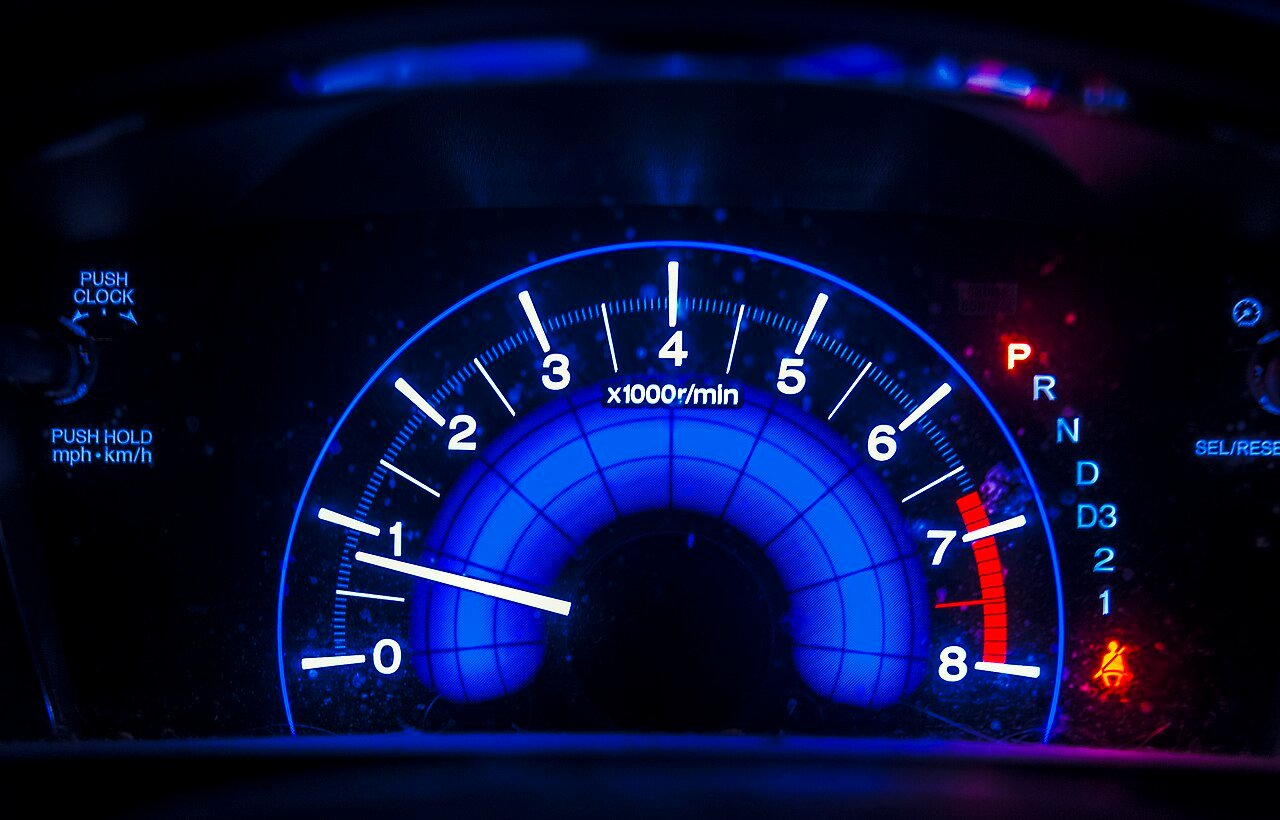
How to calculate top speed: the gear-limited formula
Your top speed from gearing is just the RPM-to-speed equation run at redline:
Top speed (mph) = (redline RPM × tire diameter in inches) ÷ (overall gear ratio × 336.13)
Where overall gear ratio = top-gear transmission ratio × axle ratio. The 336.13 is a unit constant that folds the inches-per-mile and minutes-per-hour conversions into one number. If you want the full derivation with examples at every RPM, our RPM calculator runs it both ways — RPM from speed, or speed from RPM.
Worked example
Take a sports sedan: redline 6,500 RPM, 6th gear 0.85, axle ratio 3.42, tires 27 inches tall.
- Overall ratio = 0.85 × 3.42 = 2.907
- Top speed = (6,500 × 27) ÷ (2.907 × 336.13) = 175,500 ÷ 977.14 = 179.6 mph
So the gearing allows roughly 180 mph — if the engine can actually pull 6,500 RPM in 6th gear. For most cars, that “if” is doing a lot of work, as we will see below. And that three-line calculation is the whole skill — once you’ve done it for one car, you know how to calculate top speed for any of them.
How to calculate top speed: three more worked examples
The method is identical for every vehicle: multiply redline RPM by tire diameter, divide by 336.13 times the overall ratio, and sanity-check the result. Watch how different the answers get.

Sports car
Redline 6,800 RPM, 6th gear 0.74, axle ratio 3.42, tires 27 inches tall:
- Overall ratio = 0.74 × 3.42 = 2.5308
- Top speed = (6,800 × 27) ÷ (2.5308 × 336.13) = 183,600 ÷ 850.68 = 215.8 mph — call it 216 mph
A tall overdrive (0.74) is what stretches this car past 200 mph on paper, even with the same axle and tire size as the sedan above.
Full-size pickup
Redline 5,800 RPM, 5th gear 0.75, axle ratio 3.73, tires 31 inches tall:
- Overall ratio = 0.75 × 3.73 = 2.7975
- Top speed = (5,800 × 31) ÷ (2.7975 × 336.13) = 179,800 ÷ 940.32 = 191.2 mph
Notice the pickup’s gearing “allows” 191 mph — a number it will never see. That gap is exactly why the drag section below matters.
Sport motorcycle
Redline 13,000 RPM, combined top-gear ratio 4.20, rear tire 24 inches tall:
- Top speed = (13,000 × 24) ÷ (4.20 × 336.13) = 312,000 ÷ 1,411.75 = 221.0 mph
Bikes spin far higher redlines but run much shorter overall gearing — the two effects nearly cancel, landing superbikes in the same 200+ mph territory as supercars.
Top speed scenarios
The same four inputs answer how to calculate top speed for almost anything with wheels:
| Vehicle | Redline RPM | Top gear × axle | Overall | Tire | Gear-limited top speed |
|---|---|---|---|---|---|
| Sports sedan | 6,500 | 0.85 × 3.42 | 2.907 | 27″ | 180 mph |
| Pickup truck | 5,500 | 1.00 × 4.10 | 4.100 | 33″ | 132 mph |
| Muscle car | 6,200 | 0.67 × 3.73 | 2.499 | 28″ | 207 mph |
| Sport motorcycle | 12,000 | 4.00 (combined) | 24″ | 214 mph | |
Notice the muscle car: 207 mph on paper. In reality it will never get there — which brings us to the second ceiling.
Gear-limited vs real-world top speed
Once you know how to calculate top speed on paper, the interesting question is how close the real car gets to that number. The table below lines up the gear-limited math against what these vehicles typically manage in the real world.
| Vehicle | Gear-limited | Typical real top speed | What holds it back |
|---|---|---|---|
| Sports car (example above) | 216 mph | ~190 mph | Drag; tire speed rating |
| Sports sedan | 180 mph | ~155 mph | Electronic governor |
| Muscle car | 207 mph | ~180 mph | Drag (power vs. cube law) |
| Sport motorcycle | 221 mph | ~186 mph | Manufacturer speed agreement |
| Full-size pickup | 191 mph | ~110 mph | Aerodynamics; governor |
This gap is the drag equation at work: aerodynamic drag rises with the square of speed, so the power needed to push through it rises with the cube — Wikipedia’s article on drag walks through the full derivation. The gear-limited number is the ceiling; drag, limiters, and tires decide how far below it you land.
Tire speed ratings deserve special attention here: a tire rated H (130 mph) or V (149 mph) makes any gear-limited number above that irrelevant, because exceeding the rating risks a blowout. Always check the rating molded into your sidewall before chasing a theoretical top speed.

Why your real top speed is usually lower (the drag limit)
Aerodynamic drag grows with the square of speed, and the power needed to overcome it grows with the cube. Roughly speaking, doubling your speed takes eight times the horsepower. That is why a 400-hp car that is gear-limited to 200 mph might actually top out around 170 — it simply cannot push enough air past 170 to use the remaining gears.
Practical takeaway: your real top speed is whichever ceiling is lower — the gear-limited number from the formula above, or the speed where your engine’s power equals the drag. Shorter gears (numerically higher axle ratios) lower the gear ceiling but get you to your real top speed faster; taller gears raise the theoretical ceiling but may leave the car unable to pull redline in top gear at all. Knowing how to calculate top speed on paper is step one; knowing which ceiling applies to your car is the real skill.
Which gear should you use in the formula?
Not always the tallest one. Use the gear the car can genuinely pull near redline. Many cars are drag-limited in their tallest overdrive — the engine physically cannot reach redline there, so the “top speed” of that gear is a fiction. The honest calculation uses the tallest gear in which the car can still approach redline, which for many performance cars is the second-tallest gear. This is the step most people skip when they learn how to calculate top speed — and it’s the one that decides whether the answer is real.
What changing gears or tires does to top speed
- Shorter axle gears (e.g. 3.42 → 4.10): gear-limited top speed drops by the same percentage (about 17% here), but acceleration sharpens everywhere.
- Taller tires: raise the gear-limited top speed roughly in proportion to the diameter change — but they also make every gear harder to pull, so the drag ceiling often wins anyway.
- Rev limiter vs speed limiter: the rev limiter caps RPM (which caps the gear-limited speed); many cars also carry an electronic speed governor, often set around 130–155 mph to match the factory tire speed rating. Neither can be “calculated around” — the governor wins.
For the theory behind the ratio itself, see our guide on how to calculate gear ratio, and for the RPM your setup holds at normal highway speeds, the gear ratio chart lays it out tire by tire.
The underlying tradeoff is mechanical advantage: shorter gears multiply torque at the wheels (better acceleration) at the cost of wheel speed per engine RPM, while taller gears do the reverse. Every how to calculate top speed result is just this tradeoff expressed as a single number.
Common mistakes when working out top speed
The formula is simple, but small input errors are the reason most first attempts to figure out how to calculate top speed produce nonsense numbers. Check yours against these:
- Using the sidewall math instead of the measured tire: a “31-inch” tire is rarely exactly 31 inches tall once mounted and loaded. Measure the true rolling diameter — a one-inch error moves the answer by 3–4%.
- Forgetting the overdrive: if your top gear is an overdrive (any ratio below 1.00, like 0.74), using 1.00 instead inflates the answer by 25–35%. HowStuffWorks’ guide to how gears work explains why overdrive ratios look so different from direct drive.
- Using the tallest gear instead of the tallest pullable gear: covered above, but it bears repeating — a gear the engine can’t pull to redline gives a fictional top speed.
- Ignoring the speed governor: many cars are electronically capped around 130–155 mph to match the factory tire speed rating. No formula beats the governor.
- Mixing up units: tire diameter must be in inches and the answer comes out in mph. If you want km/h, convert at the end (× 1.609).
Formula vs calculator vs GPS: three ways to check your number
The hand formula, a purpose-built calculator, and GPS data are the three honest ways to answer how to calculate top speed — and they should all agree within a few percent.
- Hand formula: fastest for understanding, and the only one that shows why the number is what it is. Do it once on paper so the relationship between gears, tires, and RPM clicks.
- RPM calculator: best for “what if” experiments — try a different axle ratio or tire size in seconds on our RPM calculator.
- GPS run: the only one that measures the real, drag-limited top speed. A phone GPS on a closed course or track day settles every argument about which ceiling you actually hit.
A quick sanity check on your result
Before trusting the number, run it past common sense. If the gear-limited top speed comes out lower than speeds you already reach comfortably, something is off in your inputs — usually the tire diameter (use the true measured height, not just the sidewall code) or the top-gear ratio (many drivers forget the overdrive and use 1.00). If it comes out wildly higher than the car’s rated top speed, that is normal: it just means drag, not gearing, is your real ceiling, and the car will stop accelerating when power runs out, well short of redline. If your number passes both tests, you’ve learned how to calculate top speed the way engineers sanity-check it.
Frequently asked questions
Can my car actually reach its gear-limited top speed?
Only if it has the power to overcome drag at that speed — most street cars do not. The formula gives the absolute ceiling; drag, limiters, and tire ratings decide where you land below it.
Does a bigger tire increase top speed?
On paper, yes: a taller tire raises the gear-limited number in direct proportion to the diameter change. In practice the car may struggle to pull the taller gearing, and the speedometer and odometer will read wrong until recalibrated.
Why do manufacturers gear cars faster than they can actually go?
For economy and emissions, not speed: a tall top gear lets the engine loaf at 1,800 RPM on the highway even though the gear could theoretically do 200 mph at redline.
How do I calculate top speed in km/h?
Run the same formula, then multiply the mph result by 1.609. A gear-limited 180 mph is 290 km/h.
What’s the fastest way to learn how to calculate top speed by hand?
Memorize the formula and run it for your own car twice — once in top gear, once in the next gear down. After two repetitions you won’t need to look it up, and the RPM calculator is there to double-check your arithmetic.
Does more horsepower raise top speed?
Yes, but inefficiently. Because the power needed to fight drag rises with the cube of speed, roughly eight times the power is needed to double top speed. That’s why a 700-hp supercar is only about 20% faster flat-out than a 400-hp sports car, not 75% faster.
Want the exact number for your setup? Plug your redline, top gear, axle ratio, and tire size into the free RPM calculator — it gives speed at any RPM, or work it from the gear ratio calculator homepage.