

The best gear ratio for towing matters more than your horsepower number. Towing is the one job where the axle ratio decides whether the engine stays in its torque band and the transmission holds gear — or whether every hill becomes a screaming, downshifting ordeal. Get the gears right and a heavy trailer pulls without drama; get them wrong and no amount of horsepower saves the trip.
The fast answer: for regular towing, numerically higher gears win — 3.73 or 4.10 on most modern half-tons and HD trucks. A 3.42 or 3.21 is an economy choice that only suits light, occasional towing on flat ground. Whichever way you go, the best gear ratio for towing is the one that keeps the engine in its band with the trailer on — not the one that wins the empty-highway MPG test.
Why towers want numerically higher gears
Four reasons, all mechanical — together they explain how to find the best gear ratio for towing for any truck:
- Torque multiplication. A 4.10 axle multiplies engine torque ~10% more than a 3.73 (4.10 ÷ 3.73 = 1.099). That shows up exactly where towing hurts: launching the load and holding speed on grades.
- Power-band placement. Towing needs the engine spinning where torque lives — typically 2,000–3,000 RPM for gas V8s, 1,600–2,200 for diesels. Taller gears put cruise RPM right there under load instead of lugging below it.
- No gear hunting. Marginal gearing makes the transmission downshift on every overpass; each shift is heat and wear. Proper gears let it hold top gear.
- Cooling. An engine lugging at low RPM under heavy load runs hotter and works harder than one spinning freely in its band.
Torque at the wheels: how the best gear ratio for towing multiplies power
An axle ratio is a torque multiplier, not just a speed number. Your engine’s torque goes through the transmission, then gets multiplied by the axle ratio before it reaches the wheels. Say your V8 makes 400 lb-ft at the crank: with 3.73 gears the axles see 400 × 3.73 = 1,492 lb-ft in a 1:1 gear; with 4.10 gears they see 400 × 4.10 = 1,640 lb-ft — 148 lb-ft more, the same ~10% jump as the ratio itself.
Launch is where it shows most. In first gear the transmission multiplies too: 400 lb-ft × 4.70 (first gear) × 4.10 (axle) = 7,708 lb-ft at the axles, versus 7,012 lb-ft with 3.73s — nearly 700 lb-ft of extra shove to get a loaded trailer rolling. A diesel example is even more dramatic: 900 lb-ft × 4.10 = 3,690 lb-ft at the axles, versus 3,357 with 3.73s.
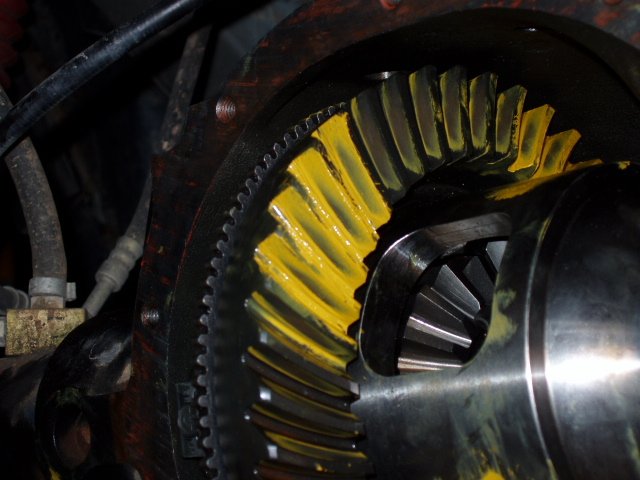
The multiplication happens inside the differential, where the small pinion gear drives the large ring gear — the tooth-count difference between the two is the axle ratio. Wikipedia’s page on how differentials work walks through the mechanics in more depth. And as HowStuffWorks explains, the final drive ratio has a multiplicative effect with every transmission gear — which is why the axle ratio, more than any single transmission gear, sets a truck’s character under load.
Worked comparison: 3.42 vs 3.73 vs 4.10 at 65 mph
Cruise RPM = 65 × ratio × 336.13 ÷ tire diameter. On 33″ tires, in a 1:1 gear (and in 0.70 overdrive):
| Axle ratio | RPM @ 65 (1:1) | RPM @ 65 (0.70 OD) | Towing verdict |
|---|---|---|---|
| 3.42 | 2,264 | 1,585 | Light trailers only; hunts on hills |
| 3.73 | 2,470 | 1,729 | The all-round tow choice |
| 4.10 | 2,715 | 1,900 | Heavy trailers, grades, big tires |
Math check: 65 × 3.73 = 242.45 × 336.13 = 81,506 ÷ 33 = 2,470 RPM. The 4.10 spins about 245 RPM faster than the 3.73 at the same speed — that’s the entire difference, and it’s exactly what keeps a loaded truck from dropping out of its power band. Model your own tires and transmission in the axle ratio calculator.
On 35″ tires, every number drops — which is exactly why tall tires and towing mix so poorly:
| Axle ratio | RPM @ 65 (1:1) | RPM @ 65 (0.70 OD) | Towing verdict |
|---|---|---|---|
| 3.73 | 2,328 | 1,630 | Loses ~140 RPM vs stock — hunts on grades |
| 4.10 | 2,559 | 1,792 | Restores near-stock feel |
| 4.30 | 2,684 | 1,879 | The sweet spot for 35s towing |
| 4.56 | 2,847 | 1,993 | Heavy trailers, severe grades |
Math check: 65 × 336.13 × 4.56 ÷ 35 = 2,847 RPM. Compare that with 3.73 on 35s (2,328 RPM): the 4.56 puts 519 more RPM in the band, exactly where a heavy trailer needs it.
Gas vs diesel: your engine decides the target RPM
A gas V8 makes peak torque around 2,000–3,000 RPM; a diesel makes it at 1,600–2,200. That one fact decides the best gear ratio for towing for each engine.
Look at the overdrive row in the table: with 4.10 gears on 33″ tires, top-gear cruise at 65 mph is 1,900 RPM — squarely in a diesel’s happy zone, but below a gas V8’s. The diesel holds the gear and pulls; the gas engine downshifts until it finds its torque, landing around 2,100–2,500 RPM (for example, 2,470 × 0.85 = 2,100 in the next gear down).
This is why diesels tow so well on seemingly tall gears: a diesel with 3.73s cruising at 1,729 RPM in overdrive is already in its power band, while the same ratio on a gas V8 means constant downshifts the moment a grade appears. If you drive a gas truck, treat 4.10 as your towing default; if it’s a diesel, 3.73 is often the sweet spot and 4.10 is reserved for the heaviest fifth wheels.
Match the ratio to the trailer
Start with the trailer, not the truck — the table below is the fastest route to the best gear ratio for towing for your setup:
| Trailer weight | Recommended axle ratio | Why |
|---|---|---|
| Under 3,500 lb (utility, small boat) | 3.42–3.73 | Load is modest; economy still matters |
| 3,500–7,500 lb (camper, car hauler) | 3.73 | Best balance of pull and daily economy |
| 7,500–12,000 lb (big camper, equipment) | 4.10 | Holds speed on grades, better launch |
| 12,000 lb+ / severe grades / 35″+ tires | 4.30–4.56 | Restores gearing the tires stole |
Real-world proof of the spread: one popular half-ton is rated to tow 8,440 lb with 3.21 gears — and 11,540 lb with 3.92 gears. Same truck, same engine; the gears alone are worth over 3,000 lb of rating.
The best gear ratio for towing: 5 proven truck-and-trailer setups
Here are five combos that show what the best gear ratio for towing looks like in real-world rigs:
- Daily driver + utility trailer (under 3,500 lb): 3.42–3.73. The load is light enough that economy still wins.
- Half-ton + travel trailer (3,500–7,500 lb): 3.73. The all-rounder — holds grades, sips fuel when empty.
- HD gas V8 + fifth wheel (7,500–12,000 lb): 4.10. The launch torque and grade-holding justify the extra cruise RPM.
- Diesel + gooseneck over 12,000 lb: 4.10–4.30. Lets the diesel’s low-RPM torque do the work without lugging.
- Lifted truck on 35″+ tires towing anything: 4.30–4.56. Re-gear to restore — or beat — the stock-equivalent ratio.
What the big three ship with
| Truck | Standard ratio | Tow-friendly ratio | Notes |
|---|---|---|---|
| Ford F-150 | 3.31–3.55 | 3.73 | The highest standard ratio; required for max tow ratings on most configurations |
| Chevrolet Silverado 1500 | 3.23 | 3.42 (Max Trailering); 3.73 on the diesel | 5.3L and 6.2L V8s run 3.23; the Max Trailering package adds 3.42 |
| Ram 1500 | 3.21 | 3.92 | Max-tow builds use the 3.92 |
The pattern is identical across brands: the economy ratio ships standard, and the factory puts the numerically higher ratio in the max-tow package. Those factory choices reveal what the best gear ratio for towing looks like at the top of each lineup. Ford’s official RV & Trailer Towing Guide publishes every configuration’s rating by axle ratio — check it before ordering a truck.
The 3.73 vs 4.10 decision
This is the classic towing dilemma. Choose 3.73 if the truck is a daily driver that tows a few times a month — you’ll appreciate the quieter cruise and better empty mileage. Choose 4.10 if towing is weekly, the trailer is heavy, you live in hills, or you’re running oversized tires. The fuel penalty of 4.10 is real but small (a few percent); the towing confidence difference is large. For the full head-to-head, see 3.73 vs 4.10 gears compared. For most owners, this single choice is the best gear ratio for towing decision — everything else is fine-tuning.
5 common towing-gear mistakes
- Sizing gears for empty cruising. The sticker MPG you see daily is earned by the ratio you’ll regret on the first mountain pass with a trailer. Size gears for the loaded trip; the few-percent empty-MPG cost of 4.10 is cheaper than a transmission rebuild.
- Re-gearing only the rear on a 4×4. Even one tooth of difference between front and rear ratios destroys the transfer case. Both axles, always.
- Skipping the break-in. New ring-and-pinion sets need roughly 500 gentle miles to seat the tooth pattern. Hammering a fresh set with a trailer on day one overheats and pits the gears.
- Choosing gears before choosing tires. Buying 3.73s and then adding 35″ tires six months later undoes the whole purchase (see the table above). Pick your final tire size first, then the ratio.
- Reading the max-tow number alone. A truck’s advertised tow rating assumes a specific engine, cab, drivetrain, and axle code. Your door sticker’s axle code is the only number that applies to your truck.
Bigger tires + towing = re-gear
Taller tires lengthen your effective gearing: a truck with 3.73 gears on 35″ tires pulls like it has roughly 3.30 gears (3.73 × 31 ÷ 35, assuming 31″ stock). That’s a towing disaster hiding inside a cool look. The fix: pick the ratio that restores your stock-equivalent gearing — or one step numerically higher for the towing margin. The tire gear ratio calculator computes the exact restore ratio and the nearest gear sets you can buy, and the gear ratio chart shows the cruise RPM for every combination.
A quick restore example: stock 3.42 gears with 31″ tires, moving to 35s. The restore ratio is 3.42 × 35 ÷ 31 = 3.86 — and since nobody sells 3.86s, you buy 4.10s. That’s one step numerically higher than stock-equivalent, which is exactly the towing margin you want. When tires enter the picture, the best gear ratio for towing is simply the ratio that restores what the tires took away.
Frequently asked questions
Is 3.73 good for towing?
Yes — it’s the sweet spot for most half-ton and HD trucks towing up to ~7,500 lb. Strong enough to hold grades without constant downshifting, tall enough to stay economical when empty.
Will 4.10 gears hurt my fuel economy?
A little. The engine spins ~10% faster than with 3.73 at the same speed, which costs a few percent in MPG. With a modern overdrive transmission the penalty is smaller than it used to be — and it vanishes as a concern the moment a trailer is attached, because the 3.73 truck burns extra fuel downshifting.
Can I tow heavy with 3.21 or 3.42 gears?
Light and occasional, on flat ground — yes. Regular heavy towing with tall gears overheats transmissions, lugs the engine, and in some cases exceeds what the manufacturer rates the combination for. Check your door sticker’s tow rating for your exact axle code.
Do I need to re-gear both axles on a 4×4?
Yes — front and rear must match exactly. Mismatched ratios in 4WD cause driveline bind that can destroy the transfer case. Budget for both diffs when pricing a re-gear.
What is the best gear ratio for towing with a diesel?
For most diesels, the best gear ratio for towing is 3.73 — the lower torque band (1,600–2,200 RPM) means a diesel holds overdrive where a gas engine would downshift. Move to 4.10 for fifth wheels over ~12,000 lb or severe grades. Even 3.42 works on a diesel for moderate trailers under ~10,000 lb on flat ground.
Does a 10-speed overdrive change which ratio I need?
It softens the penalty of numerically higher gears but doesn’t remove the choice. A 4.10 axle with a 0.70 overdrive acts like a 2.87 final ratio at cruise (4.10 × 0.70 = 2.87), which is why modern trucks run 4.10s without the old highway-MPG pain. The towing work still happens in the direct gears, though — and there, the extra torque multiplication of 4.10 is fully felt.
Run your truck’s exact numbers — tires, transmission, trailer plans — in the free axle ratio calculator and see your towing RPM before you buy gears.