

The best gear ratio for drag racing is the one that puts your engine at peak-power RPM just as you cross the finish line — in the gear you’ll finish in, with no extra shift in the last 100 feet. Gear for that, and the car spends the whole quarter in its strongest RPM band. Gear wrong, and you either run out of revs early or never reach your power peak at all.
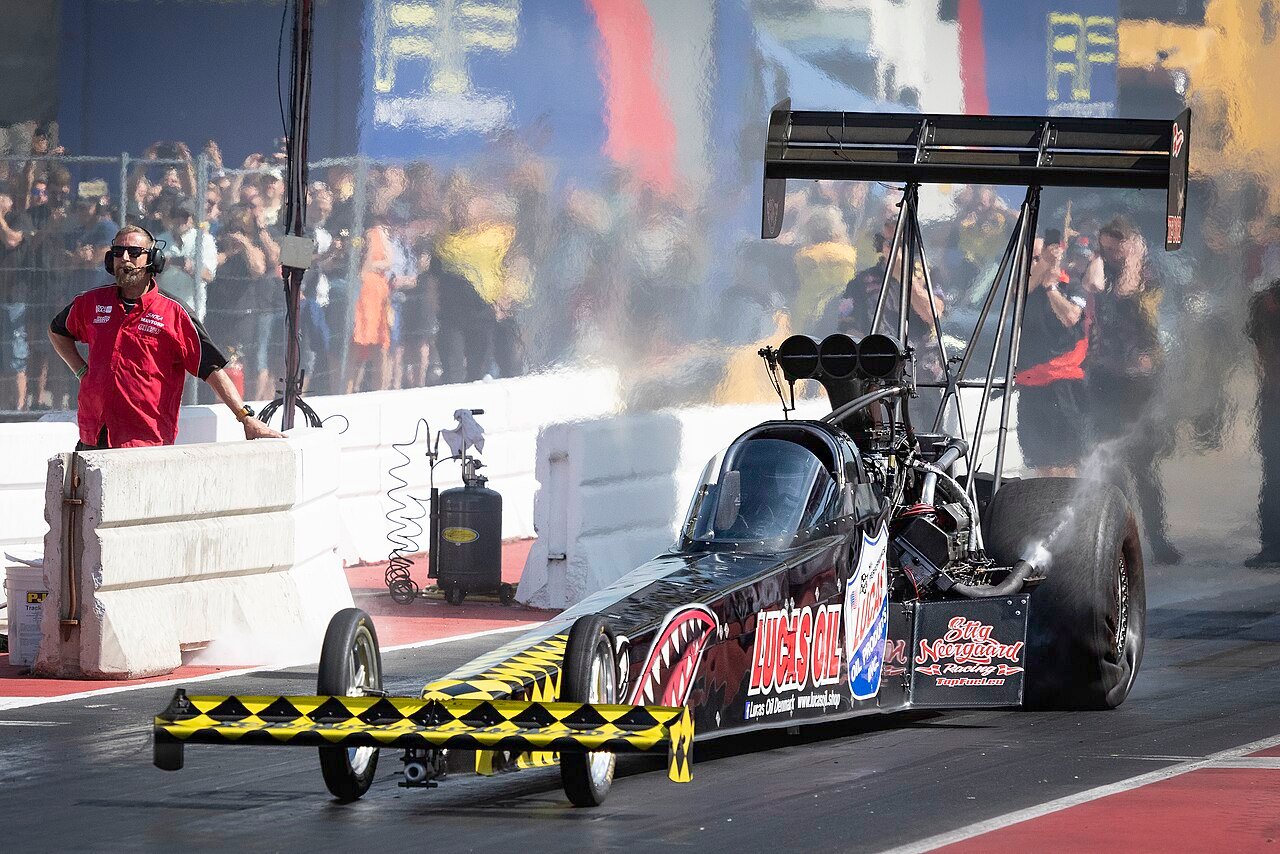
The core rule: peak power at the traps
Most naturally aspirated and stock-cammed engines accelerate hardest near their horsepower peak, not at the rev limiter. The classic dragstrip rule (from years of magazine testing) is to be at or just past peak-power RPM about 100 feet before the finish line. Too much gear and the engine hits the limiter before the stripe; too little and you’re loafing through the traps hundreds of RPM under your peak.
For a manual car there’s a corollary: pick a ratio that lets you finish at the top of a gear without an extra shift into the next gear right at the end — that shift costs time exactly where you can least afford it. Automatic? A loose converter buys some forgiveness, but the same rule applies.
Worked example: gearing for a 118-mph trap
Say your car traps 118 mph, your engine’s power peak is 7,000 RPM, you’re on 28-inch slicks, and you finish in a 1:1 gear. The formula:
Ratio = (target RPM × tire diameter) ÷ (trap speed × 336.13)
Ratio = (7,000 × 28) ÷ (118 × 336.13) = 196,000 ÷ 39,673.3 = 4.94
Gear sets come in standard steps, so round to what’s buyable and check the result:
- 4.88 gears: trap RPM = (118 × 4.88 × 336.13) ÷ 28 = 6,913 RPM — right at the power peak. This is your gear.
- 5.13 gears: trap RPM = (118 × 5.13 × 336.13) ÷ 28 = 7,267 RPM — past the 7,000 peak and into the limiter zone. Too much gear.
Run your own trap speed, RPM, and tire size through the axle ratio calculator to find the nearest gear set for your combo. How common gear choices compare on the same car (118 mph trap, 28″ slicks, 7,000 RPM peak):
| Gear set | RPM at the traps | Verdict |
|---|---|---|
| 3.73 | 5,284 | 1,700 RPM under peak — lazy finish |
| 4.10 | 5,808 | Better, but still under the power peak |
| 4.56 | 6,459 | Close — strong for a street/strip car |
| 4.88 | 6,913 | Right at peak power — the race pick |
Worked example: the best gear ratio for drag racing a 6,500-RPM street car
Now let’s run a second combo — the classic street/strip small-block: 6,500 RPM power peak, 112-mph trap, 28-inch tires, finishing in 1:1. This shows how the best gear ratio for drag racing is found, not guessed:
Ratio = (6,500 × 28) ÷ (112 × 336.13) = 182,000 ÷ 37,646.6 = 4.835 — so the nearest buyable set is 4.88. Here’s how the three most common choices compare on that car:
| Gear set | RPM at the traps | Verdict |
|---|---|---|
| 4.10 | 5,513 | 987 RPM under peak — lazy for a race car |
| 4.56 | 6,131 | 369 RPM under peak — strong street/strip compromise |
| 4.88 | 6,561 | 61 RPM past peak — the race pick |
Run the formula the other way to double-check your purchase — MPH = RPM × tire diameter ÷ (gear ratio × 336.13). With 4.88s and 28-inch tires, you cross at exactly 6,500 RPM when you trap 111.0 mph: 6,500 × 28 ÷ (4.88 × 336.13) = 182,000 ÷ 1,640.3 = 111.0 mph. If your car traps faster than that, the 4.88s will have you on the limiter before the stripe; if it traps slower, you still have headroom. That’s the self-check every gear buyer should run before spending money.
1/8-mile vs 1/4-mile: they want different gears
On an eighth-mile track, shorter (numerically higher) gearing pays off — a bigger share of the run happens in the lower gears where multiplication matters most. For the full quarter, the same aggressive gear often becomes a liability: the engine peaks too early and you’re stuck with it for the back half. Racers who run both commonly go one step taller for the quarter than the eighth.
If you only race eighths, gear for the 660, not the 1,320 — and convert your slips honestly with the 1/8-to-1/4-mile converter (a 7.50 eighth is roughly an 11.8 quarter for a typical street car). The quarter mile is drag racing‘s classic 1,320-foot format, and the best gear ratio for drag racing eighths is usually one step shorter than your quarter-mile pick.
How much ET does a gear change actually buy?
Gears are the cheapest ET on the car — but only if the tires can use them. As a rough rule of thumb for a 3,400–3,600 lb street/strip car running mid-11s to mid-12s with traction, buying the best gear ratio for drag racing instead of the gears the car came with typically works out like this:
| Gear change | Typical ET gain |
|---|---|
| 3.73 → 4.10 | 0.10–0.15 seconds |
| 4.10 → 4.56 | 0.10–0.15 seconds |
| 4.56 → 4.88 | 0.05–0.10 seconds |
Three honest caveats. First, almost all of the gain comes in the first half of the track — harder launches mean better 60-foot and 330-foot times, and that’s where ET is made. Second, the gains shrink as gears get shorter: there’s no free lunch past the point where the engine is already at peak power at the traps.
Third, on street tires a shorter gear can cost you ET — if the car spins, it goes slower, and many cars run their best numbers with slightly less gear and a hooked launch.
Street/strip compromise: how far can you go?
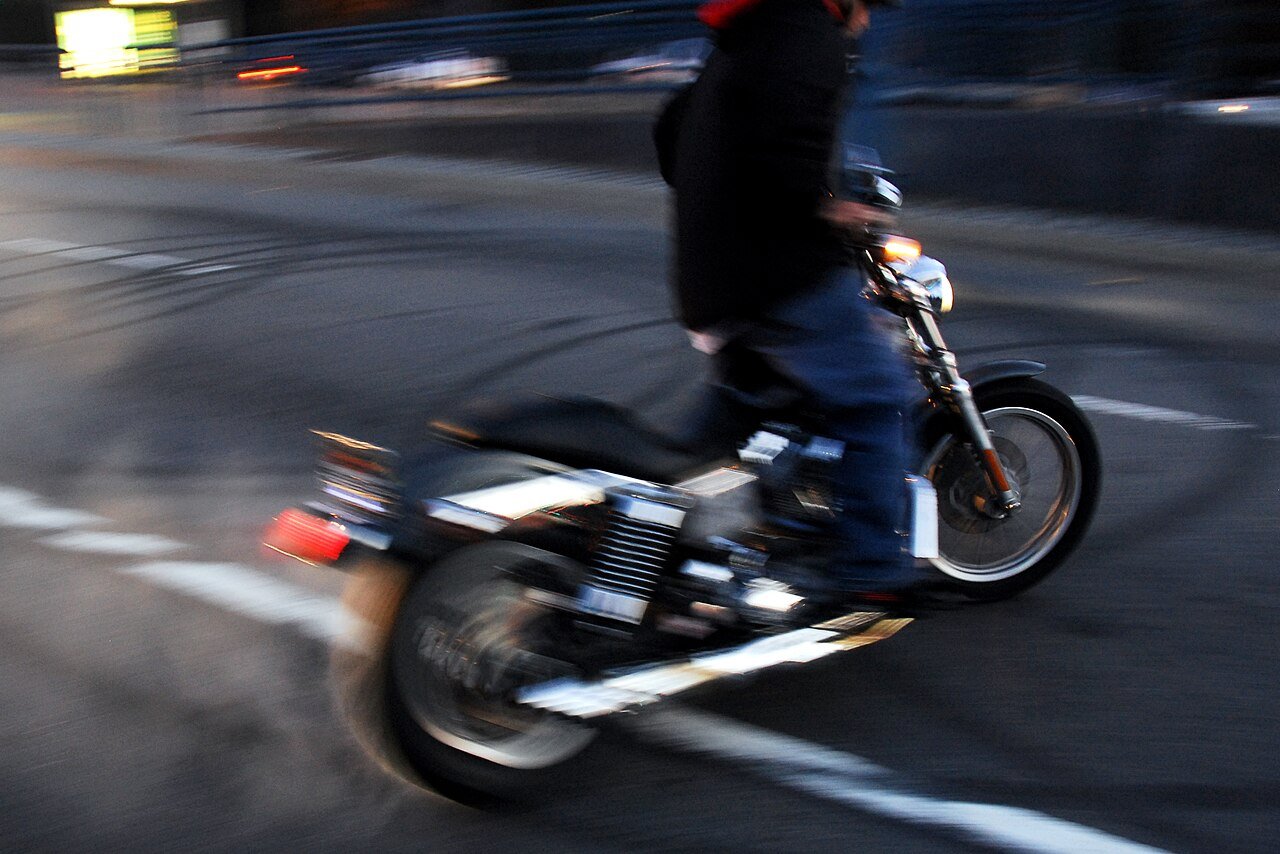
- 3.70–4.11 is the classic street/strip sweet spot for full-size cars — strong launches without screaming on the highway, especially with an overdrive top gear. Summit Racing’s ring-and-pinion recommendations agree, listing 4.10–4.88:1+ for serious drag racing.
- 4.30–4.88+ is race-car territory: brilliant at the track, miserable and thirsty on the interstate unless the car is trailered.
- Overdrive is the cheat code. A 0.67 overdrive turns a 4.10 axle into a 2.75 highway cruise gear — check your 65-mph RPM on the gear ratio chart before committing.
- Traction is the real limit. On street tires, too much gear just spins — many cars run better ETs with slightly less gear and a hooked launch than with max gear and wheelspin.
Tires change gears too: the effective-ratio trick
Here’s what most gear charts don’t tell you: change tires and the best gear ratio for drag racing changes with them. A taller tire acts like a taller gear — the engine turns fewer RPM per mile — while a shorter tire acts like more gear. Same diff, different behavior.
The math is simple: effective ratio = axle ratio × (old tire diameter ÷ new tire diameter). Take the 4.56-geared, 118-mph car from the first example (6,459 RPM at the traps on 28-inch tires) and swap to 30-inch tires: 4.56 × 28 ÷ 30 = 4.256 effective, and trap RPM drops to (118 × 4.56 × 336.13) ÷ 30 = 6,029 RPM — about 430 RPM lower, roughly the same as dropping most of a gear step.
Go the other way and a shorter tire is free gearing: 4.10s with 26-inch tires behave like 4.10 × 28 ÷ 26 = 4.415, and trap RPM at 118 mph climbs to (118 × 4.10 × 336.13) ÷ 26 = 6,255 — a roughly 450-RPM gain over the 28-inch setup (5,808), about half a gear step, with zero wrenching on the diff. That’s why serious racers buy the best gear ratio for drag racing after choosing tire size, not before.
Don’t forget first gear: the overall launch ratio
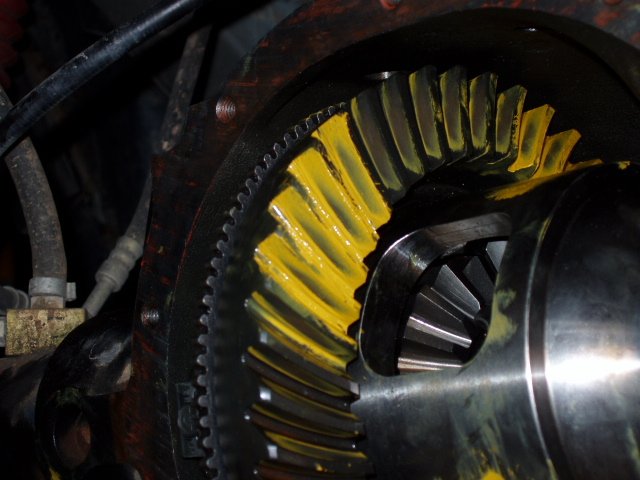
The rear axle ratio is only half the launch equation. What the tires actually feel in first gear is 1st-gear ratio × rear-axle ratio. A street car sweet spot is roughly 9–10:1 overall: a TH400’s 2.48 first gear with 3.73s gives 2.48 × 3.73 = 9.25:1 — hard launch, livable cruise. A race-only combo like a 2.75 low gear with 4.56s gives 2.75 × 4.56 = 12.5:1 — violent off the line, useless on the street. If your trap-RPM math says 4.88 but your 60-foot times are already traction-limited, you’re better off keeping the taller gear and fixing the launch.
Automatics: stall speed, shift points, and converter slip
Gear ratio picks the neighborhood; the converter and shift points pick the house. For an automatic, stall speed should sit at or just under the engine’s torque peak — a mild street cam typically wants a 2,000–2,200 RPM stall, a bigger cam wants more. Too tight and the car bogs; too loose and it slips away efficiency on the top end. And shift past peak power, not at it: the goal is to keep the average power across each gear as high as possible, which means carrying each gear slightly beyond the peak before grabbing the next one.
Then there’s converter slip — the quiet RPM tax automatics pay. A typical street/strip converter slips 5–10% at the traps, so the engine spins faster than the tire-speed math says. Actual engine RPM = theoretical trap RPM ÷ (1 − slip). Take the 4.56 example: theoretical trap RPM is 6,459, but with 8% slip the engine is really turning 6,459 ÷ 0.92 = 7,021 RPM — past a 7,000 RPM power peak and flirting with the limiter.
The practical fix: when choosing the best gear ratio for drag racing an automatic, target a theoretical trap RPM about 5–8% below your power peak, or simply go one step taller than the same combo with a stick. Shift points don’t change — carry each gear past peak power — slip just moves where “past peak” lands.
Common mistakes when picking the best gear ratio for drag racing
Most of these come from choosing the best gear ratio for drag racing by vibe instead of math:
- Gearing for an ET goal instead of your combo. “I want 11s, so I need 4.88s” ignores trap speed, tire height, and RPM range. Work backward from your actual slip and power peak.
- Forgetting tire height. A 30-inch tire on 4.56s is effectively 4.26s. Measure the tire — don’t trust the sidewall.
- Forcing an extra shift at the stripe. Finishing at the top of third and grabbing fourth 50 feet before the line costs time exactly where it hurts most.
- Too much gear on street tires. Wheelspin erases every gain the gears gave you. Hook first, gear second.
- Copying someone else’s combo. Their power peak, tire size, and transmission aren’t yours — their gear won’t be either.
- Ignoring converter slip on automatics. The trap-RPM math assumes a 1:1 lockup; a loose converter adds 5–10% RPM you never budgeted for.
Frequently asked questions
Is a 4.10 gear better than a 3.73 for drag racing?
Usually, yes — if you have the traction and the RPM range to use it. The 4.10 crosses the traps higher in the powerband, worth roughly a tenth or two over a 3.73 on the same car. Without traction it just makes more smoke.
What’s the best gear ratio for drag racing on the street?
For a street-driven car, 3.73–4.10 is the sweet spot — quick at the track without punishing you on the highway. Go deeper only if the car is trailered or runs an overdrive gear for comfortable cruising.
Do I want more gear for 1/8-mile racing?
Generally yes — the shorter track rewards aggressive gearing since most of the run is spent accelerating hard in low gears. Go one step numerically higher than your quarter-mile gearing.
Can I just change tire size instead of swapping gears?
Often, yes — a shorter tire acts like more gear and a taller tire like less, and it’s cheaper than a ring-and-pinion swap. The effective-ratio math above shows exactly what a tire change buys you. But tires can’t fix a fundamentally wrong gear, and they also change ride height, gearing in every gear, and speedometer calibration.
Will drag-racing gears hurt my fuel economy?
Yes. Higher cruise RPM means more fuel burned per mile, plus the engine runs louder and hotter on the highway. That’s the core trade-off of a street/strip build.
How do I know if my gearing is wrong at the track?
Check your time slip: if the engine is on the rev limiter well before the finish, you have too much gear. If it’s still climbing and never reaches peak power, you need more. Compare with what your trap speed and ET are telling you.
Do the math before you buy gears: the free axle ratio calculator finds the best gear ratio for drag racing for your exact trap speed, tire size, and power peak. New to the sport? NHRA’s historic drag racing photos are a great look at where it all started.