

The eighth mile to quarter mile conversion is the most-used piece of bench-racing math in grassroots drag racing. Most local tracks run the 1/8 mile, but bench racing happens in quarter-mile numbers. Converting between the two is a single multiplication — but the multiplier isn’t a constant of physics. Here’s the factor everyone uses, why it varies from car to car, and how accurate the estimate really is.
Just need the number? Our free 1/8- to 1/4-mile conversion calculator converts ET and trap speed in both directions with vehicle-type factors and an honesty range.
The quick formula
Quarter-mile ET ≈ eighth-mile ET × 1.55 to 1.57
The most common shop number is ×1.56. It comes from comparing thousands of time slips: a typical street/strip car covers the back half of the quarter in about 56% of the time it spent in the first eighth. Going the other way: eighth-mile ET ≈ quarter-mile ET ÷ 1.56.
Worked examples: eighth mile to quarter mile conversion in both directions
Formulas are easy to misread, so here is the eighth mile to quarter mile conversion done step by step, both directions, for ET and trap speed. Every number below is plain arithmetic you can check on a calculator.
Example 1 — ET, eighth to quarter. Your slip reads 7.32 in the eighth. Multiply: 7.32 × 1.56 = 11.4192, which rounds to 11.42. For an honest range, run the edges of the normal band: 7.32 × 1.55 = 11.35 and 7.32 × 1.57 = 11.49. So you’d tell your buddy “about 11.4, probably between 11.35 and 11.49” — a bracket, not a promise.
Example 2 — ET, quarter to eighth. Going the other way, divide. An 11.42 quarter ÷ 1.56 = 7.3205, so 7.32 in the eighth. Notice it lands right back where Example 1 started — the math is symmetric, which makes a handy sanity check.
Example 3 — trap speed, eighth to quarter. Trap speed uses ×1.26. An eighth-mile trap of 92 mph × 1.26 = 115.92, so call it 116 mph in the quarter.
Example 4 — trap speed, quarter to eighth. Reverse it the same way: 116 ÷ 1.26 = 92.06, so 92 mph in the eighth. Trap conversions are usually the more trustworthy of the pair, because trap speed barely cares how the launch went — more on that below.
Conversion table (×1.56)
| 1/8-mile ET | ≈ 1/4-mile ET | 1/8-mile ET | ≈ 1/4-mile ET |
|---|---|---|---|
| 5.00 | 7.80 | 8.00 | 12.48 |
| 6.00 | 9.36 | 8.50 | 13.26 |
| 7.00 | 10.92 | 9.00 | 14.04 |
| 7.50 | 11.70 | 9.50 | 14.82 |
Check the math: 6.00 × 1.56 = 9.36 ✓, 7.50 × 1.56 = 11.70 ✓, 9.50 × 1.56 = 14.82 ✓.
Eighth mile to quarter mile conversion table: common ETs from 5.5 to 10.0 seconds
This expanded eighth mile to quarter mile conversion reference covers the full grassroots range, pairing each eighth-mile ET with its quarter-mile estimate (×1.56) plus a typical eighth-mile trap with its quarter-mile trap estimate (×1.26). Trap numbers are representative for a well-sorted door car — your exact eighth trap depends on your combo, so treat that column as a neighborhood, not a guarantee.
| 1/8-mile ET | ≈ 1/4-mile ET | Typical 1/8 trap | ≈ 1/4 trap |
|---|---|---|---|
| 5.50 | 8.58 | 130 mph | 163.8 mph |
| 6.00 | 9.36 | 115 mph | 144.9 mph |
| 6.50 | 10.14 | 105 mph | 132.3 mph |
| 7.00 | 10.92 | 97 mph | 122.2 mph |
| 7.50 | 11.70 | 90 mph | 113.4 mph |
| 8.00 | 12.48 | 85 mph | 107.1 mph |
| 8.50 | 13.26 | 80 mph | 100.8 mph |
| 9.00 | 14.04 | 76 mph | 95.8 mph |
| 9.50 | 14.82 | 72 mph | 90.7 mph |
| 10.00 | 15.60 | 68 mph | 85.7 mph |
Why the factor varies (1.54 to 1.58+)
- Traction. A car that hooks hard runs a strong first eighth and a relatively smaller multiplier (low 1.5s). One that spins shows a bigger factor because the back half — where traction is easy — is comparatively faster.
- Power curve. Big top-end power (turbo, nitrous, high-RPM builds) pulls harder on the big end → higher factor, sometimes 1.57–1.58.
- Gearing. Short gearing that runs out of steam up top lowers the back-half pace → lower factor. Tall gearing that keeps pulling raises it.
- Weight and aero. Heavy, draggy cars bleed speed on the top end; slippery light cars hold it.
A concrete example shows why the eighth mile to quarter mile conversion is car-specific, not universal. Take two cars that both run 8.00 flat in the eighth. Car A is a hard-hooking small-block on 4.56 gears that does its best work early — its personal factor is 1.545, so 8.00 × 1.545 = 12.36 in the quarter. Car B is a turbo car that leaves soft and pulls like a freight train on the big end — its factor is 1.575, so 8.00 × 1.575 = 12.60. Same eighth-mile ET, quarter-mile estimates nearly a quarter-second apart.

Gearing and the power curve decide where in the 1.54–1.58 band your car lives: short gears and a flat power curve cluster low; tall gears, turbos, nitrous, and high-RPM combos cluster high. To see the spread in the wild, browse the paired 1/8- and 1/4-mile slips in DragTimes’ public timeslip database — divide any car’s quarter ET by its eighth ET and watch the factor move with the combo.
Real-world datapoint from the forums: an 8.21 @ 87.55 eighth converted with that car’s own factor of 1.545 predicted 12.68 — the car actually ran 12.73. That’s the best practice: derive your own factor from your own slips (quarter ET ÷ eighth ET across several clean runs) and use it going forward.
Trap speed conversion
Quarter-mile trap speed ≈ eighth-mile trap speed × 1.25 to 1.26
Example: 87.55 mph in the eighth × 1.257 = 110.05 mph in the quarter (real result that day: 109 mph — within a couple of percent). A rounder ×1.25 on an 85 mph eighth gives 106.3 mph. Trap speed is generally the more repeatable of the two conversions because it’s less sensitive to launch.
When the estimate is trustworthy — and when it isn’t
- Good: same car, same tune, same track conditions — expect within ~0.1–0.2 seconds and ~2% on trap speed.
- Rough: different car, unknown traction or gearing — treat it as a bracket, not a promise (±0.3 sec or more).
- Don’t: compare across power-adders, tire types, or elevation without adjusting; DA swings alone can move ET by tenths.
When NOT to use the conversion
The eighth mile to quarter mile conversion assumes one thing: the car’s back-half behavior stays the same. Break that assumption and the factor is fiction. Don’t use it when:
- Comparing two different cars. Your buddy’s 7.50 and your 7.50 are not the same run — different weight, gearing, and power curves mean different factors. Converting his slip to bench-race against your car is guessing, not estimating.
- The setup changed between passes. New gears, different tires, a converter swap, more boost, or an empty nitrous bottle all move your personal factor. Re-derive it (see below) before converting again.
- Elevation or weather swung hard. A car tuned at sea level and run at a high-altitude track is a different animal — density altitude alone can move ET by tenths, and it hits the big end hardest.
- The input pass was dirty. Wheelspin, a lifted throttle, a missed shift, or an aborted run corrupts the eighth-mile number the whole estimate hangs on. Convert only clean, full passes.
- Seeding a bracket or setting a dial-in off someone else’s converted slip. That’s two layers of guess stacked on each other — the conversion’s error plus a factor that was never yours.
Same car, same setup, clean pass: estimate. Different car, changed setup, or dirty pass: guess.
Trap speed conversion table (×1.26)
| 1/8-mile trap | ≈ 1/4-mile trap | 1/8-mile trap | ≈ 1/4-mile trap |
|---|---|---|---|
| 80 mph | 100.8 mph | 95 mph | 119.7 mph |
| 85 mph | 107.1 mph | 100 mph | 126.0 mph |
| 90 mph | 113.4 mph | 110 mph | 138.6 mph |
Check: 85 × 1.26 = 107.1 ✓, 110 × 1.26 = 138.6 ✓.
Deriving your own factor from your slips
The single most accurate move: take three or more clean runs (no wheelspin, no lifting) where you have both eighth and quarter times, and divide. Example slips:
- Run 1: 12.90 quarter ÷ 8.30 eighth = 1.554
- Run 2: 12.85 ÷ 8.27 = 1.554
- Run 3: 12.94 ÷ 8.33 = 1.553
Average: 1.554 — that’s your car’s personal factor, good until the combo changes. It’s the most honest version of the eighth mile to quarter mile conversion you’ll ever use, because it came from your car, not a rule of thumb. Re-derive it after any gear, tire, converter, or major power change.
Reading the slip: what each number tells you
A full time slip shows more than the two numbers you’re converting:
- 60-foot time — your launch. A tenth here is worth roughly two tenths at the stripe, which is why traction dominates the conversion factor.
- 330 / 660 (1/8) ET — the mid-track checkpoints. Compare your 660-foot number against the conversion; if the estimate is consistently off, your factor (not the formula) needs tuning.
- 1,000-foot ET — on many slips; the back half of the quarter is where aero and gearing show up. Note: on nitro-class slips this is the finish line, not a split — see the 1,000-foot note below.
- Trap speed (MPH) — measured over the last 66 feet. Unlike ET, it barely cares about your launch — a spinning launch ruins ET but leaves trap speed nearly intact, which is why trap-speed conversions are more repeatable.
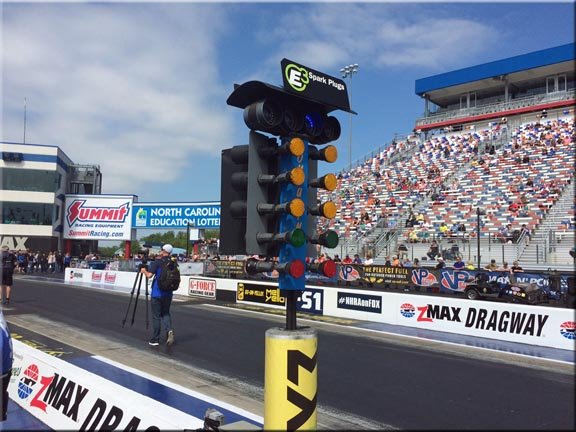
None of the ET numbers above include reaction time — the clock starts when your car leaves the starting beam, not when the tree goes green. That is exactly why the launch (and the 60-foot) dominates the conversion factor. NHRA’s own history of the Christmas tree tells how the countdown starter replaced the flagman to give every driver an identical start.
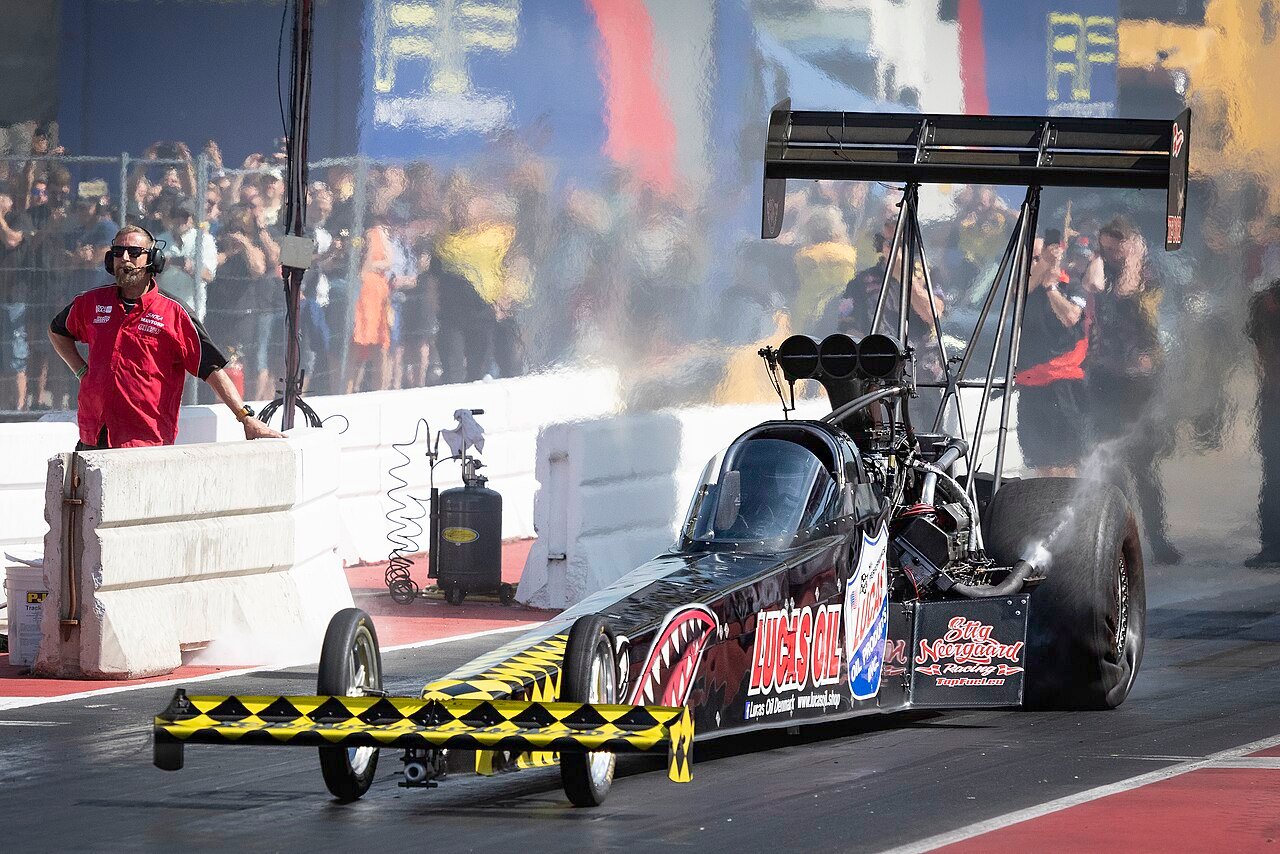
A note on 1,000-foot racing: Top Fuel doesn’t run the quarter mile
If you’ve ever seen a “3.70 @ 336 mph” slip and wondered why the eighth mile to quarter mile conversion gives nonsense — 3.70 × 1.56 = 5.77 — it’s because that slip isn’t a quarter-mile run at all. Since July 2008, NHRA Top Fuel and Funny Car have raced to 1,000 feet (304.8 m) instead of 1,320 feet (402.3 m), a change made after Scott Kalitta’s fatal crash to give the 300+ mph cars more shutdown room.
The distances to keep straight: eighth mile = 660 feet (201.2 m), 1,000 feet = 304.8 m, quarter mile = 1,320 feet (402.3 m). The 1.56 multiplier describes the 660-to-1,320 relationship for door cars; it means nothing for 1,000-foot nitro slips. Wikipedia’s drag racing overview lays out the standard distances each class runs.
Frequently asked questions
What is 1.56 times my eighth-mile time?
That’s the standard eighth-to-quarter ET estimate: multiply your 1/8-mile elapsed time by 1.56. A 7.50 becomes an estimated 11.70 quarter.
Why do some people use 1.55 or 1.57 instead?
Those are the same estimate tuned to different cars: 1.54–1.55 for hard-hooking cars, 1.57–1.58+ for cars that pull hard on the top end or had traction trouble early. Use 1.56 when you don’t know.
Can I convert quarter-mile to eighth-mile?
Yes — divide the quarter ET by 1.56. A 12.48 quarter estimates a 8.00 eighth (12.48 ÷ 1.56 = 8.00 ✓).
Does the 1.56 factor work on 1,000-foot times?
No. A 1,000-foot slip (Top Fuel, Funny Car) is a different distance — 1,000 feet versus the quarter mile’s 1,320 — so the same eighth mile to quarter mile conversion can’t be applied to it. A 3.70-second 1,000-foot pass would “convert” to 5.77, which is meaningless. There is no widely trusted 1,000-foot-to-quarter factor because almost nobody runs both distances in the same car.
What eighth-mile ET do I need for a 10-second quarter?
Divide: 10 ÷ 1.56 = 6.41. So roughly a 6.40–6.45 eighth-mile pass puts a typical car in 10-second quarter-mile territory. As always, your car’s personal factor moves that target a few hundredths either way.
How does gearing change the conversion?
It changes the factor slightly, not the method. If you’re choosing gears for the strip, our drag-racing gear ratio guide covers trap-RPM targeting, and the trap speed vs ET explainer breaks down what each half of the slip actually measures.
Convert any slip — ET or trap speed, either direction — with vehicle-matched factors in the free 1/8- to 1/4-mile conversion calculator. Use the eighth mile to quarter mile conversion as a bracket, then sharpen it with your own slips.