

In the trap speed vs ET debate, your trap speed measures your car’s power — while your ET measures how well you used it. Two cars can run the same ET with wildly different trap speeds — and once you learn to read both numbers together, a time slip becomes a diagnostic tool that tells you whether your next dollar should go to traction, gearing, or more horsepower.
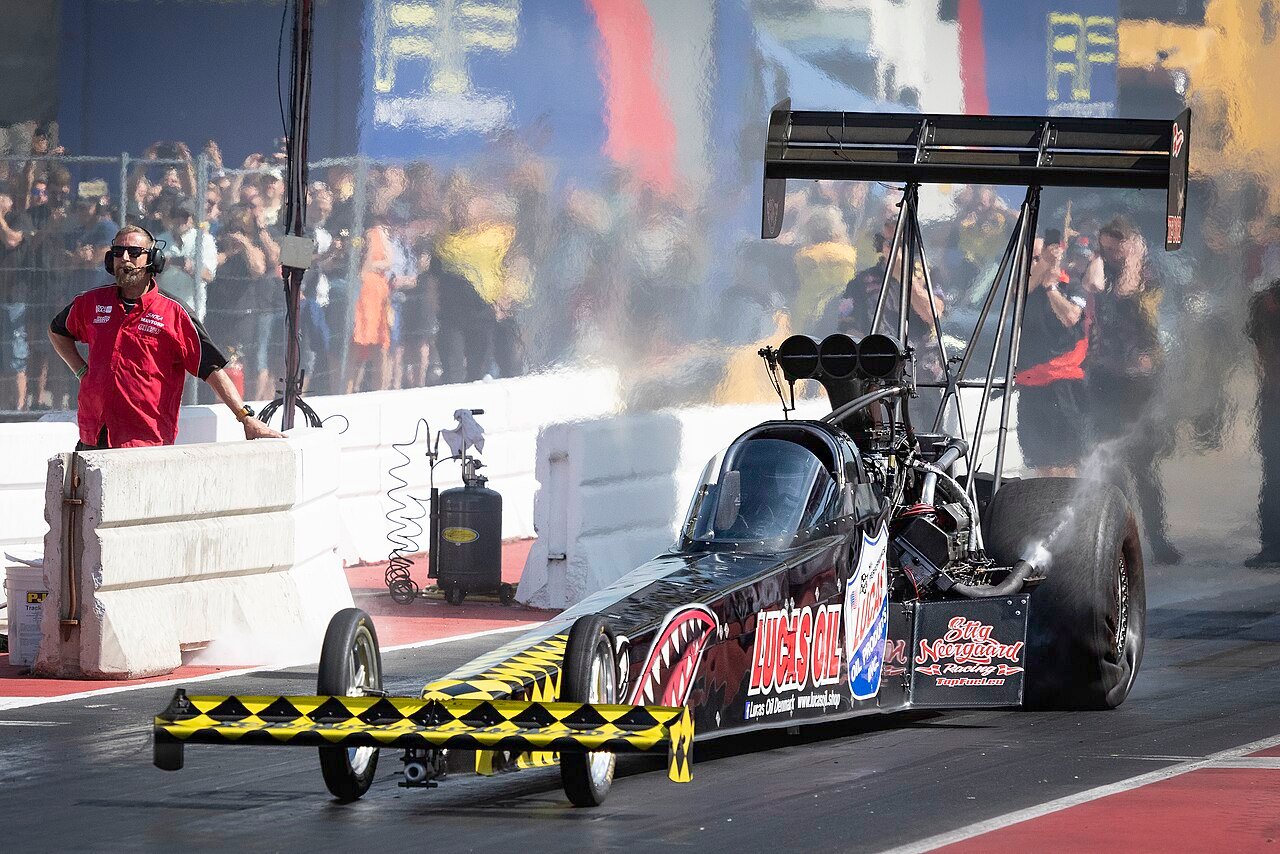
What each number actually measures
- ET (elapsed time): the seconds from when your front tire leaves the starting beam to when you cross the finish. ET is decided by your launch, 60-foot time, traction, gearing, and power — everything, in other words.
- Trap speed: your average speed over the final 66 feet of the quarter mile. It barely notices a bad launch or a sleepy reaction time — it mostly reflects raw power-to-weight.
In bracket racing the quickest car (lowest ET) wins; the fastest car (highest trap speed) just has the most power. They’re different titles for a reason.
The formulas: estimating ET and trap from weight and power
The empirical Hale formulas used across the drag-racing world estimate a well-hooked run from flywheel horsepower and total race weight (including driver):
ET ≈ 5.825 × (weight ÷ hp)^(1/3)
Trap mph ≈ 234 × (hp ÷ weight)^(1/3)
Worked example: 3,200 lb car, 400 hp.
- ET = 5.825 × (3,200 ÷ 400)^(1/3) = 5.825 × 8^(1/3) = 5.825 × 2.0 = 11.65 s
- Trap = 234 × (400 ÷ 3,200)^(1/3) = 234 × 0.125^(1/3) = 234 × 0.5 = 117 mph
Check the arithmetic: 8^(1/3) = 2 exactly, and 0.125^(1/3) = 0.5 exactly — the formulas are built on cube roots, so clean numbers aren’t a coincidence. The trap constant (234) assumes modern NHRA speed-trap placement; older publications used 230.5 or 228.4 for the pre-1989 light positions.
These are estimates for a clean pass — real ET depends on your 60-foot and traction. Model your own numbers in the power-to-weight ratio calculator, then compare against your actual slips.
Trap speed vs ET: diagnosing the split — traction vs power
Once you treat trap speed vs ET as a pair instead of a contest, two classic split patterns show up on slips — and each points at a completely different problem. The table further down summarizes this, but here is how the diagnosis actually works in the pits.
High trap, slow ET: you have a traction (or gearing) problem
This is the most common trap speed vs ET mismatch at test-and-tune nights. Your trap lands within a mile or two of the formula, but the ET is three to six tenths slow. The engine is doing its job — the power is reaching the pavement eventually — but the launch wasted it: spinning tires, a lazy 60-foot, wheelhop, or gears too tall to get the car into its powerband.
The fix lives in the chassis, not the engine: stickier tires, suspension setup, launch-rpm practice, or a shorter gear. Adding horsepower here just makes the spinning worse.
Low trap, quick ET: you have a power problem
Here the trap speed vs ET verdict flips. The ET matches the formula, so the launch is clean and the car is hooking — but the trap is 4–6 mph short of what the weight and power say it should be. Something is eating power or efficiency: heat soak, a conservative tune, high density altitude, drivetrain losses from an inefficient converter or slipping clutch, or aero drag at the big end. The chassis is fine; the engine (or the air it’s breathing) is not. This is the one split where more power — or finding the power you already paid for — is the right answer.
The 60-foot time is what ties it together
Your 60-foot time is the ET side of the equation in miniature. That is what ties the trap speed vs ET story together: two cars can trap within a mile per hour of each other while running ETs half a second apart, and the entire gap is almost always in the first 60 feet. Roughly speaking, every tenth you cut from your sixty is worth two tenths at the stripe — so a street-tire car 60-footing 2.3 against a 1.9 target is leaving roughly eight tenths of ET on the table with the trap untouched.
Log the sixty on every pass; it is the earliest warning light on the slip.

Trap speed vs ET math: Hale’s formulas worked out for three cars
Another widely used form of the estimate comes from the Patrick Hale tradition: ET = 6.269 × (weight ÷ hp)^(1/3) and MPH = 224 × (hp ÷ weight)^(1/3). These give a quick trap speed vs ET estimate from nothing but total race weight (including driver) and effective — rear-wheel — horsepower. One elegant check: the two constants multiply to 6.269 × 224 = 1,404, which is exactly where the “ET × trap is roughly constant” rule of thumb comes from. Work through three real combos and watch it hold.
Car 1 — 3,200 lb, 400 hp (the street car from the section above, so you can compare the trap speed vs ET math side by side):
- ET = 6.269 × (3,200 ÷ 400)^(1/3) = 6.269 × 8^(1/3) = 6.269 × 2.0 = 12.54 s
- MPH = 224 × (400 ÷ 3,200)^(1/3) = 224 × 0.125^(1/3) = 224 × 0.5 = 112.0 mph
Car 2 — 3,800 lb, 300 hp (heavy daily driver):
- ET = 6.269 × (3,800 ÷ 300)^(1/3) = 6.269 × 12.6667^(1/3) = 6.269 × 2.331 = 14.61 s
- MPH = 224 × (300 ÷ 3,800)^(1/3) = 224 × 0.078947^(1/3) = 224 × 0.4290 = 96.1 mph
Car 3 — 2,900 lb, 550 hp (serious street/strip build):
- ET = 6.269 × (2,900 ÷ 550)^(1/3) = 6.269 × 5.2727^(1/3) = 6.269 × 1.7405 = 10.91 s
- MPH = 224 × (550 ÷ 2,900)^(1/3) = 224 × 0.189655^(1/3) = 224 × 0.5745 = 128.7 mph
Sanity check: 12.54 × 112.0 = 1,404.5, 14.61 × 96.1 = 1,404.0, 10.91 × 128.7 = 1,404.1 — every car lands on the same constant, which is how you know the arithmetic is on track. Run your own combo through the DragTimes horsepower calculator and compare its flywheel estimate against your actual trap.
Reading your slip: what the gap tells you
| What you see | What it means | Fix |
|---|---|---|
| ET slower than formula, trap on target | Power is fine — you’re losing it at launch or in gearing | Tires, suspension setup, launch practice, gear ratio |
| ET on target, trap lower than expected | Hooking fine, but down on power or efficiency | Tune, heat management, weight, drivetrain losses |
| Both off | Underpowered for the weight, or way off tune | Power-to-weight first, then re-diagnose |
| ET × trap ≈ 1,400 | Textbook efficient pass — you’re extracting nearly all the available performance | Only more power helps now |
Two rules of thumb racers live by: a tenth shaved off your 60-foot time is worth roughly two tenths of ET, and trap speed is the cube root of power-to-weight — doubling your power only raises trap speed by about 26% (2^(1/3) = 1.26). Going from 90 to 113 mph at the same weight means the car is making twice the power. Respect small trap-speed gaps.
Gearing’s fingerprints on the slip
Tall gears typically show slower ET than the trap speed deserves — the car never gets into its powerband. Too much gear does the opposite: the engine peaks early and the ET flattens while the trap stays healthy. If your slip shows this pattern, the answer is gearing, not horsepower — see how to gear for the traps.
Density altitude and weather: why the numbers move
Density altitude is the air’s thickness expressed as an altitude number — hot, humid, high-elevation air all raise it, and an engine makes less power in thin air. A common racer’s rule of thumb: a naturally aspirated street car loses roughly 0.1 seconds of ET and 1 mph of trap per 1,000 feet of DA. So our 12.54 @ 112 sea-level car runs around 12.8 @ 109 on a 3,000-ft-DA summer afternoon — same tune, same driver, just worse air.
Notice what moved: the trap fell almost exactly in proportion to the power loss, while the ET took the double hit of weaker power plus a greasier track surface. Because density altitude moves trap speed vs ET in different proportions, never diagnose a car from one hot-day slip — compare DA-corrected numbers, or slips from similar-weather days, before you blame the tune or the tires. For background on how the speed trap and the strip itself work, see Wikipedia’s drag racing overview.
Staging, reaction time, and the holeshot
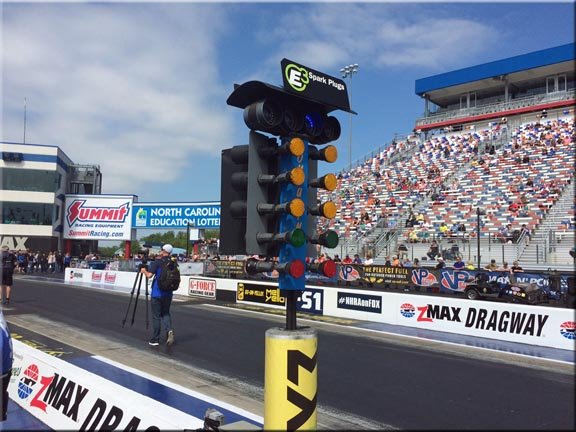
Staging is where reaction time lives: how deep you roll into the stage beam changes your rollout — the few inches the car moves before the ET clock starts. Shallow staging (just tripping the beam) gives more rollout and slightly quicker ETs but slower reaction times; deep staging does the opposite. Either way, staging changes where the clock starts, not how fast the car is.
That separation is why a holeshot win is possible: the car with the slower ET can still win if its reaction-time advantage is bigger than the ET gap. When you’re chasing ET, stage the same way every single pass — consistency is the only variable that matters. For the NHRA’s own walkthrough of your first night at the strip, including the time-slip booth, see the NHRA’s getting-started guide.
Using the formulas to plan your next mod
The cube-root relationship has a sting: power gains suffer diminishing returns. Our 3,200 lb / 400 hp example runs 11.65 @ 117. Add 50 hp (450 total):
- ET = 5.825 × (3,200 ÷ 450)^(1/3) = 5.825 × 7.111^(1/3) = 5.825 × 1.922 = 11.20 s
- Trap = 234 × (450 ÷ 3,200)^(1/3) = 234 × 0.1406^(1/3) = 234 × 0.52 = 121.7 mph
A 12.5% power gain bought 0.45 seconds and 4.7 mph — solid, but it shows why racers chase weight and traction first: going from 400 to 800 hp only raises trap speed ~26%. If your slip already matches the formula, the car is efficient and only more power (or less weight) moves the needle.
Reaction time is a separate column
Beginners often lump reaction time into ET — don’t. Your ET clock starts when you break the starting beam, not when the light turns green, so a sleepy 0.500 reaction time still prints the same ET as a sharp 0.050. Reaction time matters enormously for winning a heads-up race (total time to the stripe = RT + ET), but it tells you nothing about the car’s performance. When you’re diagnosing the car, read the ET. When you’re diagnosing the driver, read the RT.
Frequently asked questions
Which matters more, ET or trap speed?
ET wins races — it’s the number the win light follows. Trap speed is the better diagnostic: it tells you how much power the car actually makes, independent of how badly the launch went.
What is a good 60-foot time?
Street-tire cars run 2.0–2.3 seconds; drag radials bring that to 1.7–1.9; full slicks and prepped tracks get 1.3–1.6. Your 60-foot is the single biggest lever on ET — every tenth here is worth ~two tenths at the stripe.
Why did my trap speed drop on a hot day?
Heat robs power (thin, hot air + heat-soaked engine and tires), and trap speed is the most power-sensitive number on the slip. A 3–5 mph trap drop on a hot afternoon is normal, while ET suffers even more from the greasy track surface.
Can I convert my 1/8-mile slip to a 1/4-mile estimate?
Roughly: quarter-mile ET ≈ eighth-mile ET × 1.55–1.57, and quarter-mile trap ≈ eighth-mile trap × 1.26, for a typical street car. Use the 1/8-to-1/4-mile converter — it applies vehicle-type factors instead of a single flat multiplier.
Should I use flywheel or wheel horsepower in Hale’s formulas?
Use effective (rear-wheel) horsepower — the trap speed vs ET math was calibrated against power that actually reaches the track. With a flywheel rating, subtract roughly 12–15% for drivetrain loss first; skipping that step is why slips so often read “slower than the formula.”
Does a bad reaction time change my trap speed vs ET reading?
No. Your reaction time never touches the ET or trap clocks — the trap speed vs ET diagnosis is identical whether you cut a .050 or a .500 light. Reaction time only decides who reaches the stripe first in a heads-up race.
Stop guessing from one number: run your weight and power through the ET and trap calculators and read your next time slip like a tuner.
The takeaway: stop asking which number matters more. Run the trap speed vs ET split on every slip — trap first for power, ET second for execution — and you’ll know whether the next mod belongs under the hood or under the rear tires.