

If you want to know how to improve power to weight ratio, the answer is simpler than the aftermarket industry wants you to believe: you have two levers — add power or remove weight. Here’s the math that surprises most people — a 10% power gain and a 10% weight cut improve the ratio by almost exactly the same amount, but weight loss also sharpens braking and handling while power gains don’t. That makes weight the smarter first move in most builds.
The 10% rule, worked out
Start with a 3,300 lb car making 300 hp: 3,300 ÷ 300 = 11.0 lb/hp.
- Add 10% power (330 hp): 3,300 ÷ 330 = 10.0 lb/hp — a 9.1% improvement.
- Cut 10% weight (2,970 lb): 2,970 ÷ 300 = 9.9 lb/hp — a 10% improvement.
Same ratio improvement either way — but the lighter car also stops shorter and turns better, while the more powerful car usually drinks more fuel and stresses the driveline harder. Before spending money, run your own baseline through the power-to-weight ratio calculator, then model the mods you’re considering. Keep that 10% rule in mind — it is the fastest sanity check for any claim about how to improve power to weight ratio cheaply.
How to improve power to weight ratio: the full weight-loss menu, by cost tier
Most articles about how to improve power to weight ratio list a few free removals and stop. Below is the full menu, grouped by cost, with realistic savings in pounds and kilograms — work it top to bottom.
| Tier | What to remove or swap | Typical saving | Cost |
|---|---|---|---|
| Free | Spare tire + jack + tools | 40–55 lb (18–25 kg) | $0 |
| Free | Rear seats + seatbelts | 40–60 lb (18–27 kg) | $0 |
| Free | Trunk junk, cargo cover, floor mats | 10–20 lb (5–9 kg) | $0 |
| Free | Sound deadening (heat gun + scraper) | 15–30 lb (7–14 kg) | $0 + an afternoon |
| Cheap | Lead-acid battery → lithium | 20–30 lb (9–14 kg) | ~$100–$250 |
| Cheap | AC system delete (track cars only) | 25–35 lb (11–16 kg) | ~$0–$100 |
| Mid | Lightweight wheels, set of four | 25–40 lb (11–18 kg) unsprung | ~$800–$2,000 |
| Mid | Racing bucket seats, pair (vs. stock) | 40–70 lb (18–32 kg) | ~$800–$1,500 |
| Mid | Cat-back exhaust, titanium or light stainless | 15–25 lb (7–11 kg) | ~$500–$1,500 |
| Premium | Carbon-fiber hood | 15–25 lb (7–11 kg) | ~$600–$1,500 |
| Premium | Carbon trunk or hatch | 10–20 lb (5–9 kg) | ~$500–$1,200 |
| Premium | Carbon doors or fenders (race builds) | 30–50 lb (14–23 kg) | ~$2,000+ |
The free tier alone is worth 105–165 lb (48–75 kg) on a typical sedan — take the midpoint, 135 lb: 3,300 − 135 = 3,165 lb → 3,165 ÷ 300 = 10.55 lb/hp, a 4% improvement for zero dollars.
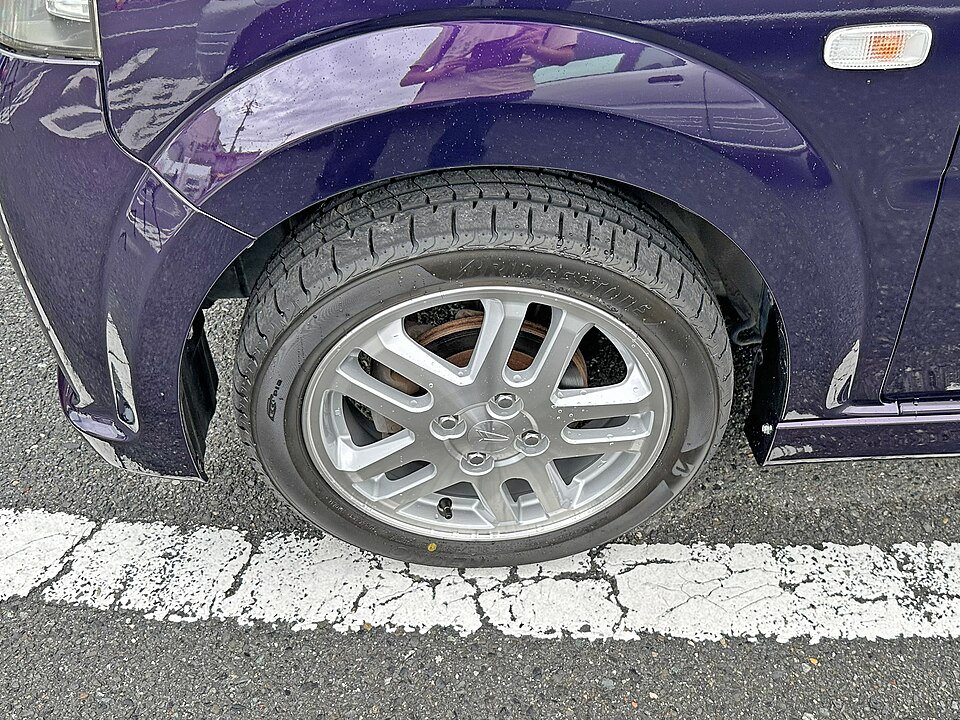
The mid tier’s best buy is usually the wheels. Factory 18-inch cast wheels often weigh 26–30 lb each; a flow-formed set can drop 6–10 lb per corner — 25–40 lb total that counts double because it’s unsprung and rotating. Tire Rack publishes per-wheel weights for lightweight flow-formed wheel designs, so compare actual numbers before you buy.
The premium tier is carbon fiber — hoods, trunks, and doors trading 10–25 lb of steel for a few pounds of composite. Carmakers do the same math: the BMW i3 was built around a carbon-fiber-reinforced-plastic passenger cell to keep mass down. Only spend here after the cheaper tiers are done.

Where the weight comes off matters more than how much
Not all pounds are equal. Unsprung weight (wheels, tires, brakes) isn’t carried by the springs, so the suspension reacts faster with less of it; rotating weight (wheels, tires, rotors, driveshaft) also has to be spun up, costing extra energy on every launch. A pound off a wheel pays back roughly twice — as mass and as inertia — which is why every serious guide to how to improve power to weight ratio puts wheels and tires at the top of the weight-loss list.
Placement matters too: weight off the nose of a front-heavy car improves balance, and weight off high up (roof, sunroof assembly) lowers the center of gravity. Remember the exchange rate — removing 100 lb (3,200 ÷ 300 = 10.67 lb/hp) equals adding about 9 hp (3,300 ÷ 309.4 = 10.67), roughly 10 lb off ≈ 1 hp at this weight. As the car gets lighter, each pound is worth more.
Free and cheap weight reduction (do these first)
| What to remove or swap | Typical saving | Cost |
|---|---|---|
| Spare tire + jack + trunk junk | 40–55 lb | Free |
| Rear seats (track builds) | 40–60 lb | Free |
| Sound deadening, floor mats, cargo covers | 15–30 lb | Free (your labor) |
| Lead-acid battery → lithium | 20–30 lb | ~$100–$250 |
| Cat-back exhaust (steel → titanium or light stainless) | 15–25 lb | ~$500–$1,500 |
| Lightweight wheels (set of four) | 25–40 lb unsprung | ~$800–$2,000 |
| Carbon-fiber hood or trunk | 15–25 lb | ~$600–$1,500 |
Prioritize unsprung and rotating weight first. A pound off a wheel, tire, or brake rotor counts double — it reduces both total mass and rotational inertia, so it pays back in acceleration and ride quality. See how a 200 lb drop compares to a 30 hp bump for yourself: 3,300 − 200 = 3,100 lb → 3,100 ÷ 300 = 10.3 lb/hp, versus 3,300 ÷ 330 = 10.0 lb/hp for the power gain. Similar ratio — but the diet also helps every corner and every stop.
How to improve power to weight ratio with bolt-on power: typical wheel-hp gains
The other half of how to improve power to weight ratio is adding power — but only power you can measure counts. Below are typical wheel-horsepower gains from independent dyno tests on a ~300 hp car, not crank ratings or marketing. A chassis dyno measures torque at the wheels and calculates horsepower from it — here is how a dynamometer actually measures horsepower. Expect 12–18% drivetrain loss, so a “300 hp” car typically shows 250–265 whp stock.
| Mod | Typical whp gain | Typical cost | Notes |
|---|---|---|---|
| High-flow panel filter / cold-air intake | +3–8 whp | ~$50–$350 | Often more noise than power; gains cluster at the top end |
| Cat-back exhaust | +5–10 whp | ~$500–$1,500 | Also saves 15–25 lb — a rare two-way gain |
| Headers (naturally aspirated) | +10–15 whp | ~$800–$1,800 | Needs a tune to realize the full gain |
| ECU tune (turbocharged) | +30–50 whp | ~$300–$600 | The best $/hp in the business; 8–15% on most turbo cars |
| ECU tune (naturally aspirated) | +5–12 whp | ~$300–$600 | Mostly sharper throttle and drivability, not big peak gains |
| Camshafts (naturally aspirated) | +15–25 whp | ~$1,200–$2,500 | Labor-heavy; can trade low-end manners for top-end power |
| Full bolt-ons + tune (NA) | +20–35 whp | ~$2,000–$3,500 | Intake + headers + exhaust + tune, combined and tuned together |
| Turbo / supercharger kit | +80–150+ whp | ~$4,000–$8,000 | Budget for cooling, clutch, and fuel system upgrades too |
One honesty rule on stacking: gains don’t add linearly — intake (+8) plus exhaust (+10) plus tune (+40) rarely equals +58 whp, since each was measured against a stock baseline. Real combined gains land 10–20% below the sum; always re-dyno after stacking mods.

Adding power, in cost-effectiveness order
Ranked honestly, here is how to improve power to weight ratio with money spent on power, best value first:
- ECU tune ($300–$600): typically +8–15% on turbocharged engines, the cheapest horsepower you’ll ever buy. Almost nothing on a naturally aspirated car — know your engine first.
- Intake + exhaust ($500–$1,500): +5–10% combined, with better throttle response and sound as a bonus.
- Forced induction ($4,000+): +30% or more from a turbo or supercharger kit — the big move, but it stresses internals, cooling, and the transmission.
- Engine swap ($5,000+): the nuclear option; the new engine’s own weight can eat the gain, so check the ratio before and after, not just the horsepower number.
Cheapest dollars per gain: the bang-for-buck table
The straightest answer to how to improve power to weight ratio on a fixed budget: common mods ranked by cost per unit of ratio improvement, on our 3,300 lb / 300 hp baseline (11.0 lb/hp, or 200.4 hp per tonne — the metric power-to-weight ratio).
| Mod | Cost | New ratio | Ratio gain | $ per hp/tonne gained |
|---|---|---|---|---|
| Free strip-out (−50 lb) | $0 | 10.83 lb/hp | −1.5% | $0 |
| ECU tune (+35 hp) | ~$500 | 9.85 lb/hp | −10.4% | ~$21 |
| Intake + cat-back (+15 hp) | ~$1,000 | 10.48 lb/hp | −4.8% | ~$100 |
| Lithium battery (−25 lb) | ~$150 | 10.92 lb/hp | −0.8% | ~$100 |
| Titanium cat-back (−20 lb, +5 hp) | ~$900 | 10.75 lb/hp | −2.2% | ~$196 |
| Lightweight wheels (−35 lb) | ~$1,000 | 10.88 lb/hp | −1.1% | ~$455 |
| Carbon hood (−20 lb) | ~$1,000 | 10.93 lb/hp | −0.6% | ~$833 |
The pattern is brutal: free weight and the turbo tune beat everything — the tune delivers 15× the ratio improvement of a carbon hood for half the money (10.4% vs. 0.6%). Carbon parts are the last dollars you spend, not the first. And note the titanium cat-back row: mods that cut weight and add power punch above either column alone.
Don’t forget the rest of the package
- Gearing: a shorter final drive multiplies wheel torque in every gear — often cheaper per “felt” horsepower than engine mods. Model it first before buying parts.
- Tires: power you can’t put down is just noise. The ratio assumes traction; sticky tires are what convert it into actual acceleration.
- Reliability and legality: aggressive tunes and stripped interiors can void warranties, fail inspections, or turn a daily driver into a chore. Match the build to the car’s real job.
Track-day prep order that actually lowers lap times
For lap times rather than dyno numbers, spend in this order — the sequence that shows how to improve power to weight ratio and actually use it:
- Brake fluid + track pads. Stock fluid boils and a boiled pedal ends your day — fresh high-temp fluid and pads are the cheapest lap time on the list.
- Tires at correct pressures. The ratio assumes traction. A 200-treadwear tire on the right pressures is worth more than 30 hp you can’t put down.
- Free weight strip + alignment. The 50 lb from the trunk plus a track alignment for even tire temps — both nearly free, both measurable.
- Cooling. Oil temperatures and brake ducts. Power you can’t sustain for a full session doesn’t count.
- Seat time or instruction. The driver mod is the cheapest “power” adder ever sold — a coached beginner routinely finds seconds, not tenths.
- Power last. Only after grip, brakes, and cooling are sorted does the tune earn its keep — because now the car can actually use it.
Example: a $1,500 weekend build on paper
Same 3,300 lb / 300 hp starting point (11.0 lb/hp):
| Step | Change | New ratio | Cost |
|---|---|---|---|
| Baseline | — | 11.0 lb/hp | — |
| Free strip-out | −50 lb (spare, jack, trunk junk) | 10.8 | $0 |
| ECU tune | +35 hp | 3,250 ÷ 335 = 9.7 | ~$500 |
| Lightweight wheels | −35 lb unsprung | 3,215 ÷ 335 = 9.6 | ~$1,000 |
Result: 11.0 → 9.6 lb/hp, a 12.7% improvement for about $1,500 — plus sharper turn-in and shorter braking from the weight you shed. That’s the difference between “family sedan” and “brisk road car” on the benchmark bands, bought mostly with elbow grease and one tune.
What NOT to do: safety and comfort traps
Nothing wrecks a plan for how to improve power to weight ratio faster than these traps:
- Deleting the AC on a street car. It saves 25–35 lb but destroys summer comfort and resale value. Keep it unless the car is trailered.
- “Swiss-cheesing” panels. Drilling holes in brackets and interior panels saves grams while weakening the structure — all risk, no meaningful reward.
- Fake carbon fiber. Vinyl wraps and stick-on covers add weight. If it isn’t real composite replacing real steel, it’s decoration.
- Extreme stance and camber. Destroys the handling and tire wear that the weight loss was supposed to improve, for looks.
- Nitrous on stock internals. The cheapest big power number there is — paired with the most expensive failure mode. Forged internals first, or not at all.
- Big audio builds on a “diet” car. A subwoofer box and amps can add 40–80 lb right back. Pick a lane: loud or light.
Mistakes that waste money (or worse)
Four mistakes undo more builds than any parts list — avoid them and your plan for how to improve power to weight ratio stays on track:
- Stripping safety equipment. Removing airbags, crash bars, or structural bracing for a better ratio is never worth it — the ratio assumes you survive to enjoy it.
- Cheap “performance chips.” Plug-in modules that just trick the ECU into running rich can cost power and reliability. A real tune on a dyno (or a reputable remote tune with data logging) is the only power adder worth paying for at the budget end.
- Comparing crank hp to wheel hp. Manufacturer ratings are crank horsepower; dyno sheets read wheel horsepower, typically 12–18% lower. If you mix them, your ratio comparisons are fiction — pick one basis and use it for everything.
- Adding power before grip and brakes. A car that was traction-limited at 300 hp is still traction-limited at 350. Tires and brakes should scale with power, or the faster number on paper never becomes a faster car in reality.
Frequently asked questions
Is it better to add horsepower or reduce weight?
Mathematically they’re near-identical per percent — but weight reduction also improves braking, cornering, and tire wear, while power gains cost fuel and stress parts. Do the free weight first, then add power.
How much weight do I need to lose to equal 50 horsepower?
On a 3,300 lb / 300 hp car (11.0 lb/hp), adding 50 hp gives 3,300 ÷ 350 = 9.43 lb/hp. Matching that by weight alone: 300 hp × 9.43 = 2,829 lb — you’d need to shed 471 lb. Big power gains are easier to buy than huge weight cuts.
Do lighter wheels really make a difference?
Yes, disproportionately: wheels are unsprung and rotating, so they resist acceleration twice over. A 30 lb wheel saving feels like roughly 60 lb of static weight loss in a drag-race launch.
What’s a realistic power-to-weight target for a fun street car?
Around 8–10 lb/hp (225–280 hp/tonne) hits the sweet spot — check the benchmark bands to see where that lands. Below 6 lb/hp you’re in supercar territory and will want chassis and brake upgrades to match.
How much power is 100 lb of weight reduction worth?
On our 3,300 lb / 300 hp example: 3,200 ÷ 300 = 10.67 lb/hp, and matching that with power alone needs 3,300 ÷ 10.67 = 309.4 hp — so 100 lb is worth about 9–10 hp. Rule of thumb: every ~10 lb off ≈ 1 hp on, and the exchange rate improves as the car gets lighter.
I’m just starting out — what’s the first step?
If you’re just learning how to improve power to weight ratio, start with the free strip-out: spare tire, jack, trunk junk, and rear seats if you don’t need them. It’s 50–100 lb for zero dollars, and a before/after run through the power-to-weight ratio calculator makes the math concrete before you spend a cent.
Test your mods on paper before buying them: the power-to-weight ratio calculator shows your before-and-after ratio side by side. Remember the order — free weight first, then the tune, then everything else — because how to improve power to weight ratio is a math problem first and a shopping list second.