

Bicycle gear ratios tell you how many times the rear wheel turns for one full turn of the pedals. That’s it — one division, and every question about gearing (“am I geared for hills?”, “why can’t I keep up on the flats?”) starts to make sense. This guide explains how to read ratios, what typical drivetrains give you, and how to pick gearing for your riding.
The fast answer: divide chainring teeth by cog teeth. A 44-tooth chainring with a 16-tooth cog = 44 ÷ 16 = 2.75, written as 2.75:1. The wheel turns 2.75 times per pedal revolution.
How to read bicycle gear ratios
Bike gears are written front/rear: 44×16 means a 44-tooth chainring and a 16-tooth rear cog. The ratio is simply the first number divided by the second:
- 44×16 → 2.75:1. Three-quarters of a turn extra per pedal revolution — a solid cruising gear.
- 50×11 → 4.55:1. A tall road sprint gear: the wheel spins 4.55 times per pedal stroke.
- 34×34 → 1.00:1. One pedal turn = one wheel turn. The classic granny/climbing gear.
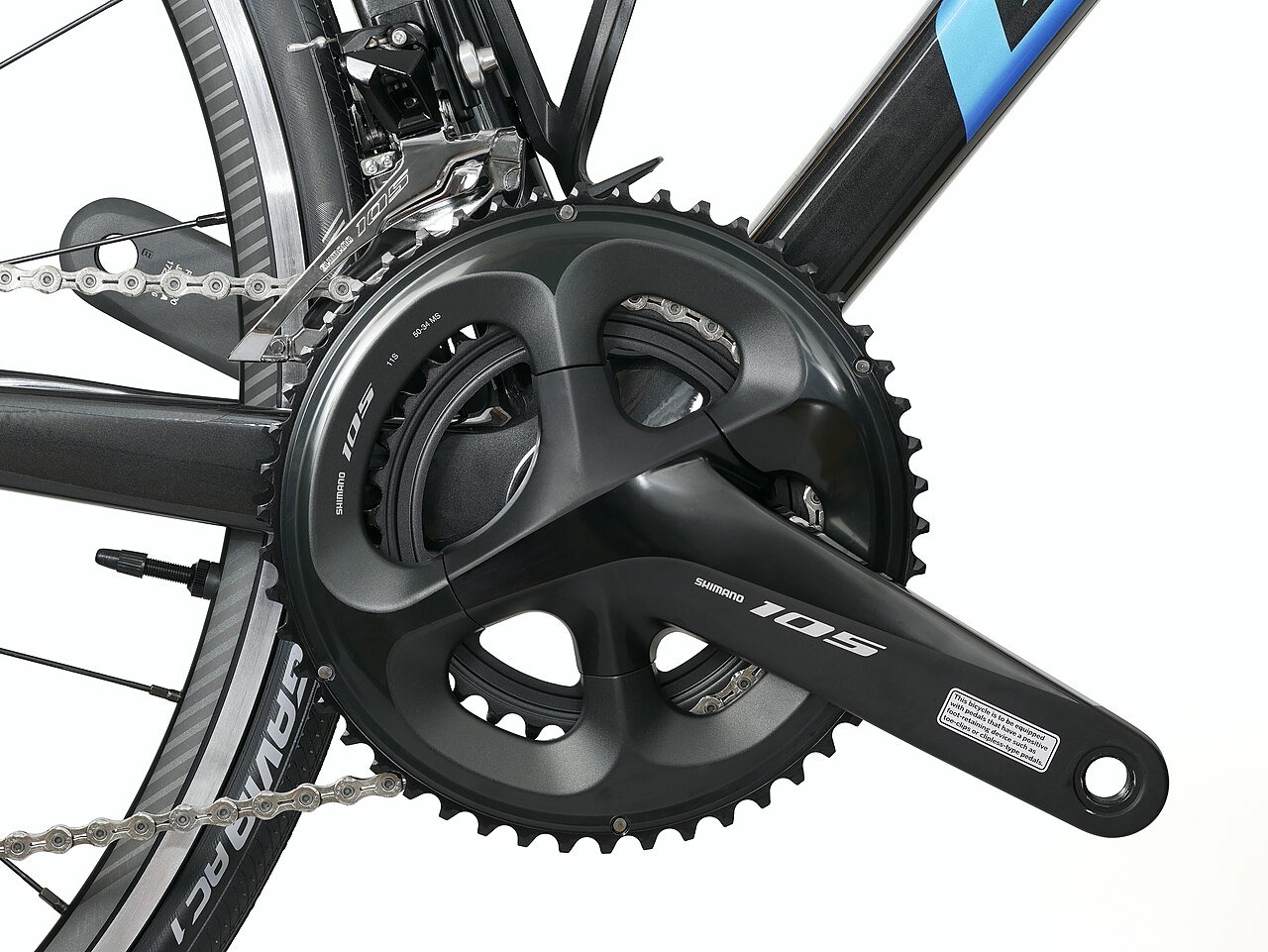
Higher number = harder and faster (each pedal stroke takes you further). Lower number = easier and slower (less force per stroke, more strokes needed). There is no universally “good” ratio — it depends on your legs, the terrain, and your wheel size, which is why cyclists also use gear inches to compare gears across bikes. Once you can read bicycle gear ratios at a glance, every spec sheet and groupset review starts making sense.
Typical bicycle gear ratios by bike type
Component tables list parts; this one lists the bicycle gear ratios most riders actually buy. High and low are chainring÷cog ratios; total range is high÷low — the percentage that tells you how far apart your easiest and hardest gears sit.
| Bike type (typical setup) | High gear | Low gear | Total range | Character |
|---|---|---|---|---|
| Road (50/34 × 11–30) | 50÷11 = 4.55 | 34÷30 = 1.13 | 401% | Endurance road — fast but forgiving |
| Gravel (40 × 11–42) | 40÷11 = 3.64 | 40÷42 = 0.95 | 382% | Gravel — one ring, wide cassette |
| MTB 1×12 (32 × 10–51) | 32÷10 = 3.20 | 32÷51 = 0.63 | 510% | Mountain — winch-low, dead simple |
| Commuter (46/30 × 11–36) | 46÷11 = 4.18 | 30÷36 = 0.83 | 502% | Commuting/touring — loaded hills plus flats |
| E-bike (44 × 11–42) | 44÷11 = 4.00 | 44÷42 = 1.05 | 382% | E-bike — the motor covers the low end |
Nobody buys range for its own sake — you buy a low gear that matches your steepest climb and a high gear that matches your fastest cruise, and the range is whatever spans the two. If you want one number that also folds in crank length, read Sheldon Brown’s explanation of gain ratios; to compare any two setups side by side, try Sheldon Brown’s online gear calculator, which reports gear inches, development, and gain ratios together.
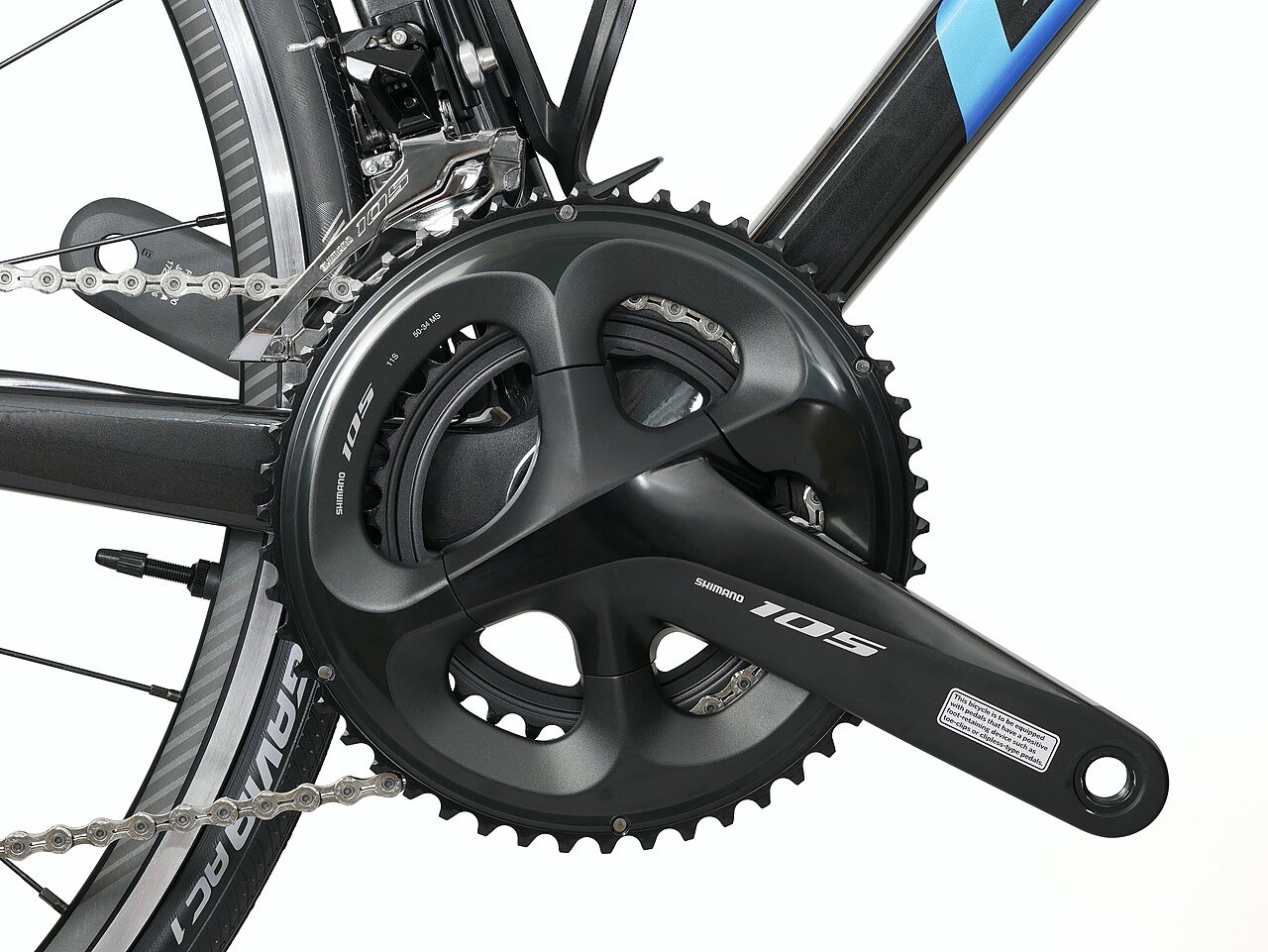
Gear ranges of common drivetrains
Your full range is the ratio of your highest gear to your lowest gear, expressed as a percentage:
| Drivetrain | High gear | Low gear | Total range | Best for |
|---|---|---|---|---|
| 1×12 (e.g. 32T × 10–51) | 32÷10 = 3.20 | 32÷51 = 0.63 | 510% | MTB, gravel — simple, wide |
| 2×12 compact (50/34 × 11–34) | 50÷11 = 4.55 | 34÷34 = 1.00 | 455% | Road — tall top, easy bottom |
| 3×9 triple (44/32/22 × 11–32) | 44÷11 = 4.00 | 22÷32 = 0.69 | 580% | Touring — huge range |
| Rohloff 14-speed hub | — | — | 526% | Commuting, touring — no derailleur |
More chainrings = wider range but more overlap between gears. Modern 1× systems won over mountain bikers because a 10–51 cassette alone gives a 510% range — nearly triple territory with one shifter.
High vs low gearing by terrain and rider
- Steep climbing / loaded touring: aim for a lowest gear at or below 1:1 (e.g. 34×34, or 32×51 on 1×). If your easiest gear is above 1.2:1 and you face real hills, you’re under-geared.
- Rolling road riding: a lowest gear around 1.0–1.5:1 and a top gear of 4.0–4.5:1 covers almost everything.
- Flat-out fast group rides / racing: top gears of 4.5:1+ (53×11 = 4.82) matter when the pace exceeds 28 mph; you can’t contribute if you spin out.
- Beginners and heavy riders: when in doubt, size your bicycle gear ratios low. Being able to spin an easy gear uphill beats grinding a tall one — your knees will thank you.
Worked example: cassette upgrade on a compact double
Run the bicycle gear ratios on paper before spending money. Say your road bike came with a compact 50/34 crankset and an 11–28 cassette, and hills are beating you. Swapping to an 11–34 cassette is the classic fix — here is what changes and what doesn’t:
- Lowest gear before: 34÷28 = 1.21. Lowest gear after: 34÷34 = 1.00. The old 28-tooth low demanded about 21% more pedaling force than the new 34-tooth low (1.21 ÷ 1.00 = 1.214) — roughly a fifth less grinding on the steepest pitch.
- Top gear is untouched: 50÷11 = 4.55 either way. You lose nothing on the flats or descents.
- The price: bigger jumps between the easy cogs. An 11–34 spreads the same 11 speeds over a wider span than an 11–28, so shifts in the climbing gears feel coarser. For most riders trading crisp steps for an easier bailout gear, that is a good deal.
- Fitment check: a bigger largest cog usually needs a longer chain and a rear derailleur with enough capacity — size the chain with the big-big-plus-two-links method, and confirm your derailleur’s max cog rating covers 34 teeth before you buy.
Worked examples: speed at 90 RPM cadence
Cadence (pedal RPM) × ratio × wheel circumference = speed. The formula: mph = ratio × wheel diameter (in) × π × cadence × 60 ÷ 63,360. On 27″ wheels at a comfortable 90 RPM cadence:
- 50×11 (4.55): 4.55 × 27 × 3.1416 × 90 × 60 ÷ 63,360 = 32.9 mph — full sprint.
- 44×16 (2.75): 2.75 × 27 × 3.1416 × 90 × 60 ÷ 63,360 = 19.9 mph — brisk solo cruise.
- 34×32 (1.06): 1.06 × 27 × 3.1416 × 90 × 60 ÷ 63,360 = 7.7 mph — seated climbing.
- 32×51 (0.63): 0.63 × 27 × 3.1416 × 90 × 60 ÷ 63,360 = 4.5 mph — winching up a wall.
Notice the same cadence produces wildly different speeds — that’s the whole point of gears: they let your legs stay at an efficient RPM while the bike’s speed varies. Plug any combination into the bicycle section of our gear ratio calculator to get ratio, gear inches, development, and speed instantly.
Changing your gearing
You don’t need a new bike to change your bicycle gear ratios — just different sprockets. Going from a 16T to an 18T rear cog drops a 44×16 (2.75) to 44÷18 = 2.44, an 11% easier gear. Going up a chainring size does the opposite. Rules of thumb: change the rear for fine tuning (one cog ≈ a few percent), change the front for a big step. And remember the rear wheel matters: the same 44×16 on 29″ wheels is effectively a taller gear than on 27″ wheels — the reason gear inches exist.
The same division covers the less common systems too — Wikipedia’s bicycle gearing overview walks through hub gears, gearboxes, and shaft drives, where the tooth-counting just moves inside the hub.
Frequently asked questions
What is a good gear ratio for a beginner?
The bicycle gear ratios that matter most for a beginner are the lowest ones: with a lowest gear near or below 1:1, such as a 34×34 on a compact double or a 30×46 on 1× gravel. You’ll rarely complain about having gears that are too easy; grinding up hills in gears that are too hard ruins rides and knees.
How many gears do I actually need?
What matters is range and steps, not the count. A modern 1×12 with 510% range covers more ground than an old 3×7 with overlapping gears. Closely spaced cogs matter most in the middle of the cassette where you spend most of your time.
Why do pros use such big chainrings?
Bigger chainrings with small cogs reduce drivetrain friction slightly and, at race speeds, let riders pedal at efficient cadences without spinning out. At 35+ mph, even a 53×11 (4.82) can feel small — at normal speeds it’s overkill.
Does wheel size change my gear ratio?
Not the ratio itself (44÷16 = 2.75 on any wheel), but it changes how far each pedal stroke takes you — a bigger wheel covers more ground per revolution. Compare gears across wheel sizes with gear inches: (chainring ÷ cog) × wheel diameter.
Should I choose 1× or 2× for range?
Both can deliver wide bicycle gear ratios — the difference is steps, top end, and simplicity. A 1× drivetrain (one chainring, one shifter, no front derailleur) wins on simplicity: no cross-chaining, nothing to drop, and a 10–51 cassette alone spans 510%. The cost is coarser jumps between gears and a lower top gear.
A 2× drivetrain keeps tighter steps where you spend most of your time and a taller top gear (50×11 = 4.55) for fast descents, at the price of front shifting and overlapping gears. If you mostly ride one terrain, 1× is liberating; if you race or ride big speed ranges, 2× still earns its place.
Do I need a new chain when I change the cassette?
A new chain alone doesn’t change your bicycle gear ratios — only tooth counts do. But a bigger largest cog wraps more chain, so upgrading the cassette usually means sizing a longer chain (the big-big-plus-two-links method) and confirming your rear derailleur’s capacity.
Skip it and the drivetrain can jam in the big-big combo — an expensive mistake. Also replace a worn chain with the cassette: a stretched chain chews new cogs fast. If a chain checker reads past 0.5% wear on an 11- or 12-speed drivetrain, the chain is done.
Try your own bicycle gear ratios in the bicycle section of the free gear ratio calculator — it computes ratio, gear inches, development, and speed at your cadence, with the formulas shown.